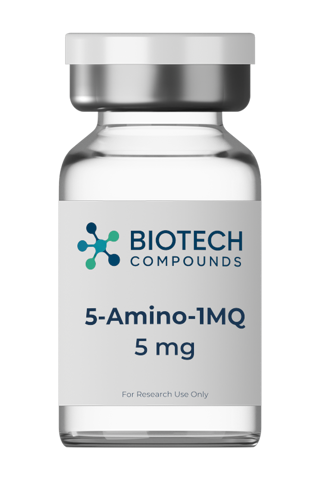
Research Compound
5-Amino-1MQ
5-Amino-1MQ is a small-molecule compound and NNMT inhibitor available in lyophilized form for laboratory research.
Select Size
5mg
SKU: 5AM5
Batch: 202609-01-5AMQ
$32.99
Ships today if ordered by 4PM EST
Est. Arrival: 09/18/2026
Volume Discounts
Qty: 1 - 4$32.99 each
Qty: 5 - 9$29.69 each(save $3.30)
Qty: 10+$26.39 each(save $6.60)
Quantity:
1
For Research Use Only. This product is intended for laboratory and scientific research purposes only. It is not a drug or dietary supplement and is not for human or veterinary consumption. Not intended to diagnose, treat, cure, or prevent any disease.
99%+ Purity
COA Included
Fast Shipping
USA Based
Product Details
5-Amino-1MQ is a synthetic small-molecule compound classified as an NNMT (nicotinamide N-methyltransferase) inhibitor.
This compound is provided as a lyophilized powder for reconstitution.
Disclaimer: This compound is provided strictly for laboratory and research purposes only. It is not intended for human consumption.
Frequently Asked Questions About 5-Amino-1MQ
Answers summarize published research and are provided for laboratory research purposes only.
5-Amino-1MQ is a synthetic small-molecule compound, not a peptide, that is classified as an inhibitor of the enzyme nicotinamide N-methyltransferase, or NNMT. Research studies have examined 5-Amino-1MQ mainly in the context of fat cell metabolism, cellular energy balance, and body composition in preclinical models. Biotech Compounds supplies 5-Amino-1MQ as a lyophilized powder for laboratory research.
Research studies have shown that 5-Amino-1MQ binds NNMT and blocks the enzyme from methylating nicotinamide. In cell culture work, researchers reported that this inhibition preserved cellular NAD+ and S-adenosylmethionine levels, two molecules that NNMT normally consumes. Published research suggests that keeping these metabolites available shifts the energy balance of fat cells, which is the mechanism most often described for 5-Amino-1MQ.
The primary research area for 5-Amino-1MQ is adipose tissue and fat cell metabolism. In rodent models of diet-induced obesity, researchers reported that NNMT inhibition with 5-Amino-1MQ was associated with reduced fat mass and smaller fat cells without a change in food intake. In vitro studies have examined the same effect in cultured adipocytes, where the compound was observed to lower lipid accumulation.
Yes. A secondary research area for 5-Amino-1MQ is skeletal muscle. In animal models, researchers reported that NNMT inhibition with 5-Amino-1MQ was associated with increased activity of muscle stem cells and greater muscle fiber regeneration after injury in aged mice. These findings are early stage, and 5-Amino-1MQ continues to be used as a tool compound for studying NNMT in muscle biology.
The evidence base for 5-Amino-1MQ consists of preclinical work. In vitro studies in cultured cells established that 5-Amino-1MQ inhibits NNMT, and rodent studies followed up on fat mass, metabolism, and muscle endpoints. 5-Amino-1MQ has not completed clinical trials and remains an investigational research compound. Researchers treat it as a tool for probing the NNMT pathway rather than as an established agent.
5-Amino-1MQ and NAD+ sit on the same metabolic pathway but act differently. NAD+ is the coenzyme itself, supplied on Biotech Compounds as a research material for studies of cellular energy and redox chemistry. 5-Amino-1MQ is a small-molecule NNMT inhibitor, and research studies have shown that it acts upstream by preventing the enzyme from consuming nicotinamide, which in cell studies was observed to spare NAD+ rather than add it.
5-Amino-1MQ is supplied as a lyophilized powder. For laboratory use, the vial is reconstituted by slowly adding Bacteriostatic Water or another suitable solvent down the inside wall of the vial, then gently swirling until the powder dissolves. The vial should never be shaken, since vigorous agitation can foam the solution. Solvent volume is chosen by the researcher to match the concentration required by the assay.
Lyophilized 5-Amino-1MQ should be kept in a cool, dry, dark place, and freezer storage is the common laboratory choice for long-term holding. Once reconstituted, the solution should be refrigerated at 2 to 8 C, protected from light, and used within a short window. Repeated freeze and thaw cycles should be avoided because they can degrade the compound and change the concentration of the working solution.
Yes. 5-Amino-1MQ from Biotech Compounds is listed at 99 percent or higher purity and is third-party tested. A Certificate of Analysis for the current lot is available on the 5-Amino-1MQ product page so that researchers can review identity and purity results before starting an experiment. Testing on each batch supports reproducible results across studies.
5-Amino-1MQ has a molecular weight of approximately 227.27 g/mol and the molecular formula C12H13N5. It is a small quinolinium-type molecule rather than a chain of amino acids, which is why 5-Amino-1MQ is described as a small-molecule compound. The low molecular weight is one reason research studies have described 5-Amino-1MQ as cell-permeable in culture systems.
No. 5-Amino-1MQ is not approved for human use and is sold strictly as a research material for laboratory research by qualified researchers and research organizations. Purchasers must be 21 years of age or older. 5-Amino-1MQ is not a drug or dietary supplement, and it is not intended for human or animal consumption.
You May Also Like