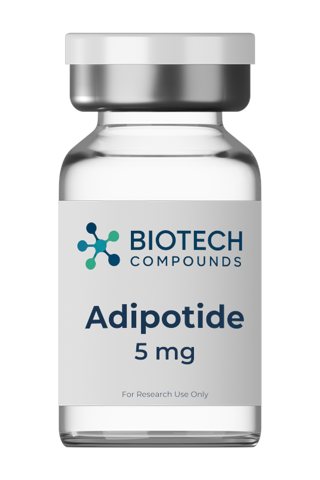
Research Compound

Adipotide

Adipotide is a synthetic chimeric peptide consisting of a targeting sequence linked to a proapoptotic motif, available as a lyophilized powder for laboratory research.

Select Size
5mg
SKU: AP5
Batch: 202510-01-AP
$43.99
Ships today if ordered by 4PM EST
Est. Arrival: 09/16/2026
Volume Discounts
Qty: 1 - 4$43.99 each
Qty: 5 - 9$39.59 each(save $4.40)
Qty: 10+$35.19 each(save $8.80)
Quantity:
1
For Research Use Only. This product is intended for laboratory and scientific research purposes only. It is not a drug or dietary supplement and is not for human or veterinary consumption. Not intended to diagnose, treat, cure, or prevent any disease.
99%+ Purity
COA Included
Fast Shipping
USA Based

Product Details

Adipotide (FTPP) is a synthetic chimeric peptide with two functional domains: targeting sequence (CKGGRAKDC) and proapoptotic sequence D(KLAKLAK)2 connected via linker.


CKGGRAKDC is cyclic with disulfide bridge between cysteines. D(KLAKLAK)2 contains D-amino acids in amphipathic alpha-helical pattern. Dual-function molecule with targeting and effector domains. Soluble in sterile water. Store at -20°C.


Disclaimer: For laboratory and research purposes only. Not intended for human consumption.

Frequently Asked Questions About Adipotide

Answers summarize published research and are provided for laboratory research purposes only.

Adipotide, also written FTPP, is a synthetic chimeric peptide built from two parts: a cyclic targeting sequence, CKGGRAKDC, and a proapoptotic sequence, D(KLAKLAK)2, joined by a linker. Research studies have examined Adipotide mainly as a tool for targeting the blood vessels that supply white fat tissue in animal models. Biotech Compounds supplies Adipotide as a lyophilized powder for laboratory research.
Research studies have shown that the CKGGRAKDC targeting domain of Adipotide binds a protein complex found on the surface of blood vessels within white adipose tissue. In animal models, researchers reported that once the peptide was bound, the D(KLAKLAK)2 domain disrupted the mitochondrial membrane of those vessel cells and triggered programmed cell death. Published research suggests that the loss of blood supply then led to a reduction in the fat tissue it served.
The primary research area for Adipotide is fat tissue reduction through vascular targeting. In rodent models of obesity, researchers reported that Adipotide was associated with rapid loss of white fat and body weight. A later study in rhesus monkeys with naturally occurring obesity reported similar reductions in body weight and fat mass, which made Adipotide one of the more widely discussed vascular-targeting peptides in metabolic research.
Yes. A secondary research area for Adipotide is metabolic function alongside fat loss. In the primate study, researchers reported improvements in insulin sensitivity measured by glucose tolerance testing after the fat reduction. Animal model researchers have also reported that the effect on kidney function was a notable safety observation, since the targeting domain was found to interact with kidney tissue as well as fat vasculature.
Evidence for Adipotide comes from preclinical studies. In vitro work confirmed that the proapoptotic domain kills cells once it is delivered inside, and rodent and non-human primate studies followed up on fat loss and metabolic endpoints. Adipotide was registered for an early-stage clinical trial, but it has not completed clinical development and remains an investigational compound that is not approved anywhere.
Adipotide and AOD-9604 are both studied in fat metabolism research, but by very different mechanisms. AOD-9604 is a fragment of human growth hormone that research studies have examined for its effect on lipolysis, the breakdown of stored fat. Adipotide is a chimeric peptide that researchers reported targets and destroys the blood vessels feeding white fat tissue. AOD-9604 acts on the fat cell metabolism, while Adipotide acts on the tissue blood supply.
Adipotide is supplied as a lyophilized powder and is soluble in sterile water. To reconstitute it, a researcher slowly adds Bacteriostatic Water or sterile water down the inside wall of the vial and swirls gently until the powder dissolves. The vial should never be shaken, since agitation can disrupt the cyclic targeting domain. Solvent volume is chosen by the researcher to match the concentration the experiment requires.
Lyophilized Adipotide should be stored at minus 20 C, protected from light and moisture. Once reconstituted, the solution should be refrigerated at 2 to 8 C and used within a short window, or divided into single-use aliquots and frozen. Repeated freeze and thaw cycles should be avoided. The disulfide bridge in the targeting domain of Adipotide is sensitive to reducing conditions, so buffers containing reducing agents should be avoided.
Yes. Adipotide from Biotech Compounds is listed at 99 percent or higher purity and is third-party tested. A Certificate of Analysis for the current lot is available on the Adipotide product page so researchers can review identity and purity results before starting an experiment. Lot-level testing helps keep results consistent from one vial of Adipotide to the next.
Adipotide has an approximate molecular weight of 1690.1 g/mol and the molecular formula C75H140N30O25. The targeting sequence CKGGRAKDC is cyclized by a disulfide bond between its two cysteine residues, and the D(KLAKLAK)2 sequence is made from D-amino acids arranged in an amphipathic alpha-helical pattern. The D-amino acids are one reason research studies have described Adipotide as resistant to enzymatic breakdown.
No. Adipotide is not approved for human use and is sold strictly as a research material for laboratory research by qualified researchers and research organizations. Purchasers must be 21 years of age or older. Adipotide is not a drug or dietary supplement, and it is not intended for human or animal consumption.