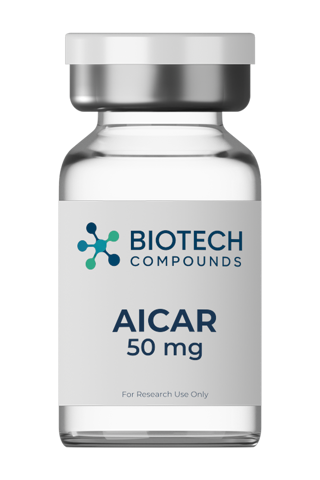
Research Compound
AICAR
AICAR (5-Aminoimidazole-4-carboxamide ribonucleoside) is a cell-permeable nucleoside analog classified as an AMPK activator, available as a lyophilized powder for laboratory research.
Select Size
50mg
SKU: AR50
Batch: 202603-01-AR
$55.99
Ships today if ordered by 4PM EST
Est. Arrival: 09/18/2026
Volume Discounts
Qty: 1 - 4$55.99 each
Qty: 5 - 9$50.39 each(save $5.60)
Qty: 10+$44.79 each(save $11.20)
Quantity:
1
For Research Use Only. This product is intended for laboratory and scientific research purposes only. It is not a drug or dietary supplement and is not for human or veterinary consumption. Not intended to diagnose, treat, cure, or prevent any disease.
99%+ Purity
COA Included
Fast Shipping
USA Based
Product Details
AICAR (Acadesine) is a cell-permeable nucleoside analog. Phosphorylated intracellularly to ZMP, an intermediate in de novo purine biosynthesis and AMP mimetic.
Consists of aminoimidazole carboxamide base linked to ribose sugar. Classified as adenosine analog. Soluble in sterile water or DMSO. Store at -20°C protected from light and moisture.
Disclaimer: For laboratory and research purposes only. Not intended for human consumption.
Frequently Asked Questions About AICAR
Answers summarize published research and are provided for laboratory research purposes only.
AICAR, also known as acadesine, is a cell-permeable nucleoside analog made of an aminoimidazole carboxamide base linked to a ribose sugar. It is classified as an adenosine analog and an AMPK activator. Research studies have examined AICAR in skeletal muscle metabolism, glucose handling, and cardiac protection models. Biotech Compounds supplies AICAR as a lyophilized powder for laboratory research.
Research studies have shown that once AICAR enters a cell it is phosphorylated to ZMP, an intermediate in purine biosynthesis. ZMP mimics AMP, the signal a cell produces when energy is low. Researchers have reported that ZMP binds and activates AMP-activated protein kinase, or AMPK, the enzyme that shifts a cell toward energy production and away from energy storage. This AMP-mimetic action is the mechanism most associated with AICAR.
The primary research area for AICAR is skeletal muscle metabolism. In rodent studies, researchers reported that AICAR was associated with increased glucose uptake, greater mitochondrial content, and improved running endurance even in animals that were not exercised, which led some researchers to describe it as an exercise mimetic. In vitro studies have examined the same AMPK pathway in cultured muscle cells.
Yes. A secondary research area for AICAR, under the name acadesine, is cardiac protection during periods of restricted blood flow. In animal models, researchers reported that acadesine was associated with higher adenosine levels in heart tissue during ischemia. Clinical trials examined acadesine in patients undergoing coronary bypass surgery, and although the results did not lead to approval, the program is one of the largest clinical datasets for an AMPK activator.
Evidence for AICAR comes from in vitro work in cultured cells, rodent studies of muscle and metabolism, and human clinical trials of acadesine in cardiac surgery. The clinical program did not result in an approved product, and AICAR remains an investigational research compound. AICAR is also listed as a prohibited substance by the World Anti-Doping Agency, which reflects the exercise mimetic findings in animal models.
AICAR and SLU-PP-332 are both studied as exercise mimetics on Biotech Compounds, but they work on different targets. Research studies have shown that AICAR activates AMPK by mimicking AMP inside the cell. SLU-PP-332 is a small-molecule agonist of the estrogen-related receptors, and researchers have reported that it changes gene expression in muscle fibers to favor oxidative metabolism. AICAR acts on an energy-sensing enzyme, while SLU-PP-332 acts on a nuclear receptor.
AICAR is supplied as a lyophilized powder and is soluble in sterile water or DMSO. To reconstitute it, a researcher slowly adds Bacteriostatic Water, sterile water, or DMSO down the inside wall of the vial and swirls gently until the powder dissolves. The vial should never be shaken. DMSO stock solutions are common in cell culture work and are diluted into medium at the time of the assay.
Lyophilized AICAR should be stored at minus 20 C, protected from light and moisture. After reconstitution, aqueous solutions should be refrigerated at 2 to 8 C and used within a short window, while DMSO stock solutions are usually divided into single-use aliquots and frozen. Repeated freeze and thaw cycles should be avoided. Keeping AICAR dry before reconstitution matters because the nucleoside can absorb moisture from the air.
Yes. AICAR from Biotech Compounds is listed at 99 percent or higher purity and is third-party tested. A Certificate of Analysis for the current lot is available on the AICAR product page so researchers can confirm identity and purity before beginning experiments. Lot-level testing helps keep results consistent from one vial of AICAR to the next.
AICAR has an approximate molecular weight of 258.23 g/mol and the molecular formula C9H14N4O5. Its full chemical name is 5-aminoimidazole-4-carboxamide ribonucleoside. The structure consists of an imidazole ring carrying an amino group and a carboxamide group attached to a ribose sugar, which is the feature that allows AICAR to be phosphorylated inside cells to ZMP.
No. AICAR is not approved for human use and is sold strictly as a research material for laboratory research by qualified researchers and research organizations. Purchasers must be 21 years of age or older. AICAR is not a drug or dietary supplement, and it is not intended for human or animal consumption.
You May Also Like