Research Compound

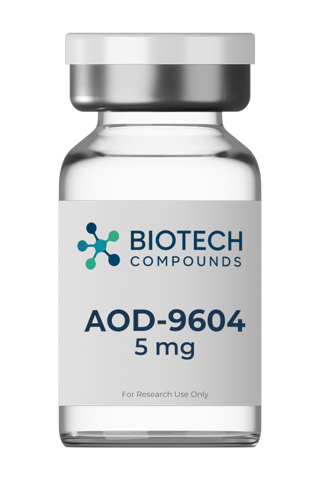
AOD-9604

AOD-9604 is a synthetic 16-amino acid peptide fragment corresponding to hGH(177-191) with added N-terminal tyrosine, available as a lyophilized powder for laboratory research.

Select Size
5mg
SKU: 5AD
Batch: 202609-01-AD
$43.99
Ships today if ordered by 4PM EST
Est. Arrival: 09/18/2026
Volume Discounts
Qty: 1 - 4$43.99 each
Qty: 5 - 9$39.59 each(save $4.40)
Qty: 10+$35.19 each(save $8.80)
Quantity:
1
For Research Use Only. This product is intended for laboratory and scientific research purposes only. It is not a drug or dietary supplement and is not for human or veterinary consumption. Not intended to diagnose, treat, cure, or prevent any disease.
99%+ Purity
COA Included
Fast Shipping
USA Based

Product Details

AOD-9604 is a 16-amino acid peptide: hGH C-terminal fragment (177-191) with added N-terminal tyrosine. Sequence: Tyr-Leu-Arg-Ile-Val-Gln-Cys-Arg-Ser-Val-Glu-Gly-Ser-Cys-Gly-Phe.


Contains disulfide bridge between Cys7 and Cys14 creating cyclic constraint. Note: AOD-9604 may gel over time even with acetic acid (normal for high-purity material). Reconstitute slowly with acetic acid/bacteriostatic water mixture. If gelling occurs, add more acetic acid. Store lyophilized at -20°C.


Disclaimer: For laboratory and research purposes only. Not intended for human consumption.

Frequently Asked Questions About AOD-9604

Answers summarize published research and are provided for laboratory research purposes only.
AOD-9604 is a synthetic 16-amino-acid peptide that corresponds to the C-terminal fragment of human growth hormone, residues 177 to 191, with an added tyrosine at the N-terminus. Research studies have examined AOD-9604 mainly for its effect on fat metabolism, and later for cartilage and joint tissue in animal models. Biotech Compounds supplies AOD-9604 as a lyophilized powder for laboratory research.
Research studies have shown that the 177 to 191 region of growth hormone is the part of the molecule responsible for its effect on fat metabolism. In animal models, researchers reported that AOD-9604 was associated with increased lipolysis, the breakdown of stored fat, and reduced lipogenesis, the formation of new fat. Published research suggests that AOD-9604 produces these effects without the growth-promoting or blood sugar effects of the full growth hormone molecule.
The primary research area for AOD-9604 is fat metabolism and body weight. In rodent models of obesity, researchers reported that AOD-9604 was associated with reduced body weight gain and increased fat oxidation. The compound then moved into clinical trials as an investigational agent, where researchers examined weight endpoints in overweight volunteers. Those trials did not demonstrate the weight effect that was seen in animal models.
Yes. A secondary research area for AOD-9604 is cartilage. In a rabbit model of joint cartilage damage, researchers reported that AOD-9604 given alongside hyaluronic acid was associated with better cartilage scores than hyaluronic acid alone. These animal model findings prompted interest in AOD-9604 as a research tool for studying cartilage repair, separate from its original fat metabolism work.
Evidence for AOD-9604 includes in vitro studies on fat cells, rodent studies of obesity and fat oxidation, a rabbit model of cartilage damage, and human clinical trials. The clinical program reached mid-stage trials before it was discontinued because the weight endpoints were not met. AOD-9604 remains an investigational compound, and it is not approved as a drug anywhere.
AOD-9604 and Tesamorelin both come from growth hormone biology but act at different points. Tesamorelin is a growth hormone releasing hormone analog, and research studies have shown that it signals the pituitary to release growth hormone. AOD-9604 is a fragment of growth hormone itself, and researchers have reported that it acts on fat metabolism directly without raising growth hormone or IGF-1 levels. Both are sold on Biotech Compounds for laboratory research.
AOD-9604 is supplied as a lyophilized powder and is known to gel over time, even in high-purity material. The recommended approach is to reconstitute slowly with a mixture of Acetic Acid 0.6% and Bacteriostatic Water, adding the liquid down the inside wall of the vial and swirling gently until clear. Never shake the vial. If gelling occurs, adding more acetic acid helps the AOD-9604 return to solution.
Lyophilized AOD-9604 should be stored at minus 20 C, protected from light and moisture. After reconstitution, the solution should be refrigerated at 2 to 8 C, protected from light, and used within a short window. Repeated freeze and thaw cycles should be avoided. Because AOD-9604 can gel, a reconstituted vial should be checked for clarity before each use, and a stored solution that has thickened can be treated with additional acetic acid.
Yes. AOD-9604 from Biotech Compounds is listed at 99 percent or higher purity and is third-party tested. A Certificate of Analysis for the current lot is available on the AOD-9604 product page so researchers can confirm identity and purity before beginning experiments. Gelling in a high-purity vial of AOD-9604 is a physical property of the peptide and does not indicate a purity problem.
AOD-9604 has an approximate molecular weight of 1815.1 g/mol and the molecular formula C78H123N23O23S2. Its sequence is Tyr-Leu-Arg-Ile-Val-Gln-Cys-Arg-Ser-Val-Glu-Gly-Ser-Cys-Gly-Phe, sixteen residues in total. A disulfide bridge between the cysteine at position 7 and the cysteine at position 14 forms a ring within the chain, which gives AOD-9604 a cyclic constraint that shapes how it folds.
No. AOD-9604 is not approved for human use and is sold strictly as a research material for laboratory research by qualified researchers and research organizations. Purchasers must be 21 years of age or older. AOD-9604 is not a drug or dietary supplement, and it is not intended for human or animal consumption.