Sourced in the USAMidwest based facilities
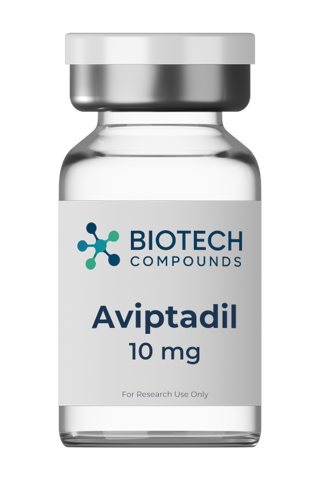
Research Compound
Aviptadil
Aviptadil is a synthetic 28-amino acid peptide identical to human vasoactive intestinal peptide (VIP), available as a lyophilized powder for laboratory research.
Select Size
10mg
SKU: AVI10
Batch: 202601-01-AVI
$215.99
Ships today if ordered by 4PM EST
Est. Arrival: 09/30/2026
Volume Discounts
Qty: 1 - 4$215.99 each
Qty: 5 - 9$194.39 each(save $21.60)
Qty: 10+$172.79 each(save $43.20)
Quantity:
1
For Research Use Only. This product is intended for laboratory and scientific research purposes only. It is not a drug or dietary supplement and is not for human or veterinary consumption. Not intended to diagnose, treat, cure, or prevent any disease.
99%+ Purity
COA Included
Fast Shipping
USA Based
Product Details
Aviptadil is synthetic human VIP, a 28-amino acid neuropeptide with C-terminal amidation. Exhibits random coil N-terminal region (1-7) and alpha-helical C-terminal structure.
Belongs to glucagon/secretin superfamily with homology to PACAP, secretin, and glucagon. Classified as VPAC1 and VPAC2 receptor agonist (class B GPCRs). Soluble in sterile water or bacteriostatic water. Store at -20°C.
Disclaimer: For laboratory and research purposes only. Not for human consumption.
Frequently Asked Questions About Aviptadil
Answers summarize published research and are provided for laboratory research purposes only.
Aviptadil is a synthetic 28-amino acid peptide identical in sequence to human vasoactive intestinal peptide, commonly abbreviated VIP. It carries a C-terminal amidation and belongs to the glucagon and secretin superfamily, sharing homology with PACAP, secretin, and glucagon. Aviptadil is classified as an agonist of the VPAC1 and VPAC2 receptors and is supplied by Biotech Compounds as a lyophilized powder for laboratory research.
Research studies have shown that Aviptadil binds the VPAC1 and VPAC2 receptors, which are class B G protein coupled receptors. Researchers have reported that receptor activation raises intracellular cyclic AMP, leading to smooth muscle relaxation and vasodilation in tissue preparations. In vitro studies have also examined how Aviptadil modulates cytokine release from immune cells that express VPAC receptors.
The primary research area for Aviptadil is pulmonary biology. In animal models, researchers reported that Aviptadil was examined for its effects on alveolar type II cells, surfactant production, and inflammatory signaling in lung tissue. Published research suggests the peptide concentrates in the lung, which is why respiratory models have been the main focus of Aviptadil studies.
Aviptadil has also been studied in vascular and neuroendocrine research. In research studies, Aviptadil has been observed to relax vascular smooth muscle in isolated vessel preparations. Researchers have additionally examined Aviptadil in models of gut motility, since vasoactive intestinal peptide was first isolated from intestinal tissue, and in studies of circadian signaling where VIP neurons play a role.
Yes. Aviptadil has been studied in human clinical trials, including trials of an intravenous formulation in respiratory research and earlier trials of inhaled formulations. Published clinical research suggests the peptide was tolerated in study participants, though outcomes varied between trials. Aviptadil remains investigational for most uses and has not been approved as a medicine in the United States.
Aviptadil and VIP refer to the same 28-amino acid molecule. VIP is the name of the naturally occurring vasoactive intestinal peptide, while Aviptadil is the international nonproprietary name given to the synthetic version used in research. Biotech Compounds lists both Aviptadil and VIP; researchers can review the specifications on each product page to select the listing that fits their protocol.
Aviptadil is supplied as a lyophilized powder that dissolves in sterile water or bacteriostatic water. The diluent should be introduced slowly along the inner wall of the vial and the contents swirled gently until clear. Aviptadil should never be shaken, since vigorous agitation can disrupt the alpha-helical C-terminal region of the peptide. Bacteriostatic Water is sold on the site as a matching diluent.
Lyophilized Aviptadil should be stored at -20 C in a dry, dark environment. Once reconstituted, Aviptadil should be kept refrigerated at 2 to 8 C, protected from light, and not subjected to repeated freeze thaw cycles. Research has reported that native VIP has a plasma half-life measured in minutes because of rapid enzymatic breakdown, so solutions of Aviptadil should be prepared close to the time of use.
Yes. Aviptadil from Biotech Compounds is supplied at 99 percent or greater purity and undergoes third-party testing. A Certificate of Analysis is posted on the Aviptadil product page so researchers can confirm identity and purity before use. Each lot of Aviptadil is tested independently.
Aviptadil has a molecular weight of 3325.80 Da and a molecular formula of C147H238N44O42S. The single sulfur atom comes from the methionine residue in the sequence. Aviptadil is a 28-amino acid peptide with a random coil N-terminal region spanning residues 1 to 7 and an alpha-helical C-terminal segment.
No. Aviptadil from Biotech Compounds is sold strictly as a research material for laboratory research by qualified researchers and research organizations. Purchasers must be 21 years of age or older. Aviptadil is not a drug or a dietary supplement, and it is not intended for human or animal consumption.
You May Also Like