Research Compound

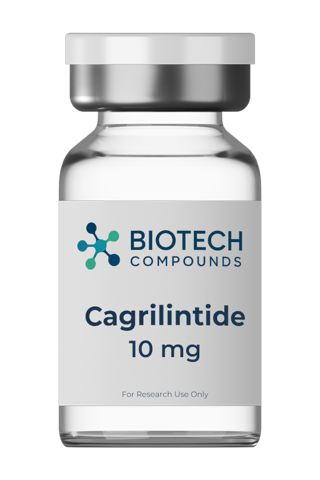
Cagrilintide

Cagrilintide is a synthetic 39-amino acid acylated peptide analog classified as a dual amylin and calcitonin receptor agonist (DACRA), available as a lyophilized powder for laboratory research.

Select Size
10mg
SKU: CGL10
Batch: 202609-01-CGL
$86.99
Ships today if ordered by 4PM EST
Est. Arrival: 09/18/2026
Volume Discounts
Qty: 1 - 4$86.99 each
Qty: 5 - 9$78.29 each(save $8.70)
Qty: 10+$69.59 each(save $17.40)
Quantity:
1
For Research Use Only. This product is intended for laboratory and scientific research purposes only. It is not a drug or dietary supplement and is not for human or veterinary consumption. Not intended to diagnose, treat, cure, or prevent any disease.
99%+ Purity
COA Included
Fast Shipping
USA Based

Product Details

Cagrilintide is a synthetic, acylated 39-amino acid peptide modified with a C20 di-acid fatty acid side chain for enhanced albumin binding. Features a disulfide bridge between Cys3 and Cys8 for structural stability.


Classified as a Dual Amylin and Calcitonin Receptor Agonist (DACRA). Provided as lyophilized powder requiring reconstitution with bacteriostatic water. Store at -20°C protected from light.


Disclaimer: For laboratory research purposes only. Not approved for human consumption, medical, veterinary, or household use.

Frequently Asked Questions About Cagrilintide

Answers summarize published research and are provided for laboratory research purposes only.
Cagrilintide is a synthetic 39-amino acid acylated peptide analog of amylin, the pancreatic hormone released alongside insulin. It is classified as a dual amylin and calcitonin receptor agonist, abbreviated DACRA. Cagrilintide carries a C20 di-acid fatty acid side chain for albumin binding and a disulfide bridge between Cys3 and Cys8. Biotech Compounds supplies Cagrilintide as a lyophilized powder for laboratory research.
Published research describes Cagrilintide as a non-selective agonist at amylin receptors and the calcitonin receptor. Researchers have reported that activation of these receptors in the brainstem and hypothalamus is associated with satiety signaling, slower gastric emptying, and reduced food intake in animal models. The fatty acid chain on Cagrilintide has been observed in research to bind albumin, which extends the time the peptide remains in circulation.
The primary research area for Cagrilintide is appetite regulation and body weight. In rodent studies, researchers reported that Cagrilintide reduced food intake and body weight over the study period. Clinical trials have since examined Cagrilintide in human participants with body weight change as the main endpoint, both alone and paired with a GLP-1 receptor agonist research peptide.
Beyond body weight, Cagrilintide has been examined in research on gastric emptying, meal size, and energy expenditure. In research studies, Cagrilintide has been observed to influence the rate at which the stomach empties in animal models. Researchers have also looked at glucose handling in participants receiving Cagrilintide together with an incretin peptide, and at how amylin receptor signaling interacts with GLP-1 pathways.
Yes. Cagrilintide has progressed through animal models into human clinical trials. Published phase 1 and phase 2 studies have evaluated Cagrilintide as a once-weekly long-acting amylin analog, and later trials have studied it in combination with a GLP-1 receptor agonist. Cagrilintide remains an investigational compound and has not been approved as a medicine in any market.
Cagrilintide and Eloralintide are both long-acting acylated amylin analogs, but they differ in receptor selectivity and length. Cagrilintide is a 39-amino acid dual amylin and calcitonin receptor agonist, meaning it activates both receptor families. Eloralintide is a 37-amino acid analog that research describes as a selective amylin receptor agonist with less calcitonin receptor activity. Researchers comparing selective and non-selective amylin signaling can study both.
Cagrilintide is supplied as a lyophilized powder that requires reconstitution with bacteriostatic water. The diluent is added slowly down the inside wall of the vial and the contents are swirled gently until the powder dissolves. Cagrilintide should never be shaken, because the fatty acid chain and disulfide bridge can be disturbed by vigorous agitation. Bacteriostatic Water is available on the site as a diluent.
Lyophilized Cagrilintide should be stored at -20 C, protected from light. After reconstitution, Cagrilintide should be refrigerated at 2 to 8 C, protected from light, and not put through repeated freeze thaw cycles. Research has reported that the C20 fatty di-acid modification gives Cagrilintide a long half-life in circulation through albumin binding, which is why it was designed for once-weekly study protocols.
Yes. Cagrilintide from Biotech Compounds is supplied at 99 percent or greater purity and is third-party tested. A Certificate of Analysis is available on the Cagrilintide product page so researchers can review identity and purity results before use. Each lot of Cagrilintide is tested independently.
Cagrilintide has a molecular weight of 4,409.01 g/mol and a molecular formula of C194H312N54O59S2. The two sulfur atoms come from the cysteine residues at positions 3 and 8 that form the disulfide bridge. Cagrilintide is a 39-amino acid peptide, two residues longer than native human amylin, with the added mass largely coming from the C20 fatty di-acid side chain.
No. Cagrilintide from Biotech Compounds is sold strictly as a research material for laboratory research by qualified researchers and research organizations. Purchasers must be 21 years of age or older. Cagrilintide is not a drug or a dietary supplement, and it is not intended for human or animal consumption.