
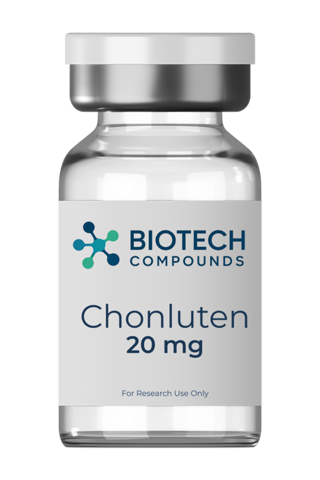
ChonlutenChonluten is a synthetic tripeptide bioregulator (Glu-Asp-Gly) belonging to the Khavinson short-peptide class, studied for tissue-specific activity in bronchopulmonary and respiratory epithelial systems.
Product Details
Chonluten is a synthetic tripeptide composed of the amino acid sequence Glutamic acid–Aspartic acid–Glycine (Glu-Asp-Gly / EDG). It was developed by Professor Vladimir Khavinson and colleagues at the St. Petersburg Institute of Bioregulation and Gerontology as part of the Khavinson bioregulator peptide program. Its naturally derived counterpart, Bronchogen, was originally isolated from bronchial tissue; Chonluten is the synthesized equivalent, produced from constituent amino acids to reproduce the active signaling sequence in a precisely defined molecular structure.
Chonluten belongs to the class of short regulatory peptides known as cytogens or bioregulators — low-molecular-weight compounds (typically 2–4 residues) proposed to exhibit tissue-specific modulation of gene expression. Unlike conventional compounds that act through receptor agonism or enzyme inhibition, Khavinson bioregulators are hypothesized to interact directly with specific complementary DNA sequences in the promoter regions of target genes, influencing transcription rather than initiating a downstream surface-receptor cascade.
Chonluten's documented target tissue is the bronchopulmonary system, where it has been examined in models of respiratory epithelial cell biology, bronchial gene expression, and age-associated changes in pulmonary tissue. In the literature it is associated with modulation of stress-response genes (c-Fos, HSP70), antioxidant enzymes (SOD), inflammatory mediators (COX-2, TNF-α), and epithelial barrier maintenance. It is frequently paired conceptually with Bronchogen (AEDL), which targets overlapping but complementary pathways in bronchial tissue.
Disclaimer: This product is intended strictly for laboratory and in vitro applications only. It is NOT for human consumption, ingestion, injection, or any in vivo use, and is not approved for diagnostic, therapeutic, cosmetic, or veterinary applications. Handle using appropriate laboratory safety procedures and personal protective equipment.
Frequently Asked Questions About Chonluten
Answers summarize published research and are provided for laboratory research purposes only.
Related Products
Purity, documented
What the box and the inbox are like.
My order shipped 10 minutes after placing it. Arrived a few days later packed perfectly. Quick and easy. Very happy with Biotech Compounds customer service.
JerrodSep 16, 2026My package was stolen from my porch. The customer service person that I got just handled it. No arguing, no rudeness. This company cares about more than just sales.
Verified customerAug 23, 2026Quick and seamless ordering, good product pricing and fast customer service. I had a question about a COA and they responded in a timely fashion.
M. MitchellAug 6, 2026So happy with the products I ordered! It was a pleasant surprise when they were shipped out so quickly. Will definitely be ordering again.
LauraSep 16, 2026Great selection of products, excellent customer service, and fast, efficient processing. My order arrived quickly.
MandySep 16, 2026I have ordered several peps from this company. I just want to say they have the best customer service response if you have any issues.
JulieJul 28, 2026