Research Compound

Follistatin

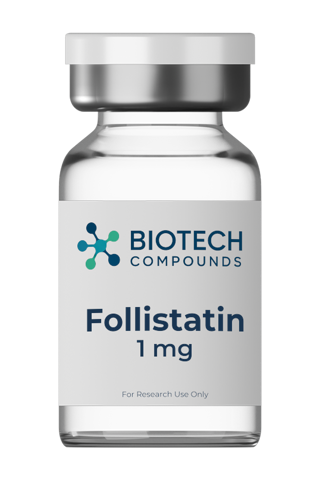
Follistatin is a single-chain glycoprotein classified as an activin-binding protein, available as a lyophilized powder for laboratory research.

Select Size
1mg
SKU: FN1
Batch: 202512-01-FN
$134.99
Ships within 7-14 business days
Volume Discounts
Qty: 1 - 4$134.99 each
Qty: 5 - 9$121.49 each(save $13.50)
Qty: 10+$107.99 each(save $27.00)
Quantity:
1
Out of Stock
For Research Use Only. This product is intended for laboratory and scientific research purposes only. It is not a drug or dietary supplement and is not for human or veterinary consumption. Not intended to diagnose, treat, cure, or prevent any disease.
99%+ Purity
COA Included
Fast Shipping
USA Based

Product Details

Follistatin is a naturally occurring single-chain glycoprotein characterized by its cysteine-rich structure. The FS344 isoform contains 344 amino acids with multiple disulfide bonds contributing to its tertiary structure.


Contains three follistatin domains (FS domains), each with approximately 73-77 amino acids and a conserved arrangement of 10 cysteine residues forming 5 disulfide bonds per domain. Produced through recombinant expression and provided as lyophilized powder. Soluble in sterile water or PBS. Store at -20°C to -80°C.


Disclaimer: For laboratory and research purposes only. Not intended for human consumption.

Frequently Asked Questions About Follistatin

Answers summarize published research and are provided for laboratory research purposes only.
Follistatin is a naturally occurring single-chain glycoprotein classified as an activin-binding protein. The FS344 isoform contains 344 amino acids arranged in a cysteine-rich structure. Research studies have examined Follistatin for its ability to bind and neutralize members of the TGF-beta superfamily, particularly activin and myostatin. Biotech Compounds supplies recombinant Follistatin as a lyophilized powder for laboratory research.
Published research describes Follistatin as a high-affinity binding partner for activin and for myostatin, also called GDF-8. In vitro binding studies have reported that Follistatin wraps around these ligands and blocks them from reaching their activin type II receptors. Because myostatin signaling through SMAD2 and SMAD3 restrains muscle growth in animal models, researchers use Follistatin to study what happens when that signal is removed.
The primary research area for Follistatin is skeletal muscle biology. In rodent studies and other animal models, researchers have reported increased muscle mass when Follistatin was expressed or delivered, which they attribute to neutralization of myostatin and activin. Follistatin is also used in cell culture to probe how myostatin blockade changes myoblast growth and differentiation.
Beyond muscle, Follistatin has been studied in reproductive biology, where researchers have examined how it regulates activin signaling in the pituitary and gonads. Research studies have also looked at Follistatin in models of fibrosis and tissue repair, and in developmental biology, where activin gradients help pattern early embryos. Its role in these areas is investigated in vitro and in animal models.
Evidence for Follistatin comes from in vitro binding studies, cell culture experiments, and animal model work, including gene delivery studies in rodents and larger animals. Clinical trials have explored Follistatin-based gene therapy approaches in an investigational setting. Follistatin as a protein is not an approved medicine. Biotech Compounds supplies it strictly for laboratory research into these reported observations.
Follistatin and GDF-8 153 sit on opposite sides of the same pathway. GDF-8 153 is a synthetic peptide fragment from the myostatin sequence used in vitro for receptor-binding and reporter assays. Follistatin is the full recombinant glycoprotein that binds and neutralizes myostatin. In laboratory work, GDF-8 153 fragments are used in competitive displacement assays against Follistatin, so the two are often studied together. Related products include ACE-031.
Follistatin is supplied as a lyophilized powder that is soluble in sterile water or PBS. Allow the vial to reach room temperature, then add the liquid slowly against the inner wall. Swirl gently until the powder dissolves and never shake, because Follistatin is a large disulfide-rich glycoprotein that is easily damaged by shear. Bacteriostatic Water may also be used where a preserved diluent is preferred.
Store lyophilized Follistatin at -20 C to -80 C, protected from moisture and light. After reconstitution, keep the solution refrigerated at 2 to 8 C for short-term use, or divide it into single-use aliquots and freeze them. Avoid repeated freeze thaw cycles, which research on glycoproteins has reported can cause aggregation and loss of binding activity. Do not leave reconstituted Follistatin at room temperature.
Yes. Follistatin from Biotech Compounds is produced by recombinant expression and supplied at 99 percent or greater purity. Each lot is third-party tested for identity and purity, and the Certificate of Analysis is available on the product page. Researchers can review the lot data before committing the material to a binding assay or animal model experiment.
Follistatin has a molecular weight of approximately 31,500 g/mol and a molecular formula of C1355H2189N381O391S10 for the FS344 isoform. The protein contains three follistatin domains, each with roughly 73 to 77 amino acids and a conserved set of 10 cysteine residues forming 5 disulfide bonds per domain. That disulfide framework gives Follistatin the folded shape that research shows is needed for ligand binding.
No. Follistatin is sold by Biotech Compounds strictly as a research material for laboratory research by qualified researchers and research organizations. Purchasers must be 21 or older. Follistatin is not a drug or dietary supplement, has not been approved by any regulatory agency, and is not for human or animal consumption.