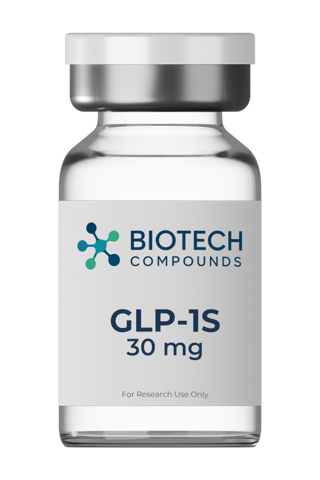
Research Compound
GLP-1S
GLP-1S is a synthetic 31-amino acid peptide classified as a GLP-1 receptor agonist, available as a lyophilized powder for laboratory research.
Select Size
30mg
SKU: SM30
Batch: 202609-01-SM
$86.99
Ships today if ordered by 4PM EST
Est. Arrival: 09/18/2026
Volume Discounts
Qty: 1 - 4$86.99 each
Qty: 5 - 9$78.29 each(save $8.70)
Qty: 10+$69.59 each(save $17.40)
Quantity:
1
For Research Use Only. This product is intended for laboratory and scientific research purposes only. It is not a drug or dietary supplement and is not for human or veterinary consumption. Not intended to diagnose, treat, cure, or prevent any disease.
99%+ Purity
COA Included
Fast Shipping
USA Based
Product Details
Semaglutide is a synthetic 31-amino acid peptide analog of human GLP-1. Features a-aminoisobutyric acid (Aib) at position 8 for DPP-4 resistance, and C18 fatty di-acid acylation at Lys26 via glutamic acid spacer for albumin binding.
Classified as a GLP-1 receptor agonist. Provided as lyophilized powder, soluble in bacteriostatic water or sterile water. Store at -20°C protected from light.
Disclaimer: For laboratory and research purposes only. Not intended for human consumption.
Frequently Asked Questions About GLP-1S
Answers summarize published research and are provided for laboratory research purposes only.
GLP-1S is a synthetic 31-amino acid acylated peptide classified as a GLP-1 receptor agonist research peptide. It is an analog of human glucagon-like peptide-1 with modifications that extend its lifetime in the body of a research model. Research studies have examined GLP-1 receptor agonists like GLP-1S in models of glucose regulation, appetite signaling, and energy balance. GLP-1S is supplied as a lyophilized powder for laboratory research.
In research studies, GLP-1S has been shown to bind and activate the GLP-1 receptor, a G protein-coupled receptor found on pancreatic beta cells, in the gut, and in the brain. Researchers have reported that receptor activation raises cyclic AMP inside the cell, which in animal models has been linked to glucose-dependent insulin release, slower gastric emptying, and reduced food intake. Its fatty acid side chain binds albumin, which published research suggests slows clearance.
GLP-1S carries two key changes compared with native GLP-1. An alpha-aminoisobutyric acid residue at position 8 replaces the alanine that the enzyme DPP-4 would normally cleave, and research studies have shown this substitution protects the peptide from rapid breakdown. A C18 fatty di-acid is attached at lysine 26 through a glutamic acid spacer, and researchers have reported that this chain binds serum albumin and extends the circulating half-life of GLP-1S in research models.
The primary research area for GLP-1S is metabolic regulation. In research studies, GLP-1 receptor agonists of this type have been examined for effects on blood glucose control, insulin secretion, and body weight in both animal models and clinical trials. Researchers have reported that GLP-1S reduces food intake and body weight in rodent models, which is why GLP-1S is one of the most requested GLP-1 class peptides for metabolic research.
Beyond metabolism, GLP-1S has been studied in several secondary areas. Published research suggests that GLP-1 receptor activation influences cardiovascular markers, and clinical trials of this peptide class have reported cardiovascular outcome data. In animal models, researchers have examined GLP-1S for effects on liver fat accumulation, kidney markers, and neuroinflammation. These secondary research areas continue to expand as GLP-1S is used in new laboratory models.
GLP-1S belongs to one of the most thoroughly studied peptide classes. Research on this GLP-1 receptor agonist spans in vitro receptor assays, rodent and primate models, and large clinical trial programs. Peptides of this exact structure have completed phase 3 clinical trials in the metabolic field. The GLP-1S sold by Biotech Compounds is a research-grade peptide intended for laboratory study of the same molecule, not a finished pharmaceutical.
GLP-1S, GLP-2T, and GLP-3R differ in how many receptors they target. GLP-1S is a single GLP-1 receptor agonist. GLP-2T is a dual agonist of the GIP and GLP-1 receptors. GLP-3R is a triple agonist of the GLP-1, GIP, and glucagon receptors. In research studies, each added receptor has been associated with a different metabolic profile, so researchers select GLP-1S when they want to isolate GLP-1 receptor activity alone.
GLP-1S is supplied as a lyophilized powder and is reconstituted with bacteriostatic water or sterile water. The diluent is added slowly along the inside wall of the vial so it runs down onto the powder, and the vial is then swirled gently until the GLP-1S dissolves completely. The vial should never be shaken. Because GLP-1S is an acylated peptide it may take a little longer to dissolve than a small unmodified peptide.
Lyophilized GLP-1S should be stored frozen at minus 20 C and protected from light. Once reconstituted, GLP-1S should be kept refrigerated at 2 to 8 C, shielded from light, and used within the timeframe set by the research protocol. Repeated freeze and thaw cycles should be avoided. Research studies have reported that the albumin-binding fatty acid chain gives GLP-1S a long half-life in biological systems, but that does not replace proper cold storage of the vial.
GLP-1S has a molecular weight of about 4113.6 g/mol and a molecular formula of C187H291N45O59. It is a 31-amino acid peptide with a C18 fatty di-acid side chain. Biotech Compounds supplies GLP-1S as a lyophilized powder with a purity of 99 percent or higher, verified by third-party testing. The Certificate of Analysis for each lot of GLP-1S is available on the product page.
Yes. Every lot of GLP-1S sold by Biotech Compounds is tested by an independent laboratory for identity and purity, and GLP-1S is listed at 99 percent purity or higher. The Certificate of Analysis is posted on the GLP-1S product page so researchers can confirm the lot data before ordering. Testing confirms that the GLP-1S peptide matches its expected mass and that impurities are within specification.
No. GLP-1S is sold strictly as a research material for laboratory research by qualified researchers and research organizations. Purchasers must be 21 years of age or older. GLP-1S from Biotech Compounds is not a drug or a dietary supplement, it is not a substitute for any prescription product, and it is not for human or animal consumption.
You May Also Like