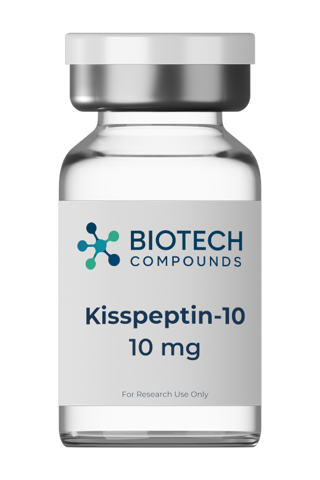
Research Compound
Kisspeptin-10
Kisspeptin-10 is a synthetic decapeptide corresponding to the C-terminal 10 amino acids of full-length kisspeptin, available as a lyophilized powder for laboratory research.
Select Size
10mg
SKU: KS10
Batch: 202609-01-KS
$52.99
Ships today if ordered by 4PM EST
Est. Arrival: 09/18/2026
Volume Discounts
Qty: 1 - 4$52.99 each
Qty: 5 - 9$47.69 each(save $5.30)
Qty: 10+$42.39 each(save $10.60)
Quantity:
1
For Research Use Only. This product is intended for laboratory and scientific research purposes only. It is not a drug or dietary supplement and is not for human or veterinary consumption. Not intended to diagnose, treat, cure, or prevent any disease.
99%+ Purity
COA Included
Fast Shipping
USA Based
Product Details
Kisspeptin-10 (KP-10) is a synthetic decapeptide: Tyr-Asn-Trp-Asn-Ser-Phe-Gly-Leu-Arg-Phe-NH2. C-terminus amidated. Corresponds to C-terminal 10 amino acids of kisspeptin-54.
Minimal bioactive sequence of kisspeptin family with high affinity for KISS1R (GPR54). C-terminal Arg-Phe-NH2 motif critical for receptor binding. Soluble in sterile water or bacteriostatic water. Store at -20°C.
Disclaimer: Not for human consumption. For controlled laboratory and experimental use only.
Frequently Asked Questions About Kisspeptin-10
Answers summarize published research and are provided for laboratory research purposes only.
Kisspeptin-10, also written KP-10, is a synthetic decapeptide with the sequence Tyr-Asn-Trp-Asn-Ser-Phe-Gly-Leu-Arg-Phe-NH2. It matches the final ten amino acids of kisspeptin-54, the full-length product of the KISS1 gene. The C-terminus is amidated. Kisspeptin-10 is the shortest fragment that research has identified as fully active at the kisspeptin receptor. Biotech Compounds supplies Kisspeptin-10 as a lyophilized powder for laboratory research.
Published research describes Kisspeptin-10 as a high-affinity agonist of KISS1R, a G protein-coupled receptor also known as GPR54. Researchers have reported that the C-terminal Arg-Phe-NH2 motif is essential for receptor binding, which places the peptide in the RFamide family. In research studies, receptor activation by Kisspeptin-10 has been observed to trigger Gq signaling, calcium mobilization, and downstream release of gonadotropin releasing hormone from hypothalamic neurons.
The primary research area for Kisspeptin-10 is reproductive neuroendocrinology. In animal models and in human clinical studies, researchers have reported that Kisspeptin-10 stimulates GnRH neurons and produces a rise in luteinizing hormone and follicle stimulating hormone. Kisspeptin-10 has become a standard tool peptide for probing the hypothalamic control of the reproductive axis in both sexes.
Beyond the reproductive axis, Kisspeptin-10 has been examined in cancer biology, where the KISS1 gene was first identified as a metastasis suppressor. In vitro studies have reported that Kisspeptin-10 reduced migration of certain tumor cell lines. Rodent studies have also examined the peptide in models of puberty timing, energy balance, and mood-related brain circuits, reflecting the wide distribution of KISS1R in the brain.
Kisspeptin-10 has a broader evidence base than many research peptides. In vitro receptor pharmacology, rodent and sheep studies, and multiple early-phase clinical trials in healthy volunteers have been published. Kisspeptin-10 remains investigational and is not an approved drug, but clinical trials have used it as a diagnostic probe of the reproductive axis under research protocols.
Kisspeptin-10 and HCG act at different levels of the reproductive axis. Kisspeptin-10 acts upstream at the hypothalamus, where researchers have reported it triggers GnRH neurons and produces a pulse of pituitary gonadotropins. HCG is a large glycoprotein that acts downstream on the LH receptor of the gonads directly. In research studies, Kisspeptin-10 has been used to test the whole axis, while HCG bypasses the brain and pituitary. Biotech Compounds sells HCG separately.
Kisspeptin-10 is supplied as a lyophilized powder and is soluble in sterile water or Bacteriostatic Water. Researchers add the diluent slowly down the inside wall of the vial and swirl gently until the solution is clear. The vial should not be shaken. Bacteriostatic Water is typically used when the reconstituted Kisspeptin-10 solution will be sampled more than once.
Lyophilized Kisspeptin-10 should be stored at minus 20 C, protected from light and moisture. After reconstitution, the solution should be refrigerated at 2 to 8 C and protected from light. Repeated freeze thaw cycles should be avoided, so aliquoting is recommended for frozen storage. Researchers have reported that Kisspeptin-10 has a very short half-life in circulation, measured in minutes, because it is rapidly cleaved by peptidases.
Yes. Kisspeptin-10 from Biotech Compounds is listed at 99 percent plus purity. Each lot is tested by an independent third-party laboratory, and the Certificate of Analysis is posted on the product page. Researchers can review the identity and purity data for the specific lot of Kisspeptin-10 before it is used.
Kisspeptin-10 has an approximate molecular weight of 1299.4 g/mol and a molecular formula of C59H90N16O17. The ten-residue chain includes a tryptophan and two phenylalanines, which give the peptide a distinct ultraviolet absorbance that is useful for concentration checks. The amidated C-terminus of Kisspeptin-10 is part of the receptor-binding motif rather than a manufacturing artifact.
No. Kisspeptin-10 is sold by Biotech Compounds strictly as a research material for laboratory research by qualified researchers and research organizations. Purchasers must be 21 years of age or older. Kisspeptin-10 is not a drug or a dietary supplement, has not been approved by the FDA, and is not for human or animal consumption.
You May Also Like