Research Compound

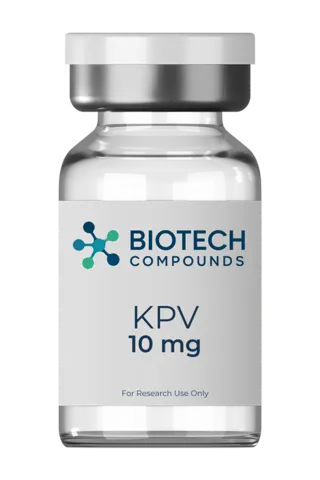
KPV

KPV is a synthetic tripeptide (Lys-Pro-Val) corresponding to the C-terminal fragment of a-MSH, available as a lyophilized powder for laboratory research.

Select Size
10mg
SKU: KPV10
Batch: 202609-01-KPV
$32.99
Ships today if ordered by 4PM EST
Est. Arrival: 09/18/2026
Volume Discounts
Qty: 1 - 4$32.99 each
Qty: 5 - 9$29.69 each(save $3.30)
Qty: 10+$26.39 each(save $6.60)
Quantity:
1
For Research Use Only. This product is intended for laboratory and scientific research purposes only. It is not a drug or dietary supplement and is not for human or veterinary consumption. Not intended to diagnose, treat, cure, or prevent any disease.
99%+ Purity
COA Included
Fast Shipping
USA Based

Product Details

KPV is a synthetic tripeptide: Lys-Pro-Val. Corresponds to C-terminal tripeptide fragment (amino acids 11-13) of alpha-melanocyte-stimulating hormone (a-MSH).


Contains one basic (lysine), one cyclic imino (proline), and one hydrophobic branched-chain (valine) amino acid. Proline introduces conformational constraint. Does not contain core melanocortin pharmacophore (His-Phe-Arg-Trp). Soluble in sterile water. Store at -20°C.


Disclaimer: For laboratory and research purposes only. Not intended for human consumption.

Frequently Asked Questions About KPV

Answers summarize published research and are provided for laboratory research purposes only.
KPV is a synthetic tripeptide with the sequence Lys-Pro-Val. It matches amino acids 11 through 13 at the C-terminal end of alpha-melanocyte-stimulating hormone, or alpha-MSH. KPV contains one basic residue, lysine, one cyclic imino residue, proline, and one branched hydrophobic residue, valine. It does not contain the His-Phe-Arg-Trp core that binds melanocortin receptors. Biotech Compounds supplies KPV as a lyophilized powder for laboratory research.
Published research describes KPV as acting through a pathway that does not depend on classical melanocortin receptor binding, since the tripeptide lacks the melanocortin pharmacophore. In vitro studies have reported that KPV enters epithelial and immune cells through the peptide transporter PepT1 and then reduces activation of NF-kB, a transcription factor that drives inflammatory gene expression. Researchers have also observed reduced release of inflammatory cytokines in cell models exposed to KPV.
The primary research area for KPV is inflammation. In rodent studies, researchers have reported examining KPV in models of intestinal inflammation, where the tripeptide was observed to lower inflammatory markers in colon tissue. Cell culture work has extended those findings to intestinal epithelial cells and macrophages. KPV is often chosen as a minimal anti-inflammatory fragment of alpha-MSH in these studies.
Beyond gut models, KPV has been studied in skin and antimicrobial research. In vitro studies have reported that KPV reduced growth of certain bacteria and fungi, an activity that researchers attributed to the C-terminal region of alpha-MSH. Animal studies have also examined KPV in models of skin inflammation and wound healing, and in eye inflammation models. That range is why KPV appears in the KLOW research blend alongside repair-focused peptides.
The evidence base for KPV is preclinical. It consists of in vitro cell culture studies, in vitro antimicrobial assays, and rodent models. KPV has not been through a clinical trial program and is not an approved drug in any jurisdiction. Researchers regard the tripeptide as an investigational tool for studying alpha-MSH derived anti-inflammatory signaling.
KPV and LL-37 are both studied in inflammation and antimicrobial research but differ in size and origin. KPV is a three-residue fragment of alpha-MSH, and research studies describe its main action as damping NF-kB driven inflammation. LL-37 is a 37-amino acid cathelicidin antimicrobial peptide that researchers have reported disrupts bacterial membranes directly and modulates immune signaling. Biotech Compounds sells LL-37 as a separate research product.
KPV is supplied as a lyophilized powder and is soluble in sterile water, and Bacteriostatic Water is also used in laboratory preparation. Researchers add the diluent slowly down the inside of the vial and swirl gently until the powder dissolves. The vial should not be shaken. As a short tripeptide, KPV dissolves readily and the resulting solution should be clear.
Lyophilized KPV should be stored at minus 20 C, protected from light and moisture. After reconstitution, the solution should be refrigerated at 2 to 8 C and protected from light. Repeated freeze thaw cycles should be avoided, so aliquoting is recommended for frozen storage. Researchers have reported that the proline in the KPV sequence adds conformational constraint and some resistance to enzymatic breakdown compared with a fully flexible tripeptide.
Yes. KPV from Biotech Compounds is listed at 99 percent plus purity. Each lot is tested by an independent third-party laboratory, and the Certificate of Analysis is posted on the product page. Researchers can review the identity and purity data for the specific KPV lot before it is used in an experiment.
KPV has an approximate molecular weight of 397.5 g/mol and a molecular formula of C19H35N5O4. At under 400 daltons, KPV is one of the smallest peptides Biotech Compounds sells. Its low molecular weight and the presence of the PepT1 transporter substrate motif are the features that in vitro studies have linked to its uptake into cells.
No. KPV is sold by Biotech Compounds strictly as a research material for laboratory research by qualified researchers and research organizations. Purchasers must be 21 years of age or older. KPV is not a drug or a dietary supplement, has not been approved by the FDA, and is not for human or animal consumption.