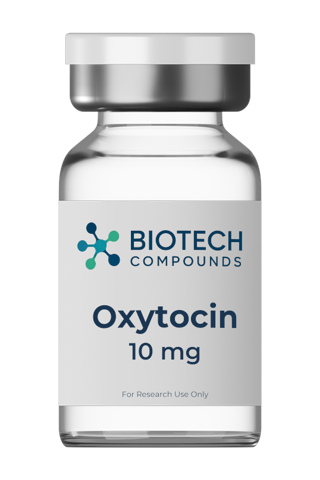
Research Compound
Oxytocin
Oxytocin is a cyclic nonapeptide with disulfide bridge between cysteine residues, available as a lyophilized powder for laboratory research.
Select Size
10mg
SKU: OT10
Batch: 202610-01-OT
$75.99
Ships today if ordered by 4PM EST
Est. Arrival: 09/18/2026
Volume Discounts
Qty: 1 - 4$75.99 each
Qty: 5 - 9$68.39 each(save $7.60)
Qty: 10+$60.79 each(save $15.20)
Quantity:
1
For Research Use Only. This product is intended for laboratory and scientific research purposes only. It is not a drug or dietary supplement and is not for human or veterinary consumption. Not intended to diagnose, treat, cure, or prevent any disease.
99%+ Purity
COA Included
Fast Shipping
USA Based
Product Details
Oxytocin is a cyclic nonapeptide: Cys-Tyr-Ile-Gln-Asn-Cys-Pro-Leu-Gly-NH2. Features disulfide bridge between Cys1 and Cys6 forming six-membered ring. C-terminus amidated.
Structurally related to vasopressin, differing by only two amino acids. First peptide hormone to have its structure determined and synthesized (Nobel Prize 1955). Soluble in sterile water, bacteriostatic water, or dilute acetic acid. Store at -20°C.
Disclaimer: For laboratory and research purposes only. Not intended for human consumption.
Frequently Asked Questions About Oxytocin
Answers summarize published research and are provided for laboratory research purposes only.
Oxytocin is a cyclic nonapeptide with the sequence Cys-Tyr-Ile-Gln-Asn-Cys-Pro-Leu-Gly-NH2. A disulfide bridge between the cysteine residues at positions 1 and 6 forms a six membered ring, and the C-terminus is amidated. It was the first peptide hormone to have its structure determined and chemically synthesized. Research studies have examined Oxytocin in reproductive physiology, social behavior in animal models, and receptor pharmacology.
In research studies, Oxytocin has been observed to bind the oxytocin receptor, a G protein coupled receptor found in smooth muscle and in specific brain regions. Researchers have reported that receptor activation raises intracellular calcium, which drives contraction in smooth muscle preparations. Published research also shows that Oxytocin binds vasopressin receptors with lower affinity because the two peptides differ by only two amino acids.
Reproductive physiology is the classic research area for Oxytocin. In isolated tissue preparations, researchers have shown that Oxytocin stimulates contraction of uterine smooth muscle, and in animal models it has been observed to trigger milk ejection from mammary tissue. These effects are why Oxytocin became a standard reference agonist in smooth muscle contraction assays and receptor binding studies.
A large body of animal research has examined Oxytocin and social behavior. In rodent studies, researchers reported that Oxytocin signaling influences pair bonding, maternal behavior, and social recognition. Published research in prairie voles in particular linked oxytocin receptor distribution to bonding patterns. Human studies have measured natural Oxytocin levels and examined intranasal Oxytocin in experimental settings, with mixed results that remain a subject of active debate among researchers.
Oxytocin has been studied for decades in vitro, in animal models, and in clinical trials. Pharmaceutical Oxytocin is an approved prescription drug in many countries for specific clinical uses, but those products are regulated formulations that are separate from the research material sold here. Research grade Oxytocin from Biotech Compounds is a lyophilized powder intended for receptor assays, tissue preparations, and animal model work.
Oxytocin and Kisspeptin-10 are both studied in reproductive research, but at different points in the system. Kisspeptin-10 is a 10 amino acid fragment that research studies have shown stimulates gonadotropin releasing hormone neurons at the top of the reproductive axis. Oxytocin is a nonapeptide that acts on smooth muscle and on brain circuits for social behavior. Biotech Compounds sells both as separate research materials.
Oxytocin is supplied as a lyophilized powder that is soluble in sterile water, Bacteriostatic Water, or dilute acetic acid. For research preparation, the diluent is added slowly down the wall of the vial and the vial is swirled gently until the solution is clear. Shaking is avoided. Biotech Compounds carries both Bacteriostatic Water and Acetic Acid 0.6 percent as reconstitution vehicles that pair with Oxytocin.
Lyophilized Oxytocin should be stored at minus 20 C, protected from light and moisture, and allowed to reach room temperature before the vial is opened. After reconstitution, Oxytocin should be refrigerated at 2 to 8 C and protected from light. Published research reports that Oxytocin in solution degrades faster at elevated temperatures and that the disulfide bridge is sensitive to oxidation, so prompt use and avoidance of freeze thaw cycles are recommended.
Yes. Oxytocin from Biotech Compounds is supplied at 99 percent purity, and each lot is third-party tested to confirm identity and purity. A Certificate of Analysis for Oxytocin is available on the product page. Researchers can compare the lot number on the vial with the certificate before use.
Oxytocin has a molecular formula of C43H66N12O12S2 and a molecular weight of approximately 1007.2 g/mol. The two sulfur atoms come from the cysteine residues that form the disulfide bridge. Oxytocin is a nine amino acid peptide. These values are listed in the specifications on the Oxytocin product page and on the Certificate of Analysis.
Oxytocin and vasopressin are structurally very similar nonapeptides that differ at only two amino acid positions. Both contain the same disulfide bridged ring. Research studies have shown that this similarity leads to partial cross activity, with Oxytocin binding vasopressin receptors at lower affinity and vasopressin binding the oxytocin receptor. Researchers use this relationship when designing selective ligands for the oxytocin receptor.
No. The Oxytocin sold by Biotech Compounds is not an approved drug and is not a dietary supplement. It is sold strictly as a research material for laboratory research by qualified researchers and research organizations. Purchasers must be 21 years of age or older. Oxytocin from Biotech Compounds is not for human or animal consumption and is not intended for any therapeutic, diagnostic, or clinical application.
You May Also Like