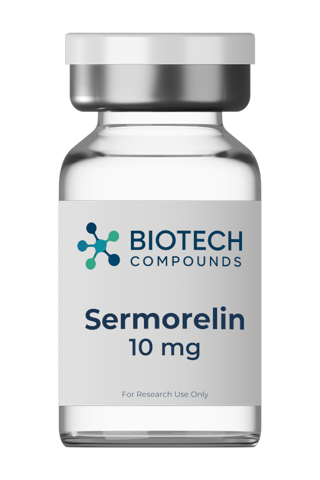
Research Compound
Sermorelin
Sermorelin is a synthetic 29-amino acid peptide corresponding to GHRH(1-29), available as a lyophilized powder for laboratory research.
Select Size
10mg
SKU: SMMO10
Batch: 202609-01-SMMO
$53.99
Ships today if ordered by 4PM EST
Est. Arrival: 09/18/2026
Volume Discounts
Qty: 1 - 4$53.99 each
Qty: 5 - 9$48.59 each(save $5.40)
Qty: 10+$43.19 each(save $10.80)
Quantity:
1
For Research Use Only. This product is intended for laboratory and scientific research purposes only. It is not a drug or dietary supplement and is not for human or veterinary consumption. Not intended to diagnose, treat, cure, or prevent any disease.
99%+ Purity
COA Included
Fast Shipping
USA Based
Product Details
Sermorelin is a synthetic 29-amino acid peptide corresponding to the N-terminal 1-29 fragment of human growth hormone-releasing hormone (GHRH 1-29). C-terminus is amidated.
Represents the minimal bioactive fragment of full-length 44-amino acid GHRH. Methionine at position 27 may be oxidation-susceptible. Soluble in sterile water or bacteriostatic water. Store at -20°C protected from light.
Disclaimer: For laboratory and research purposes only. Not intended for human consumption.
Frequently Asked Questions About Sermorelin
Answers summarize published research and are provided for laboratory research purposes only.
Sermorelin is a synthetic 29 amino acid peptide that matches the first 29 residues of human growth hormone releasing hormone, written GHRH 1-29, with an amidated C-terminus. This fragment is the shortest piece of the natural 44 amino acid hormone that keeps full activity. Research studies have examined Sermorelin mainly as a tool for stimulating growth hormone release from the pituitary. Biotech Compounds supplies Sermorelin as a lyophilized powder for laboratory research.
Sermorelin binds the growth hormone releasing hormone receptor on somatotroph cells in the anterior pituitary. Researchers have reported that this binding raises cyclic AMP inside the cell and triggers release of stored growth hormone. In research studies, Sermorelin has been observed to preserve the natural pulsatile pattern of secretion and to remain subject to negative feedback from somatostatin and IGF-1, which distinguishes it from direct administration of growth hormone.
The primary research area for Sermorelin is growth hormone secretion. In animal models and in human clinical studies, researchers reported measurable rises in serum growth hormone following Sermorelin administration, with downstream increases in IGF-1 over longer study periods. Because the response depends on a working pituitary, Sermorelin has also been used in research as a diagnostic probe to assess pituitary reserve.
Yes. A second research area for Sermorelin is the age-related decline in growth hormone output. Clinical studies in older adults have examined whether Sermorelin restores growth hormone and IGF-1 levels toward those seen in younger subjects, and researchers reported changes in body composition markers and sleep architecture in some of these studies. Sermorelin is treated in this literature as a way to study the somatotropic axis in aging rather than as a therapy.
Sermorelin has a substantial evidence base that includes receptor studies, animal models, and human clinical trials. A pharmaceutical form of Sermorelin was once approved in the United States for diagnostic and pediatric use and was later withdrawn from the market for commercial rather than safety reasons. The Sermorelin sold by Biotech Compounds is a research material and is not that pharmaceutical product.
Sermorelin and Ipamorelin are both growth hormone secretagogues sold by Biotech Compounds, but they act on different receptors. Sermorelin is a GHRH analog that stimulates the GHRH receptor. Ipamorelin is a pentapeptide that stimulates the ghrelin receptor, GHS-R1a. Research studies have reported that the two pathways are complementary and produce a larger growth hormone pulse when combined, which is why many study designs pair a GHRH analog with a ghrelin mimetic.
Sermorelin and CJC-1295 (no DAC) are both GHRH 1-29 analogs sold by Biotech Compounds. Sermorelin uses the natural amino acid sequence. CJC-1295 (no DAC), also called Mod GRF 1-29, carries four amino acid substitutions that researchers have reported protect it from enzymatic cleavage and extend its half-life. Studies use Sermorelin when they want the native fragment and CJC-1295 (no DAC) when they want a more stable version of the same signal.
Sermorelin is supplied as a lyophilized powder that dissolves in sterile water or Bacteriostatic Water. The water is added slowly down the inside wall of the vial so it does not strike the powder. The vial is then swirled gently until the solution is clear. Sermorelin should never be shaken. Because the methionine at position 27 can oxidize, keeping air exposure short during preparation helps protect the peptide.
Lyophilized Sermorelin should be kept at minus 20 C, sealed and protected from light. Once reconstituted, Sermorelin should be refrigerated at 2 to 8 C, protected from light, and used within a limited window. Repeated freeze and thaw cycles should be avoided. In research studies, Sermorelin has been reported to have a short half-life in circulation measured in minutes, so laboratory stability depends heavily on proper cold, dark storage.
Yes. Sermorelin from Biotech Compounds is listed at 99 percent or higher purity and is third-party tested to confirm identity and purity. A Certificate of Analysis for Sermorelin is available on the product page so researchers can review the results for their specific lot. This documentation supports reproducible research and gives research organizations a record for their quality process.
Sermorelin has the molecular formula C149H246N44O42S and a molecular weight of approximately 3357.9 Da. It contains 29 amino acids, making it one of the larger peptides in the Biotech Compounds catalog compared with short bioregulator peptides. The single sulfur atom in the formula comes from the methionine residue at position 27, and the C-terminal amide is part of the native sequence.
No. The Sermorelin sold by Biotech Compounds is not an approved drug and is not a dietary supplement. It is sold strictly as a research material for laboratory research by qualified researchers and research organizations. Purchasers must be 21 years of age or older. Sermorelin from Biotech Compounds is not intended for human or animal consumption and is not intended to diagnose, treat, cure, or prevent any disease.
You May Also Like