
Introduction
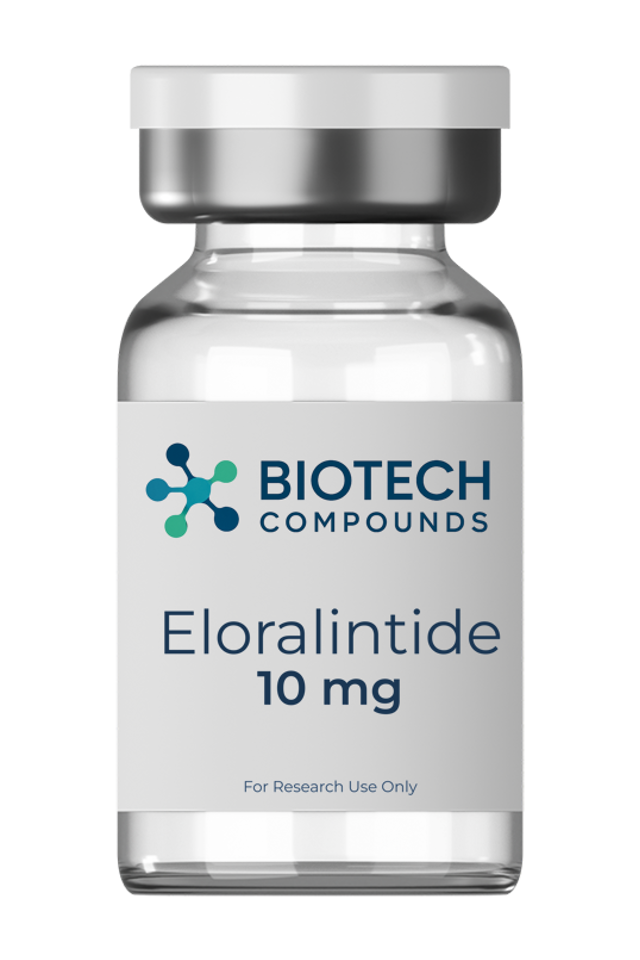
Eloralintide vs Cagrilintide is one of the most common comparisons researchers raise when evaluating long-acting amylin receptor agonists for laboratory study. Both compounds are lipidated analogs of human amylin engineered for extended circulating exposure through reversible albumin binding, yet they differ substantially in receptor selectivity and backbone design. Understanding the Eloralintide vs Cagrilintide distinction matters because it determines whether an observed experimental effect can be attributed to amylin receptor signaling specifically, or whether it reflects broader calcitonin receptor engagement. This article works through the mechanistic, structural, and research-application differences between the two compounds, with particular attention to why Eloralintide's selectivity profile makes it a useful tool for isolating AMY1R-mediated pharmacology in metabolic research models.
Eloralintide vs Cagrilintide: Mechanism of Action and Receptor Selectivity
The core of the Eloralintide vs Cagrilintide comparison rests on receptor pharmacology. Amylin receptors are not stand-alone proteins; they arise when the calcitonin receptor (CTR) associates with one of three receptor activity modifying proteins, producing AMY1R, AMY2R, and AMY3R. Because CTR forms the structural core of every amylin receptor subtype, most amylin analogs, cagrilintide included, activate CTR itself in addition to the RAMP-associated complexes. This dual engagement is why cagrilintide is classified as a dual amylin and calcitonin receptor agonist, often abbreviated DACRA.
Eloralintide was engineered along a different path. Reported potency data place its EC50 at 23.9 pM at AMY1R and 253.8 pM at AMY3R, a roughly 11- to 12-fold selectivity favoring AMY1R over AMY3R and over unmodified CTR[1]. Cagrilintide, by contrast, engages CTR with potency comparable to its amylin receptor activity, consistent with its DACRA classification[2]. In practical terms, the Eloralintide vs Cagrilintide mechanism difference allows investigators to separate amylin-specific signaling through AMY1R from broader calcitonin pathway activity, a distinction that is difficult to draw cleanly with a dual agonist. Researchers working with Eloralintide in receptor binding or cell-based assays can attribute observed effects more confidently to AMY1R engagement, since off-target activity at AMY3R and CTR is substantially reduced relative to cagrilintide.
Structural Differences Between Eloralintide and Cagrilintide
Beyond receptor pharmacology, the Eloralintide vs Cagrilintide comparison reflects two distinct engineering strategies built on the same 37-residue native amylin template.
- Backbone length. Eloralintide retains the native 37-amino acid amylin length. Cagrilintide extends the backbone to 39 residues.
- Ring closure. Eloralintide substitutes a methylene bridge for the native Cys2-Cys7 disulfide, a modification intended to resist reduction and limit aggregation. Cagrilintide retains a Cys3-Cys8 disulfide bond.
- Non-canonical residues. Eloralintide incorporates ornithine at position 11, alpha-methyl-phenylalanine at position 15, and N-methyl-asparagine at position 22, substitutions designed to limit proteolytic degradation and reduce aggregation propensity.
- Lipidation chemistry. Both peptides carry a C20 fatty diacid attached through a gamma-Glu-gamma-Glu linker, a shared strategy for promoting reversible serum albumin binding and prolonging circulating half-life. In Eloralintide this conjugation occurs at Lys26.
The shared lipidation chemistry explains why both compounds behave similarly with respect to prolonged exposure kinetics in research models, while the receptor-facing modifications explain why their downstream signaling profiles diverge. This is the structural crux of the Eloralintide vs Cagrilintide question: near-identical pharmacokinetic engineering paired with deliberately different receptor engagement.
Research Findings: Eloralintide vs Cagrilintide in Preclinical Studies
Preclinical literature on amylin receptor pharmacology consistently frames the Eloralintide vs Cagrilintide comparison around the question of receptor bias and its downstream consequences. Amylin analogs are studied for effects on meal termination, satiation signaling, gastric emptying, and glucagon regulation, largely through action in the area postrema and nucleus of the solitary tract[3]. Because these regions express a mix of AMY1R, AMY2R, AMY3R, and CTR, distinguishing which receptor subtype drives a given effect requires ligands with defined selectivity profiles.
In published preclinical comparisons, the selective AMY1R profile of Eloralintide tracked with reduced conditioned taste avoidance at a body-weight effect comparable to cagrilintide, a dual agonist with broader CTR engagement[4]. Conditioned taste aversion is a standard behavioral readout used to flag aversive or malaise-like responses in rodent models, and its dissociation from body-weight effect is a mechanistic question that Eloralintide vs Cagrilintide study designs are specifically built to probe. This kind of head-to-head comparison is valuable because it lets investigators test whether calcitonin receptor engagement, rather than amylin receptor activation per se, contributes to specific behavioral or physiological outcomes observed with dual agonists.
Cagrilintide has additionally been studied in combination with GLP-1 receptor agonist mechanisms, given the overlapping but non-identical signaling pathways involved in appetite and energy balance regulation[2]. Eloralintide's narrower receptor engagement makes it a useful comparator arm in these combination studies, since it isolates the AMY1R contribution more cleanly.
Applications in Metabolic Research
The Eloralintide vs Cagrilintide comparison extends naturally into applied research design across several domains:
- Pathway dissection. Using Eloralintide alongside a dual agonist like cagrilintide lets researchers parse amylin-specific effects from calcitonin receptor contributions in the same experimental system.
- Combination pharmacology. Amylin pathway agonists are frequently studied alongside incretin receptor agonists (GLP-1, GIP) to characterize additive or synergistic effects on energy balance signaling in metabolic research models.
- Receptor mapping. Selective ligands such as Eloralintide support in vitro receptor characterization work, including EC50 determination across AMY1R, AMY2R, AMY3R, and CTR expressed in recombinant cell lines.
- Behavioral pharmacology. Comparing Eloralintide and cagrilintide in the same behavioral battery, including conditioned taste aversion and food intake assays, helps clarify which receptor engagement pattern underlies specific behavioral readouts.
Any application of Eloralintide or cagrilintide in these contexts is restricted to laboratory and preclinical research settings using appropriate model systems, not human or veterinary use.
Considerations for Eloralintide vs Cagrilintide Researchers
Working with either compound in an Eloralintide vs Cagrilintide study design requires attention to handling detail, since peptide stability directly affects data reproducibility.
- Store lyophilized Eloralintide at -20°C, protected from moisture and light, until ready for use.
- Reconstitute with bacteriostatic or sterile water directed against the inner vial wall, swirling gently rather than shaking to avoid mechanical shearing of Eloralintide vs Cagrilintide.
- Hold reconstituted solution at 2 to 8°C and avoid repeated freeze-thaw cycles, which can degrade peptide integrity over time.
- Confirm purity and identity against the certificate of analysis for each lot; Eloralintide is supplied at 99 percent or greater purity by HPLC.
- Design experiments with appropriate receptor subtype controls (AMY1R, AMY3R, CTR) when the research question depends on distinguishing selective from dual receptor engagement.
Molecular details for reference: Eloralintide has molecular formula C201H319N49O65S2, molecular weight 4,526.10 g/mol, and CAS number 2883634-40-8.
Conclusion
The Eloralintide vs Cagrilintide comparison ultimately comes down to a single design decision built on a shared lipidation strategy: whether the analog is engineered to engage the calcitonin receptor broadly, as cagrilintide does, or to favor AMY1R selectively, as Eloralintide does. That difference in receptor bias has measurable consequences in preclinical behavioral and physiological readouts, making the two compounds complementary tools rather than interchangeable ones. Researchers designing studies around amylin pathway pharmacology, receptor subtype mapping, or combination work with incretin receptor agonists can use this selectivity distinction to sharpen their experimental conclusions. To review full technical specifications, purity data, and handling guidance, explore Eloralintide on the Biotech Compounds product page. Learn more about Eloralintide research.