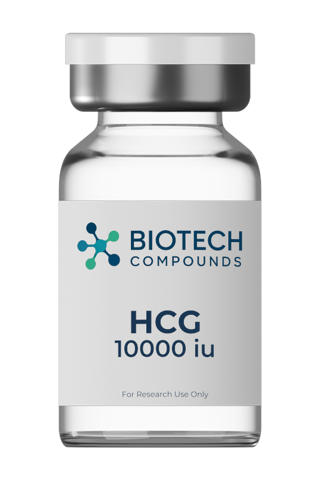
Research Compound
HCG
HCG (Human Chorionic Gonadotropin) is a heterodimeric glycoprotein hormone, available as a lyophilized powder for laboratory research.
Select Size
10000iu
SKU: G10K
Batch: 202610-01-G10K
$107.99
Ships today if ordered by 4PM EST
Est. Arrival: 09/18/2026
Volume Discounts
Qty: 1 - 4$107.99 each
Qty: 5 - 9$97.19 each(save $10.80)
Qty: 10+$86.39 each(save $21.60)
Quantity:
1
For Research Use Only. This product is intended for laboratory and scientific research purposes only. It is not a drug or dietary supplement and is not for human or veterinary consumption. Not intended to diagnose, treat, cure, or prevent any disease.
99%+ Purity
COA Included
Fast Shipping
USA Based
Product Details
HCG is a heterodimeric glycoprotein: alpha subunit (92 amino acids) common to LH, FSH, TSH; beta subunit (145 amino acids) conferring specificity.
Heavily glycosylated (~30% carbohydrate by mass). Beta subunit contains unique C-terminal "seat belt" region wrapping alpha subunit. Multiple glycosylation isoforms exist. Binds LH/CG receptor (LHCGR). Soluble in sterile water. Store at -20°C.
Disclaimer: For laboratory research purposes only. Not for human consumption, diagnostic, or therapeutic use.
Frequently Asked Questions About HCG
Answers summarize published research and are provided for laboratory research purposes only.
HCG, short for human chorionic gonadotropin, is a heterodimeric glycoprotein hormone made of two non-covalently bound subunits. Research studies have examined HCG as a ligand for the LH/CG receptor, in models of reproductive endocrinology, and as a marker molecule in pregnancy and tumor biology assays. Biotech Compounds supplies HCG as a lyophilized powder for laboratory research.
In research studies, HCG has been shown to bind the luteinizing hormone and chorionic gonadotropin receptor, known as LHCGR, a G protein-coupled receptor on gonadal cells. Researchers have reported that receptor activation raises cyclic AMP inside the cell, which in animal models and cell culture has been linked to steroid hormone production by Leydig cells and corpus luteum cells. Published research suggests that HCG binds this receptor with higher affinity and longer duration than native LH.
HCG is a heterodimer. Its alpha subunit has 92 amino acids and is identical to the alpha subunit shared by LH, FSH, and TSH. Its beta subunit has 145 amino acids and gives HCG its receptor specificity. About 30 percent of the mass of HCG is carbohydrate. Research studies have shown that a section of the beta subunit called the seat belt wraps around the alpha subunit and holds the dimer together, and multiple glycosylation isoforms of HCG exist.
The primary research area for HCG is reproductive endocrinology. In animal models, researchers have reported that HCG stimulates testosterone production in testicular tissue and supports the corpus luteum in ovarian tissue through the LH/CG receptor. In vitro studies have used HCG to examine steroidogenesis in Leydig cell and granulosa cell cultures. HCG is a standard reference ligand in research on gonadotropin receptor signaling.
HCG has been studied in several secondary areas beyond gonadal signaling. Research studies have examined HCG as a biomarker, since its beta subunit is the molecule detected by pregnancy assays and is measured in certain tumor marker studies. Researchers have also reported work on HCG in placental biology, angiogenesis models, and immune tolerance at the maternal-fetal interface. In vitro studies have compared HCG glycosylation isoforms to understand how carbohydrate content affects receptor binding.
HCG has a long and mature research record. It has been characterized in vitro, studied extensively in animal models of reproductive function, and used in human clinical research for decades in fertility and endocrinology settings. Its receptor, structure, and glycosylation have been mapped in detail. The HCG sold by Biotech Compounds is a research-grade preparation for laboratory study of the same molecule and is not a pharmaceutical product.
HCG and Kisspeptin-10 act at different points of the reproductive axis. Kisspeptin-10 is a short peptide that research studies have shown acts in the hypothalamus to trigger GnRH release, which then drives LH and FSH from the pituitary. HCG acts downstream, directly at the LH/CG receptor on gonadal cells. Researchers choose Kisspeptin-10 to study upstream control of the axis and HCG to study the gonadal response itself.
HCG is supplied as a lyophilized powder and is reconstituted with sterile water or bacteriostatic water. The diluent is added slowly down the inside wall of the vial, and the vial is rocked or swirled very gently until the HCG dissolves. As a large glycoprotein, HCG is more sensitive to mechanical stress than a small peptide, so the vial must never be shaken and foaming should be avoided.
Lyophilized HCG should be stored frozen at minus 20 C and protected from light and moisture. After reconstitution, HCG should be refrigerated at 2 to 8 C, protected from light, and used within the timeframe set by the research protocol. Repeated freeze and thaw cycles should be avoided because they can break apart the two subunits of the HCG dimer. Research studies have reported that HCG has a longer circulating half-life than LH because of its heavily glycosylated beta subunit.
HCG has a molecular weight of about 22,950 Da and a molecular formula of C1047H1650N274O302S26, reflecting both subunits and their carbohydrate content. Biotech Compounds supplies HCG as a lyophilized powder with a purity of 99 percent or higher, confirmed by third-party testing. The Certificate of Analysis for each lot of HCG is available on the product page so researchers can review identity and purity data before ordering.
No. HCG is sold strictly as a research material for laboratory research by qualified researchers and research organizations. Purchasers must be 21 years of age or older. HCG from Biotech Compounds is not a drug or a dietary supplement, is not for diagnostic or therapeutic use, and is not for human or animal consumption.
You May Also Like