Research Compound

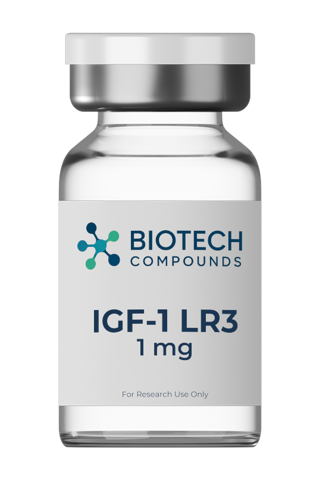
IGF-1 LR3

IGF-1 LR3 is an 83-amino acid synthetic analog of human IGF-1 with N-terminal extension and Arg3 substitution, available as a lyophilized powder for laboratory research.

Select Size
1mg
SKU: IG1
Batch: 202610-01-IG
$59.99
Ships today if ordered by 4PM EST
Est. Arrival: 09/18/2026
Volume Discounts
Qty: 1 - 4$59.99 each
Qty: 5 - 9$53.99 each(save $6.00)
Qty: 10+$47.99 each(save $12.00)
Quantity:
1
For Research Use Only. This product is intended for laboratory and scientific research purposes only. It is not a drug or dietary supplement and is not for human or veterinary consumption. Not intended to diagnose, treat, cure, or prevent any disease.
99%+ Purity
COA Included
Fast Shipping
USA Based

Product Details

IGF-1 LR3 (Long Arg3 IGF-1) is a synthetic 83-amino acid IGF-1 analog. Features 13-amino acid N-terminal extension and Glu3 to Arg3 substitution vs native 70-amino acid IGF-1.


Modifications reduce IGFBP binding affinity, increasing bioavailability and half-life. Retains three-domain structure and three disulfide bridges. Produced recombinantly. Soluble in sterile water or dilute acetic acid. Store at -20°C to -80°C.


Disclaimer: For laboratory and research purposes only. Not intended for human consumption.

Frequently Asked Questions About IGF-1 LR3

Answers summarize published research and are provided for laboratory research purposes only.
IGF-1 LR3, also written Long Arg3 IGF-1, is a synthetic 83-amino acid analog of human insulin-like growth factor 1. Native IGF-1 has 70 amino acids. IGF-1 LR3 adds a 13-amino acid extension at the N-terminus and swaps the glutamate at position 3 for an arginine. It keeps the three-domain fold and the three disulfide bridges of the parent protein and is produced recombinantly. Biotech Compounds supplies IGF-1 LR3 as a lyophilized powder for laboratory research.
Published research describes IGF-1 LR3 as a ligand for the IGF-1 receptor, a receptor tyrosine kinase. Researchers have reported that the Arg3 substitution and the N-terminal extension sharply reduce binding to the IGF binding proteins, or IGFBPs, that normally sequester native IGF-1 in circulation. In research studies, that reduced binding-protein affinity has been associated with a longer functional half-life and greater receptor availability compared with the unmodified peptide.
The primary research area for IGF-1 LR3 is cell growth and proliferation signaling. In cell culture, IGF-1 LR3 has been used widely as a media supplement because researchers have reported that it sustains proliferation and viability in mammalian cell lines, including in recombinant protein production systems. Studies have examined how the analog drives the PI3K-Akt and MAPK pathways downstream of the IGF-1 receptor.
Beyond cell culture, IGF-1 LR3 has appeared in animal research on skeletal muscle. In rodent studies, researchers reported examining the analog in models of muscle hypertrophy, satellite cell activation, and protein synthesis signaling. Other research has explored IGF-1 LR3 in models of tissue repair and in comparative pharmacology work that measures how binding-protein escape changes the distribution of IGF-1 signaling across tissues.
The evidence base for IGF-1 LR3 is preclinical. Most published work comes from in vitro cell culture systems and from animal models, especially rodent studies. IGF-1 LR3 is an investigational research reagent and has not been approved as a drug in any jurisdiction. Researchers regard findings from these models as hypothesis-generating rather than as established outcomes.
IGF-1 LR3 and MGF are both related to the IGF-1 gene but are different molecules. IGF-1 LR3 is a full-length engineered analog built to escape binding proteins and act on the IGF-1 receptor. MGF, or mechano growth factor, is a short peptide from an IGF-1 splice variant that researchers have reported appears in muscle after mechanical loading. Studies describe MGF as acting locally and briefly, while IGF-1 LR3 acts systemically with a longer half-life.
IGF-1 LR3 is supplied as a lyophilized powder. The product page notes it is soluble in sterile water or dilute acetic acid, and Biotech Compounds also sells Acetic Acid 0.6 percent for peptides that dissolve poorly in plain water. Researchers add the diluent slowly down the inside of the vial wall and swirl gently until the powder dissolves. The vial should never be shaken, since agitation can damage a folded protein like IGF-1 LR3.
Lyophilized IGF-1 LR3 should be stored frozen at minus 20 C to minus 80 C, protected from light and moisture. Once reconstituted, the solution should be kept refrigerated at 2 to 8 C and used within a short window, or divided into aliquots and frozen to avoid repeated freeze thaw cycles. Researchers have reported that binding-protein escape lengthens the in vivo half-life of IGF-1 LR3 relative to native IGF-1, but shelf stability still depends on cold storage.
Yes. IGF-1 LR3 from Biotech Compounds is listed at 99 percent plus purity. Each lot is tested by an independent third-party laboratory, and the Certificate of Analysis is posted on the product page so researchers can review identity and purity results before ordering. Lot-level documentation supports reproducible experimental work with IGF-1 LR3.
IGF-1 LR3 has an approximate molecular weight of 9117 g/mol and a molecular formula of C400H625N111O115S9. The nine sulfur atoms reflect the cysteine residues that form the three disulfide bridges plus the methionine content of the 83-amino acid chain. At roughly 9 kDa, IGF-1 LR3 is a small protein rather than a short peptide, which is why gentle handling during reconstitution matters.
No. IGF-1 LR3 is sold by Biotech Compounds strictly as a research material for laboratory research by qualified researchers and research organizations. Purchasers must be 21 years of age or older. IGF-1 LR3 is not a drug or a dietary supplement, has not been approved by the FDA for any use, and is not for human or animal consumption.