Research Compound

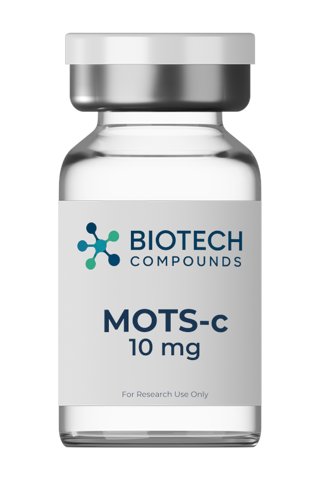
MOTS-c

MOTS-c is a 16-amino acid mitochondrial-derived peptide (MDP) encoded within the mitochondrial 12S rRNA gene, available as a lyophilized powder for laboratory research.

Select Size
10mg
SKU: MS10
Batch: 202609-01-MS
$37.99
Ships today if ordered by 4PM EST
Est. Arrival: 09/18/2026
Volume Discounts
Qty: 1 - 4$37.99 each
Qty: 5 - 9$34.19 each(save $3.80)
Qty: 10+$30.39 each(save $7.60)
Quantity:
1
For Research Use Only. This product is intended for laboratory and scientific research purposes only. It is not a drug or dietary supplement and is not for human or veterinary consumption. Not intended to diagnose, treat, cure, or prevent any disease.
99%+ Purity
COA Included
Fast Shipping
USA Based

Product Details

MOTS-c (Mitochondrial ORF of the Twelve S rRNA type-c) is a 16-amino acid peptide: Met-Arg-Trp-Gln-Glu-Met-Gly-Tyr-Ile-Phe-Tyr-Pro-Arg-Lys-Leu-Arg. Encoded within mitochondrial DNA.


Belongs to mitochondrial-derived peptide (MDP) class alongside humanin and SHLP family. Contains two methionine residues susceptible to oxidation. Soluble in sterile water. Store at -20°C; minimize oxidizing conditions.


Disclaimer: For laboratory and research purposes only. Not intended for human consumption.

Frequently Asked Questions About MOTS-c

Answers summarize published research and are provided for laboratory research purposes only.
MOTS-c is a 16 amino acid peptide encoded within the mitochondrial 12S ribosomal RNA gene, which makes it a mitochondrial derived peptide rather than a product of nuclear DNA. Its name stands for Mitochondrial ORF of the Twelve S rRNA type-c. Research studies have examined MOTS-c mainly in metabolic regulation, exercise physiology, and aging models, alongside related mitochondrial derived peptides such as humanin.
In research studies, MOTS-c has been observed to activate AMPK, an energy sensing enzyme, by interfering with the folate and one carbon metabolism cycle inside cells. Researchers have also reported that under metabolic stress MOTS-c moves from the cytoplasm into the nucleus, where it associates with stress responsive transcription factors and alters gene expression. This nuclear activity is the basis for describing MOTS-c as a mitochondrial signal to the nuclear genome.
Metabolic regulation is the main research area for MOTS-c. In rodent studies, researchers reported that MOTS-c improved insulin sensitivity and glucose handling in animals fed a high fat diet and reduced fat accumulation. Cell culture experiments have examined its effect on glucose uptake in skeletal muscle cells. Published research has also described lower circulating MOTS-c levels in aged animals, which linked the peptide to age related metabolic decline in those models.
A second research area for MOTS-c is exercise physiology. Research studies have shown that MOTS-c levels in skeletal muscle and circulation rise after exercise in both rodent and human samples. In animal models, researchers reported that MOTS-c improved physical performance and treadmill running capacity, including in older animals. Investigators have described MOTS-c as an exercise mimetic candidate on the basis of these findings, though the work remains at the research stage.
MOTS-c research includes cell culture, rodent studies, and human observational work that measured natural MOTS-c levels in blood and muscle. A synthetic analog of MOTS-c has also been examined in early phase clinical trials, but MOTS-c itself is not an approved drug anywhere. Its status is investigational. Biotech Compounds supplies MOTS-c as a research grade lyophilized peptide for laboratory studies.
MOTS-c and NAD+ are both studied in mitochondrial and metabolic research, but they are different kinds of molecules. NAD+ is a small coenzyme that carries electrons in cellular redox reactions and serves as a substrate for sirtuin and PARP enzymes. MOTS-c is a 16 amino acid signaling peptide that research has shown activates AMPK and regulates nuclear gene expression. Researchers sometimes examine them together because both are linked to energy metabolism in aging models.
MOTS-c is a lyophilized powder that is soluble in sterile water. For research preparation the water is added slowly down the inside of the vial and the vial is swirled gently until clear. It should never be shaken. Because MOTS-c contains two methionine residues that are prone to oxidation, researchers minimize air exposure, avoid oxidizing additives, and prepare only the volume required for the immediate experiment.
Lyophilized MOTS-c should be stored at minus 20 C, sealed, dry, and protected from light, and warmed to room temperature before opening. After reconstitution, MOTS-c solutions should be kept at 2 to 8 C, protected from light, and used promptly, or divided into single use aliquots and frozen. Repeated freeze thaw cycles should be avoided. Because of its methionine residues, MOTS-c is more sensitive to oxidation than many peptides, so minimizing oxygen exposure helps preserve it.
Yes. MOTS-c from Biotech Compounds is supplied at 99 percent or greater purity, and each lot is third-party tested to confirm identity and purity. A Certificate of Analysis for MOTS-c is available on the product page so researchers can review the results and match the lot number on the vial before use.
MOTS-c has a molecular formula of C190H294N52O54S2 and a molecular weight of approximately 2171 g/mol. Its 16 amino acid sequence is Met-Arg-Trp-Gln-Glu-Met-Gly-Tyr-Ile-Phe-Tyr-Pro-Arg-Lys-Leu-Arg. The two sulfur atoms in the formula come from the two methionine residues. These values appear in the specifications on the MOTS-c product page.
Mitochondrial derived peptides are short proteins encoded by small open reading frames in mitochondrial DNA rather than in the cell nucleus. MOTS-c belongs to this class alongside humanin and the SHLP family, and Biotech Compounds also offers Humanin as a research material. Research studies have shown that these peptides act as signaling molecules, and published research treats MOTS-c as evidence that mitochondria communicate with the rest of the cell through their own peptide output.
No. MOTS-c is not an approved drug and is not a dietary supplement. Biotech Compounds sells MOTS-c strictly as a research material for laboratory research by qualified researchers and research organizations. Purchasers must be 21 years of age or older. MOTS-c is not for human or animal consumption and is not intended for any therapeutic, diagnostic, or clinical application.