
Introduction to KLOW Peptide Blend and Skin Biology Research
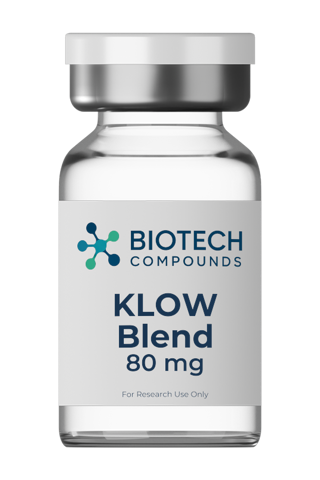
The KLOW peptide blend collagen skin research field has gained considerable traction as scientists seek to understand how multi-peptide formulations interact with dermal architecture at a molecular level. KLOW (BPC-157 10mg + GHK-Cu 50mg + TB-500 10mg + KPV 10mg) is a lyophilized research compound that combines four biochemically distinct peptides, each with documented roles in connective tissue biology, collagen regulation, and inflammatory signaling. For researchers investigating wrinkle reduction mechanisms, skin elasticity, and extracellular matrix remodeling, this blend offers a multi-target approach within a single standardized formulation.
Skin aging at the cellular level is fundamentally a story of collagen loss, cross-linking disruption, and chronic low-grade inflammation. The dermis, which provides tensile strength and resilience, depends on a balanced production-degradation cycle of fibrillar collagens, primarily types I and III. As this cycle tilts toward net degradation, wrinkles form, elasticity declines, and skin texture becomes irregular. The four peptides in KLOW each address different nodes of this process, which is precisely why researchers find a combined formulation scientifically compelling.
All KLOW peptide blend collagen skin research conducted with this product is performed strictly under laboratory conditions. KLOW peptide blend collagen skin research is not approved for human use and is provided solely for in vitro and preclinical investigation.
KLOW Peptide Blend Collagen Skin Research: Mechanisms of Each Component
Research on tendon repair suggests that Research on KLOW peptide blend collagen skin research gastric protection suggests that Research on tissue regeneration suggests that Research on healing peptide suggests that Understanding how KLOW functions requires examining each peptide independently before considering their collective effect on collagen production and skin biology.
BPC-157 (Body Protection Compound, 10mg)
BPC-157 is a 15-amino acid synthetic peptide derived from a naturally occurring protein found in gastric juice. In research models, BPC-157 has demonstrated the ability to upregulate growth hormone receptor expression and activate the nitric oxide system, both of which influence fibroblast migration and proliferation. Fibroblasts are the primary collagen-producing cells of the dermis, and any compound that promotes their activity has direct implications for skin architecture research. Studies in rodent models have documented accelerated tendon-to-bone healing and improved collagen fiber organization following BPC-157 administration, suggesting meaningful effects on connective tissue remodeling.[1]
GHK-Cu (Copper Tripeptide, 50mg)
GHK-Cu is perhaps the most extensively studied component of KLOW from a skin biology perspective. The tripeptide glycine-histidine-lysine, when complexed with copper, has been shown in multiple studies to stimulate collagen synthesis in fibroblast cultures, increase the production of elastin and glycosaminoglycans, and activate metalloproteinases that clear damaged collagen to make way for new fibrillar structures. Research published across dermatology and biochemistry journals consistently identifies GHK-Cu as a regulator of over 4,000 human genes, including many directly associated with skin repair and anti-aging pathways.[2] The 50mg concentration in the KLOW peptide blend reflects the proportionally larger role GHK-Cu plays in collagen-focused research protocols.
TB-500 (Thymosin Beta-4, 10mg)
TB-500 is the research-grade designation for Thymosin Beta-4, the full 43-amino-acid peptide. Thymosin Beta-4 is a ubiquitous intracellular protein that sequesters G-actin and modulates cell migration and differentiation. In wound healing models, TB-500 has been shown to promote keratinocyte migration across wound beds, stimulate angiogenesis, and reduce inflammation through downregulation of inflammatory cytokines such as TNF-alpha and IL-1beta.[3] From a skin texture and elasticity standpoint, TB-500's role in remodeling the actin cytoskeleton of fibroblasts and keratinocytes is of particular research interest.
KPV (Lysine-Proline-Valine, 10mg)
KPV is a C-terminal tripeptide fragment of alpha-melanocyte stimulating hormone (alpha-MSH). Research has demonstrated that KPV exerts potent anti-inflammatory effects through direct inhibition of the NF-kB signaling pathway, a master regulator of inflammatory gene expression.[4] Chronic skin inflammation accelerates collagen degradation through matrix metalloproteinase upregulation. By suppressing inflammatory signaling, KPV may help preserve the collagen matrix and support a biochemical environment more conducive to skin repair and texture improvement in research contexts.
Research Findings on Collagen Production, Skin Elasticity, and Wrinkle Pathways
The scientific literature surrounding the individual components of the KLOW peptide blend provides a substantial foundation for understanding how combined administration might influence collagen biology and skin aging markers.
GHK-Cu has been the subject of clinical and in vitro research for several decades. A landmark study by Pickart et al. demonstrated that GHK-Cu at nanomolar concentrations significantly increased collagen synthesis in cultured fibroblasts, with effects observed across multiple collagen subtypes relevant to dermal structure.[2] Separate in vivo studies found that topical and systemic delivery of GHK-Cu improved skin density, reduced fine line depth, and increased dermal thickness in animal models. These findings make it the anchor component in KLOW peptide blend collagen skin research protocols focused on wrinkle reduction.
BPC-157 research in connective tissue models has shown consistent promotion of collagen deposition and organization. A 2018 study published in the Journal of Applied Physiology documented that BPC-157-treated tendon fibroblasts showed significantly elevated type I collagen gene expression compared to controls, with histological analysis confirming more organized fibrillar structure.[1] While most BPC-157 collagen research has focused on musculoskeletal tissue, the underlying fibroblast biology is shared with dermal tissue, making these findings relevant to skin research design.
Thymosin Beta-4 research in skin wound models has shown acceleration of re-epithelialization and reduction in scar formation, both of which depend on coordinated collagen remodeling. A study in the Annals of the New York Academy of Sciences reported that TB-500 treatment in corneal wound models improved healing speed and tissue organization, with collagen fiber alignment as a key measured outcome.[3]
KPV's contribution to the research picture is primarily through inflammatory pathway suppression. Studies on KLOW peptide blend collagen skin research NF-kB inhibition by KPV in skin cell lines have shown reduced expression of MMP-1 (collagenase-1), the enzyme most directly responsible for collagen I degradation in aging skin.[4] By attenuating this degradative signal, KPV may help preserve net collagen content in experimental tissue models.
Key research observations across these peptides include:
- GHK-Cu stimulates type I and III collagen synthesis in fibroblast cultures at nanomolar concentrations
- BPC-157 promotes fibroblast migration and collagen fiber organization in connective tissue models
- TB-500 reduces inflammatory cytokine expression while supporting keratinocyte migration and tissue remodeling
- KPV inhibits NF-kB-driven MMP-1 expression, potentially reducing collagen degradation rates
- Combining peptides with complementary mechanisms may address multiple nodes of skin aging biology simultaneously
Research Applications: Skin Texture, Elasticity, and Wrinkle Reduction Models
For researchers designing in vitro or preclinical studies around skin biology, KLOW (BPC-157 10mg + GHK-Cu 50mg + TB-500 10mg + KPV 10mg) presents several areas of potential experimental application.
Fibroblast Culture Studies
Primary human dermal fibroblasts or established fibroblast cell lines can be treated with reconstituted KLOW fractions to assess collagen gene expression, collagen protein secretion, and matrix metalloproteinase activity. Hydroxyproline assays, qRT-PCR for COL1A1 and COL3A1, and ELISA-based MMP quantification are all established readouts relevant to this experimental design.
Three-Dimensional Skin Equivalent Models
Reconstructed human epidermis or full-thickness skin equivalent models allow researchers to study the effects of KLOW peptide blend collagen skin research compounds in a more physiologically relevant context. Parameters such as epidermal thickness, dermal collagen density by Masson's trichrome staining, and skin stiffness measurements can all be applied.
UV-Induced Photoaging Models
UV radiation is a well-validated inducer of collagen degradation and MMP upregulation in cell and animal models. KLOW components, particularly KPV and GHK-Cu, may be studied for their capacity to attenuate UV-induced collagen loss and inflammatory signaling in these systems.
Preclinical Animal Models
Rodent models of skin aging or wound healing have been used extensively to study individual KLOW components. A combined formulation study could assess histological markers of skin thickness, collagen density, elastin content, and inflammatory cell infiltration as primary endpoints.
Formulation, Handling, and Research Considerations
KLOW is supplied as a lyophilized powder, a standard preservation method for peptide compounds that maximizes stability during storage. Lyophilization removes water through sublimation under vacuum, preserving the primary structure of each peptide and preventing hydrolytic degradation. Researchers should reconstitute the powder with bacteriostatic water or sterile saline according to their experimental design, with reconstituted solutions typically stored at 4 degrees Celsius for short-term use or returned to frozen storage for longer periods.
Because KLOW is a blend of four chemically distinct peptides with different molecular weights, solubility profiles, and potential interaction characteristics, researchers should account for these variables in their experimental design. Stability studies for the individual components are available in the published literature, and investigators working with the combined formulation may wish to conduct independent stability verification under their specific laboratory conditions.
The concentration ratios in KLOW, specifically the higher GHK-Cu content at 50mg relative to the other components at 10mg each, reflect the proportional dosing patterns observed in published GHK-Cu research, where higher concentrations are often required to achieve measurable collagen synthesis effects in culture systems.
Several considerations are relevant for rigorous KLOW peptide blend collagen skin research:
- Establish appropriate positive and negative controls for each collagen-related assay
- Consider testing individual peptide components alongside the blend to assess additive or synergistic effects
- Account for copper's potential cytotoxicity at high concentrations when designing GHK-Cu dosing ranges
- Follow institutional guidelines for peptide compound handling and disposal
- Document reconstitution conditions and storage history for reproducibility
Conclusion
The KLOW peptide blend collagen skin research framework draws on decades of individual peptide science to construct a multi-target model for studying dermal biology. BPC-157 provides fibroblast activation signals, GHK-Cu drives collagen synthesis and matrix remodeling, TB-500 supports cell migration and anti-inflammatory pathways, and KPV suppresses NF-kB-driven collagen degradation. Together, these mechanisms address the major biochemical events underlying skin aging, including wrinkle formation, loss of elasticity, and texture deterioration.
For research teams investigating collagen production, skin elasticity models, or wrinkle reduction pathways at the molecular level, a standardized multi-peptide formulation like KLOW offers scientific utility by enabling investigation of combined peptide effects within a single controlled variable. The lyophilized format ensures consistency between experimental batches, and the documented literature on each component provides a strong mechanistic basis for hypothesis development.
Researchers interested in exploring KLOW peptide blend collagen skin research for laboratory use can find full product specifications and ordering information at KLOW (BPC-157 10mg + GHK-Cu 50mg + TB-500 10mg + KPV 10mg) on the Biotech Compounds platform. All use is strictly for in vitro and preclinical research purposes. Learn more about KLOW (BPC-157 10mg + GHK-Cu 50mg + TB-500 10mg + KPV 10mg) research. Learn more about KLOW (BPC-157 10mg + GHK-Cu 50mg + TB-500 10mg + KPV 10mg) research.