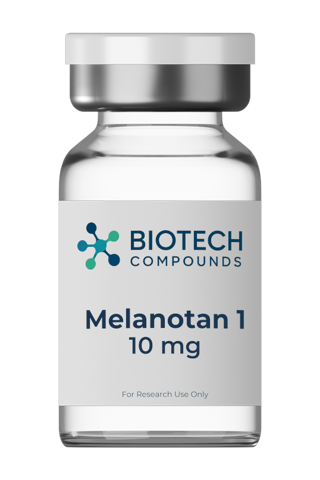
Research Compound
Melanotan 1
Melanotan 1 (Afamelanotide) is a synthetic 13-amino acid linear peptide analog of a-MSH, available as a lyophilized powder for laboratory research.
Select Size
10mg
SKU: MT1
Batch: 202510-01-MT1
$42.99
Ships today if ordered by 4PM EST
Est. Arrival: 09/18/2026
Volume Discounts
Qty: 1 - 4$42.99 each
Qty: 5 - 9$38.69 each(save $4.30)
Qty: 10+$34.39 each(save $8.60)
Quantity:
1
For Research Use Only. This product is intended for laboratory and scientific research purposes only. It is not a drug or dietary supplement and is not for human or veterinary consumption. Not intended to diagnose, treat, cure, or prevent any disease.
99%+ Purity
COA Included
Fast Shipping
USA Based
Product Details
Melanotan 1 (Afamelanotide) is a synthetic 13-amino acid linear a-MSH analog: [Nle4, D-Phe7]-a-MSH. Contains norleucine at position 4 and D-phenylalanine at position 7 vs native a-MSH.
These substitutions increase potency and stability. Linear peptide structure distinguishes it from cyclic Melanotan 2. Classified as melanocortin receptor agonist. Soluble in sterile water or bacteriostatic water. Store at -20°C.
Disclaimer: For laboratory and research purposes only. Not intended for human consumption.
Frequently Asked Questions About Melanotan 1
Answers summarize published research and are provided for laboratory research purposes only.
Melanotan 1, also known as afamelanotide, is a synthetic 13 amino acid linear analog of alpha melanocyte stimulating hormone. It carries a norleucine at position 4 and a D-phenylalanine at position 7, written as [Nle4, D-Phe7]-alpha-MSH. Research studies have examined Melanotan 1 primarily for melanogenesis, the process that produces the pigment melanin, and for photoprotection in skin models.
In research studies, Melanotan 1 has been observed to act as an agonist at the melanocortin 1 receptor, MC1R, which is expressed on melanocytes. Researchers have reported that receptor activation raises cyclic AMP inside the cell and increases tyrosinase activity, the enzyme that drives melanin synthesis. Published research suggests that the two amino acid substitutions in Melanotan 1 make it more potent and more resistant to enzymatic breakdown than native alpha MSH.
Pigmentation is the main research area for Melanotan 1. In cell culture, researchers have reported that Melanotan 1 increases melanin production in cultured melanocytes. In animal models and early human studies, investigators observed darkening of skin after exposure to the compound, and published research describes an increase in eumelanin, the brown black form of melanin, rather than the red yellow pheomelanin.
A second research area for Melanotan 1 is photoprotection. Research studies have shown that eumelanin absorbs ultraviolet light and scavenges free radicals, and investigators have examined whether raising eumelanin with Melanotan 1 reduces ultraviolet induced DNA damage in skin cells. In vitro studies have also reported that MC1R activation influences DNA repair pathways independently of pigment, which remains an active line of research.
Melanotan 1 has a longer research record than most synthetic peptides. It has been studied in cell culture, in animal models, and in clinical trials, and a pharmaceutical implant form of afamelanotide has been approved by regulators in some regions as a prescription product. That approved product is a separate regulated formulation and is not what Biotech Compounds sells. Melanotan 1 from Biotech Compounds is a research grade lyophilized powder.
Melanotan 1 and Melanotan 2 are both synthetic alpha MSH analogs, but they differ in structure and receptor profile. Melanotan 1 is a 13 amino acid linear peptide that research has characterized as relatively selective for MC1R, the pigmentation receptor. Melanotan 2 is a smaller cyclic heptapeptide, and research studies have shown that it activates MC1R, MC3R, MC4R, and MC5R. Because of this broader activity, Melanotan 2 has been studied for effects beyond pigmentation in animal models.
Melanotan 1 is supplied as a lyophilized powder that is soluble in sterile water or Bacteriostatic Water. To reconstitute, the chosen diluent is added slowly along the inside wall of the vial rather than sprayed directly onto the powder. The vial is then swirled gently until the solution is clear. Shaking is avoided because agitation can damage peptide structure. Bacteriostatic Water is available from Biotech Compounds as a companion product.
Lyophilized Melanotan 1 should be stored at minus 20 C, protected from light and moisture, and kept sealed until the vial has warmed to room temperature. Once reconstituted, Melanotan 1 should be stored in a refrigerator at 2 to 8 C and protected from light. Freezing reconstituted solution in single use aliquots is an option, but repeated freeze thaw cycles should be avoided. Published research describes Melanotan 1 as more stable than native alpha MSH.
Yes. Melanotan 1 from Biotech Compounds is supplied at 99 percent or greater purity. Each lot is third-party tested to confirm identity and purity, and a Certificate of Analysis is posted on the Melanotan 1 product page. Researchers can review the certificate before purchase to confirm that the material meets the requirements of their protocol.
Melanotan 1 has a molecular formula of C78H111N21O19 and a molecular weight of approximately 1646.9 g/mol. It is a 13 amino acid linear peptide. These figures are listed in the specifications on the Melanotan 1 product page and repeated on the Certificate of Analysis that accompanies each lot.
Native alpha MSH is broken down quickly by enzymes and has a methionine that is easily oxidized. Melanotan 1 replaces that methionine at position 4 with norleucine, which does not oxidize, and replaces L-phenylalanine at position 7 with the D form, which resists protease cleavage. Research studies have shown that these two changes give Melanotan 1 greater potency at MC1R and a longer duration of activity than native alpha MSH.
No. The Melanotan 1 sold by Biotech Compounds is not an approved drug and is not a dietary supplement. It is sold strictly as a research material for laboratory research by qualified researchers and research organizations. Purchasers must be 21 years of age or older. Melanotan 1 is not for human or animal consumption and is not intended for any therapeutic, diagnostic, or clinical application.
You May Also Like