Research Compound
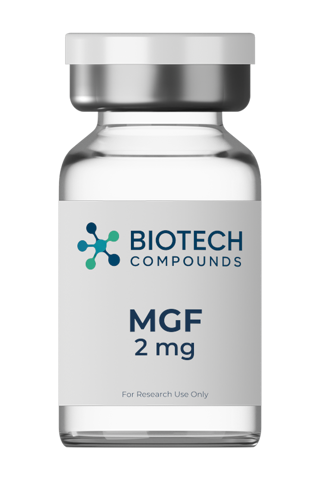
MGF
MGF (Mechano Growth Factor) is a synthetic peptide corresponding to the E domain splice variant of IGF-1, available as a lyophilized powder for laboratory research.
Select Size
2mg
SKU: FM2
Batch: 202512-01-MGF
$42.99
Ships today if ordered by 4PM EST
Est. Arrival: 09/18/2026
Volume Discounts
Qty: 1 - 4$42.99 each
Qty: 5 - 9$38.69 each(save $4.30)
Qty: 10+$34.39 each(save $8.60)
Quantity:
1
For Research Use Only. This product is intended for laboratory and scientific research purposes only. It is not a drug or dietary supplement and is not for human or veterinary consumption. Not intended to diagnose, treat, cure, or prevent any disease.
99%+ Purity
COA Included
Fast Shipping
USA Based
Product Details
MGF (Mechano Growth Factor) corresponds to the E domain of IGF-1Ec splice variant. 24-amino acid C-terminal sequence unique to this splice variant.
Arises from alternative splicing of IGF-1 gene exons 4, 5, and 6. Differs from E domains of other IGF-1 isoforms. Unmodified MGF has relatively short half-life. Soluble in sterile water or bacteriostatic water. Store at -20°C.
Disclaimer: For laboratory and research purposes only. Not intended for human consumption.
Frequently Asked Questions About MGF
Answers summarize published research and are provided for laboratory research purposes only.
MGF, short for Mechano Growth Factor, is a synthetic peptide that reproduces the E domain of the IGF-1Ec splice variant. It is a 24 amino acid sequence produced when exons 4, 5, and 6 of the IGF-1 gene are spliced in an alternative pattern. Research studies have examined MGF primarily in skeletal muscle, where it is expressed after mechanical loading, and secondarily in cardiac and nerve tissue models.
In research studies, MGF has been observed to act differently from mature IGF-1. Researchers have reported that the E domain peptide activates muscle satellite cells and promotes their proliferation, while delaying their fusion into mature fibers. Published research suggests that this activity does not depend on the classic IGF-1 receptor, and in vitro studies have examined alternative signaling routes. The exact receptor for MGF has not been conclusively identified.
Skeletal muscle is the main research area for MGF. In rodent studies, researchers reported that MGF expression rises sharply after stretch or resistance loading and precedes the rise in systemic IGF-1. Animal models have been used to examine whether MGF increases muscle fiber size and speeds repair after damage, and cell culture work has looked at satellite cell activation. These studies form the basis of ongoing MGF research.
Beyond skeletal muscle, MGF has been studied in cardiac and nervous tissue. In animal models, researchers have reported that the MGF E domain peptide reduced loss of heart muscle cells after experimentally induced injury, and other studies examined MGF for neuroprotective activity in models of nerve damage. In vitro work has also looked at MGF in bone and cartilage cell cultures. These lines of research are earlier stage than the muscle work.
MGF research rests on cell culture experiments and animal models, mostly rodent studies, along with human muscle biopsy studies that measured natural MGF expression after exercise. There are no clinical trials of synthetic MGF as a product, and it is not an approved drug anywhere. MGF is considered an investigational research compound, and results from animal models cannot be assumed to transfer to other settings.
MGF and IGF-1 LR3 both derive from the IGF-1 gene but are very different research tools. IGF-1 LR3 is a full length analog of mature IGF-1 that acts through the IGF-1 receptor, and research studies have shown that it has reduced binding to IGF binding proteins. MGF is only the 24 amino acid E domain peptide, and research reports that it works through a separate pathway focused on satellite cell activation. Biotech Compounds sells both as separate research materials.
MGF is supplied as a lyophilized powder that is soluble in sterile water or Bacteriostatic Water. To reconstitute MGF, the diluent is added slowly down the side of the vial so it does not hit the powder directly. The vial is swirled gently until the solution is clear and is never shaken. Because unmodified MGF has a short half-life, researchers usually reconstitute only what a protocol needs in the near term.
Lyophilized MGF should be stored at minus 20 C in a dark, dry location and allowed to reach room temperature before the vial is opened. After reconstitution, MGF should be refrigerated at 2 to 8 C, protected from light, and used promptly. Published research describes unmodified MGF as having a relatively short half-life in biological fluids, which is why a pegylated version, PEG-MGF, was developed for longer experiments. Repeated freeze thaw cycles should be avoided.
Yes. MGF from Biotech Compounds is supplied at 99 percent or greater purity, and each lot is third-party tested to confirm identity and purity. A Certificate of Analysis for MGF is available on the product page. Researchers can check the lot number on the vial against the certificate before beginning a study.
MGF has a molecular formula of C121H200N42O39 and a molecular weight of approximately 2948.4 Da. It is a 24 amino acid peptide corresponding to the C-terminal E domain of IGF-1Ec. These values are listed in the specifications on the MGF product page and appear on the Certificate of Analysis for each lot.
No. MGF is sometimes confused with TB-500 because both are studied in tissue repair, but they are unrelated. MGF is an E domain splice variant peptide of IGF-1 that research has linked to satellite cell activation in muscle. TB-500 is Thymosin Beta-4, a 43 amino acid actin binding protein fragment that researchers have studied for cell migration and wound models. They come from different genes and act through different reported mechanisms.
No. MGF is not an approved drug and is not a dietary supplement. Biotech Compounds sells MGF strictly as a research material for laboratory research by qualified researchers and research organizations. Purchasers must be 21 years of age or older. MGF is not for human or animal consumption and is not intended for any therapeutic, diagnostic, or clinical application.
You May Also Like