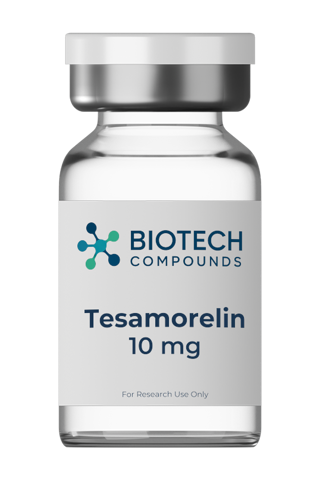
Research Compound
Tesamorelin
Tesamorelin is a synthetic 44-amino acid peptide consisting of GHRH(1-44) with N-terminal trans-3-hexenoic acid modification, available as a lyophilized powder for laboratory research.
Select Size
10mg
SKU: TSM10
Batch: 202609-01-TSM
$53.99
Ships today if ordered by 4PM EST
Est. Arrival: 09/18/2026
Volume Discounts
Qty: 1 - 4$53.99 each
Qty: 5 - 9$48.59 each(save $5.40)
Qty: 10+$43.19 each(save $10.80)
Quantity:
1
For Research Use Only. This product is intended for laboratory and scientific research purposes only. It is not a drug or dietary supplement and is not for human or veterinary consumption. Not intended to diagnose, treat, cure, or prevent any disease.
99%+ Purity
COA Included
Fast Shipping
USA Based
Product Details
Tesamorelin is the full 44-amino acid human GHRH sequence with added trans-3-hexenoic acid at N-terminus for stability.
N-terminal modification protects from aminopeptidase degradation. Full-length 44-amino acid sequence distinguishes it from sermorelin (GHRH 1-29). Soluble in sterile water or bacteriostatic water. Store at -20°C.
Disclaimer: For laboratory and research purposes only. Not intended for human consumption.
Frequently Asked Questions About Tesamorelin
Answers summarize published research and are provided for laboratory research purposes only.
Tesamorelin is a synthetic 44 amino acid peptide made up of the full human GHRH(1-44) sequence with a trans-3-hexenoic acid group attached at the N-terminus. It belongs to the class of growth hormone releasing hormone analogs. Research studies have examined Tesamorelin for its activity at the GHRH receptor, its stability against enzymatic degradation, and its effects on growth hormone signaling and body composition in animal models and human clinical trials.
Research studies have shown that Tesamorelin binds and activates the GHRH receptor on pituitary somatotroph cells, a class B G-protein coupled receptor that signals through cAMP. Researchers have reported that this activation stimulates the pulsatile release of growth hormone in the models studied, which in turn raises IGF-1 signaling. Because Tesamorelin works upstream through the natural GHRH pathway, published research describes its effect as preserving the normal feedback control of the axis.
The primary research area for Tesamorelin has been the growth hormone axis and body composition. In clinical trials, researchers have reported that Tesamorelin reduced visceral adipose tissue in the study populations examined, with corresponding changes in IGF-1 levels. Animal model research has looked at how Tesamorelin alters growth hormone pulsatility over time. These studies position Tesamorelin as a reference GHRH analog for metabolic and endocrine research.
Secondary research on Tesamorelin has included cognitive and neuroscience studies. In clinical research involving older adults, researchers have examined Tesamorelin for effects on memory and executive function measures and reported changes in brain metabolite markers. Other laboratory work has used Tesamorelin in liver fat research and in studies of how GHRH analogs affect muscle tissue. These secondary areas are smaller literatures than the body composition work.
Tesamorelin is one of the better studied GHRH analogs. Evidence includes in vitro receptor assays, animal models, and multiple phase 3 clinical trials. A pharmaceutical form of tesamorelin has been approved as a prescription drug for a specific indication in some jurisdictions. The Tesamorelin sold by Biotech Compounds is a research grade lyophilized peptide, not that pharmaceutical product, and is supplied for laboratory investigation only.
Native GHRH is broken down quickly in circulation by aminopeptidases and by the enzyme DPP-4, which cleaves near the N-terminus. The trans-3-hexenoic acid group on Tesamorelin caps that end of the peptide. Research studies have shown that this modification protects Tesamorelin from aminopeptidase degradation and extends its activity compared with the unmodified GHRH sequence. It is the main structural reason Tesamorelin behaves differently from native GHRH in stability assays.
Tesamorelin and Sermorelin are both GHRH analogs but differ in length and stability. Tesamorelin is the full 44 amino acid GHRH sequence with an N-terminal hexenoic acid cap. Sermorelin is GHRH(1-29), a truncated 29 amino acid fragment without that modification. Research studies have reported that Sermorelin is degraded quickly by peptidases, while Tesamorelin resists that breakdown. Both activate the GHRH receptor in research models, so Tesamorelin is often the longer acting comparator in studies.
Tesamorelin is supplied as a lyophilized powder and is soluble in sterile water or Bacteriostatic Water. To reconstitute, the diluent is added slowly down the inner wall of the vial so it flows onto the Tesamorelin powder without splashing. The vial is then gently swirled or rolled until the solution is clear. Tesamorelin should never be shaken, since a 44 amino acid peptide is easily damaged by agitation and foaming.
Lyophilized Tesamorelin should be stored at minus 20 C in a sealed vial, protected from light and moisture. After reconstitution, Tesamorelin solution should be kept refrigerated at 2 to 8 C, protected from light, and used within a short period. Repeated freeze thaw cycles should be avoided. Pharmacokinetic research has reported that Tesamorelin has a short plasma half-life, so laboratory protocols generally prepare solution close to the time of the experiment.
Yes. Tesamorelin from Biotech Compounds is listed at 99 percent or higher purity and each lot is tested by an independent laboratory. The Certificate of Analysis for Tesamorelin is available on the product page and reports identity and purity results for the batch. Researchers should confirm the lot number on the Tesamorelin vial matches the posted COA before beginning an experiment.
Tesamorelin has a molecular weight of approximately 5135.9 g/mol and the molecular formula C221H366N72O67S. It is a 44 amino acid peptide, which makes Tesamorelin one of the larger peptides in the Biotech Compounds catalog. The single sulfur atom in the formula comes from the methionine residue in the GHRH sequence, and the hexenoic acid cap adds to the total mass relative to native GHRH.
Tesamorelin from Biotech Compounds is sold strictly as a research material for laboratory research by qualified researchers and research organizations. Purchasers must be 21 years of age or older. The research grade Tesamorelin sold here is not a drug or a dietary supplement, is not the approved pharmaceutical product, and is not for human or animal consumption. It is intended only for laboratory investigation.
You May Also Like