Research Compound

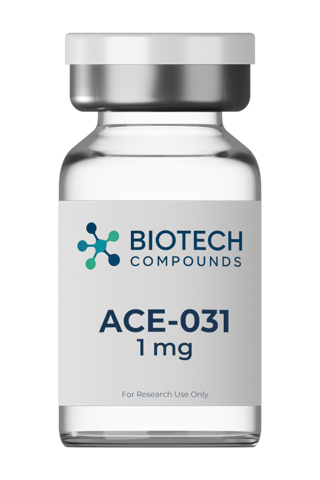
ACE-031

ACE-031 is a recombinant fusion protein consisting of ActRIIB extracellular domain fused to human IgG1 Fc domain, available as a lyophilized powder for laboratory research.

Select Size
1mg
SKU: AE1
Batch: 202601-01-AE
$129.99
Ships today if ordered by 4PM EST
Est. Arrival: 09/18/2026
Volume Discounts
Qty: 1 - 4$129.99 each
Qty: 5 - 9$116.99 each(save $13.00)
Qty: 10+$103.99 each(save $26.00)
Quantity:
1
For Research Use Only. This product is intended for laboratory and scientific research purposes only. It is not a drug or dietary supplement and is not for human or veterinary consumption. Not intended to diagnose, treat, cure, or prevent any disease.
99%+ Purity
COA Included
Fast Shipping
USA Based

Product Details

ACE-031 is a recombinant fusion protein linking the extracellular domain of human activin receptor type IIB (ActRIIB) to human IgG1 Fc domain, creating a soluble decoy receptor.


ActRIIB domain provides ligand-binding; Fc domain contributes stability and extends half-life through FcRn-mediated recycling. Exists as homodimer due to Fc dimerization. Store at -20°C to -80°C; avoid freeze-thaw cycles.


Disclaimer: For laboratory and research purposes only. Not intended for human consumption.

Frequently Asked Questions About ACE-031

Answers summarize published research and are provided for laboratory research purposes only.
ACE-031 is a recombinant fusion protein that joins the extracellular domain of human activin receptor type IIB, known as ActRIIB, to the Fc region of human IgG1. This structure makes ACE-031 a soluble decoy receptor. Research studies have examined ACE-031 primarily for its effect on skeletal muscle mass in animal models and in early clinical trials. Biotech Compounds supplies it as a lyophilized powder for laboratory research.
Research studies have shown that ACE-031 acts as a ligand trap. The ActRIIB portion binds circulating proteins such as myostatin, activin A, and other members of the TGF-beta family before they can reach the natural receptor on muscle cells. In animal models, researchers reported that blocking this signaling was associated with increased muscle growth, since myostatin normally limits muscle size.
The primary research area for ACE-031 is skeletal muscle biology. In rodent studies, researchers reported that ACE-031 was associated with rapid increases in muscle mass and strength across multiple muscle groups. The compound was later carried into clinical trials in a muscle-wasting disorder to test whether the same myostatin-pathway effect could be observed in a human research setting.
Yes. A secondary research area for ACE-031 is bone. In animal models, researchers reported that ACE-031 was associated with increased bone mineral density and bone formation, which is consistent with activin signaling playing a role in bone turnover. Researchers have also observed changes in fat mass in some rodent studies, so ACE-031 is sometimes described as a whole-body regulator of the activin pathway.
ACE-031 advanced through phase 1 studies in healthy volunteers and into a phase 2 trial before its clinical development program was discontinued. Researchers reported safety observations in those trials, including minor bleeding from the nose and gums and small dilated blood vessels in the skin, which led the sponsor to halt further dosing. ACE-031 remains an investigational compound and is not approved anywhere.
ACE-031 and Follistatin are both studied as myostatin-pathway blockers, but they differ in origin. Follistatin is a naturally occurring protein that research studies have shown binds activins and myostatin directly. ACE-031 is an engineered decoy receptor built from the ActRIIB binding domain and an IgG1 Fc tail. In research studies, the Fc region of ACE-031 was reported to extend its half-life well beyond that of the native receptor domain.
ACE-031 is supplied as a lyophilized powder. To reconstitute it, a researcher adds Bacteriostatic Water or a suitable sterile buffer slowly down the inside wall of the vial and then swirls gently until the powder dissolves. Because ACE-031 is a large protein, the vial should never be shaken, since shaking can cause the protein to unfold or aggregate. Solvent volume depends on the concentration needed for the assay.
Lyophilized ACE-031 should be stored frozen at minus 20 C to minus 80 C, protected from light and moisture. After reconstitution, the solution should be kept refrigerated at 2 to 8 C for short-term use or divided into single-use aliquots and frozen for longer holding. Repeated freeze and thaw cycles should be avoided because they can damage the Fc fusion structure and reduce binding activity.
Yes. ACE-031 from Biotech Compounds is listed at 99 percent or higher purity and is third-party tested. A Certificate of Analysis for the current lot is available on the ACE-031 product page so researchers can confirm identity and purity before beginning experiments. Lot-level testing helps a lab keep results consistent from one vial of ACE-031 to the next.
ACE-031 has an approximate molecular weight of 95 to 100 kDa. That size reflects its structure as a homodimer, since the two IgG1 Fc chains pair with each other and each carries an ActRIIB extracellular domain. A single molecular formula is not listed for ACE-031 because it is a recombinant glycoprotein rather than a small synthetic peptide with a fixed formula.
No. ACE-031 is not approved for human use and is sold strictly as a research material for laboratory research by qualified researchers and research organizations. Purchasers must be 21 years of age or older. ACE-031 is not a drug or dietary supplement, and it is not intended for human or animal consumption.