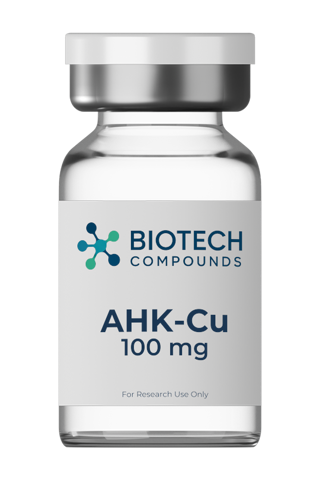
AHK-Cu
AHK-Cu is a tripeptide-metal complex in which the amino acid sequence alanine-histidine-lysine (Ala-His-Lys) is coordinated to a divalent copper ion, Cu(II). It is supplied as a lyophilized powder for in vitro coordination-chemistry and biochemical assay work, including UV-Vis and circular dichroism metal-binding studies, potentiometric determination of stability constants, copper-dependent oxidoreductase assays, and use as a reference standard for reversed-phase HPLC, LC-MS, and ICP-MS copper determination. For research and laboratory use only. Not a drug, dietary supplement, or medical device, and not for human or animal consumption.
Product Details
AHK-Cu is a tripeptide-metal complex composed of the amino acid sequence alanine-histidine-lysine (Ala-His-Lys) coordinated to a divalent copper ion, Cu(II). Copper chelation is facilitated primarily through the imidazole ring of the histidine residue together with the terminal amine and backbone amide nitrogen donors. It is supplied as a lyophilized powder for in vitro biochemical investigation and as an analytical reference material.
Coordination chemistry is the defining feature of the molecule. The Cu(II) center produces a characteristic d-d absorbance band in the visible region, which allows binding stoichiometry, coordination geometry, and stability constants to be determined by UV-Vis spectrophotometry, circular dichroism, electron paramagnetic resonance, and potentiometric titration. Because copper serves as a cofactor of several oxidoreductases, including superoxide dismutase and lysyl oxidase, AHK-Cu is also used in cell-free systems that measure metal transfer between ligands, redox cycling behavior, and copper-dependent enzyme activity.
In cultured-cell systems the complex has been used as a test article to measure defined laboratory endpoints: transcript and protein levels of extracellular matrix components such as collagen, elastin, and glycosaminoglycans quantified by qPCR and immunoassay; matrix metalloproteinase activity measured by gelatin zymography; fibroblast proliferation measured by MTT and BrdU incorporation assays; and TGF-beta pathway readouts assessed with SMAD-responsive reporter constructs. These are in vitro measurements described here for methodological reference only.
Typical analytical applications include reversed-phase HPLC purity determination, LC-MS and MALDI-TOF mass confirmation, amino acid analysis, and copper content determination by inductively coupled plasma mass spectrometry (ICP-MS) or atomic absorption spectroscopy. Store the lyophilized solid desiccated at -20 C and protected from light, and prepare working solutions in metal-free buffer to avoid competing chelation by buffer components.
Disclaimer: AHK-Cu is supplied strictly for research and laboratory use only. This product is not a drug, dietary supplement, or medical device. It is not intended for human or animal consumption, and not for therapeutic, diagnostic, or clinical application. It has not been evaluated by the FDA, and no statement here should be read as a claim to diagnose, treat, cure, or prevent any condition. All handling should be performed by qualified researchers in accordance with applicable laboratory safety protocols and institutional guidelines.
Frequently Asked Questions About AHK-Cu
Answers summarize published research and are provided for laboratory research purposes only.