Research Compound

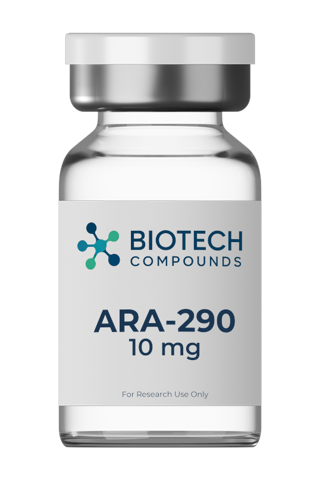
ARA-290

ARA-290 is a synthetic 11-amino acid peptide derived from the helix B surface region of erythropoietin (EPO), available as a lyophilized powder for laboratory research.

Select Size
10mg
SKU: RA10
Batch: 202609-01-RA
$43.99
Ships today if ordered by 4PM EST
Est. Arrival: 09/18/2026
Volume Discounts
Qty: 1 - 4$43.99 each
Qty: 5 - 9$39.59 each(save $4.40)
Qty: 10+$35.19 each(save $8.80)
Quantity:
1
For Research Use Only. This product is intended for laboratory and scientific research purposes only. It is not a drug or dietary supplement and is not for human or veterinary consumption. Not intended to diagnose, treat, cure, or prevent any disease.
99%+ Purity
COA Included
Fast Shipping
USA Based

Product Details

ARA-290 is a synthetic 11-amino acid linear peptide derived from the three-dimensional helix B surface region of erythropoietin. Sequence corresponds to spatial amino acid arrangement rather than contiguous primary sequence.


Designed to interact with the innate repair receptor (IRR), a heteroreceptor complex formed by EPOR and CD131 subunits. Soluble in sterile water or bacteriostatic water. Store at -20°C.


Disclaimer: For laboratory and scientific use only. Not intended for human consumption.

Frequently Asked Questions About ARA-290

Answers summarize published research and are provided for laboratory research purposes only.
ARA-290 is a synthetic 11-amino acid linear peptide derived from the helix B surface region of erythropoietin, also known as EPO. Its sequence follows the spatial arrangement of residues on that surface rather than a continuous stretch of the parent protein. ARA-290 is also known in the literature as cibinetide. Biotech Compounds supplies ARA-290 as a lyophilized powder for laboratory research.
Published research describes ARA-290 as a selective ligand for the innate repair receptor, a heteroreceptor complex formed by the EPO receptor and the CD131 subunit. Researchers have reported that ARA-290 engages this repair pathway without activating the classical EPO receptor homodimer that drives red blood cell production. That separation is the reason the peptide was designed.
The primary research area for ARA-290 is tissue protection and repair signaling through the innate repair receptor. In animal models, researchers have reported that ARA-290 was examined for its effects on small nerve fibers and on inflammatory signaling after tissue injury. Studies have also looked at the peptide in models of neuropathic pain and peripheral nerve fiber density.
Beyond nerve fiber research, ARA-290 has been studied in models of metabolic regulation, wound repair, and cardiac tissue protection. In rodent studies, researchers reported that ARA-290 was evaluated for its influence on glucose handling and on inflammatory markers. Cell culture work has also examined how ARA-290 interacts with immune cells that express the innate repair receptor.
Yes. ARA-290 has progressed beyond animal models into human clinical trials under the name cibinetide. Published phase 2 studies have examined the peptide in participants with small fiber nerve involvement, measuring symptom scores and nerve fiber density. ARA-290 remains an investigational compound and has not received regulatory approval as a medicine in any market.
ARA-290 and BPC-157 are both short peptides studied in tissue repair research, but they act through different pathways. ARA-290 is an EPO-derived 11-amino acid peptide that targets the innate repair receptor. BPC-157 is a 15-amino acid fragment from a gastric juice protein that research has linked to growth factor and nitric oxide signaling. BPC-157 has mostly animal data, while ARA-290 also has clinical trial data.
ARA-290 is supplied as a lyophilized powder and is soluble in sterile water or bacteriostatic water. To reconstitute ARA-290, the diluent is added slowly down the inside wall of the vial and the vial is swirled gently until the powder dissolves. Shaking should be avoided because agitation can damage the peptide structure. Bacteriostatic Water is available on the site for this purpose.
Lyophilized ARA-290 should be stored at -20 C, protected from light and moisture. Once reconstituted, ARA-290 should be refrigerated at 2 to 8 C and used within a limited window, with repeated freeze thaw cycles avoided. As a linear peptide without disulfide bonds, ARA-290 is relatively straightforward to handle, but it still benefits from minimal exposure to heat and light.
Yes. ARA-290 from Biotech Compounds is supplied at 99 percent or greater purity and is third-party tested. A Certificate of Analysis is available on the ARA-290 product page so researchers can review the purity data before use. Each lot of ARA-290 is tested to confirm identity and purity.
ARA-290 has a molecular weight of 1184.5 g/mol and a molecular formula of C54H99N17O15. It is an 11-amino acid peptide, which makes ARA-290 one of the smaller research peptides in the catalog. This low molecular weight is consistent with its origin as a surface fragment of the much larger erythropoietin protein.
No. ARA-290 from Biotech Compounds is sold strictly as a research material for laboratory research by qualified researchers and research organizations. Purchasers must be 21 years of age or older. ARA-290 is not a drug or a dietary supplement, and it is not intended for human or animal consumption in any form.