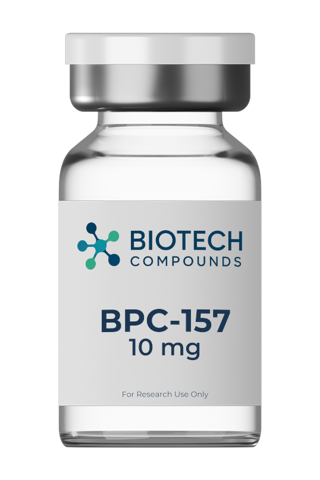
Research Compound
BPC-157
BPC-157 is a synthetic 15-amino acid peptide fragment derived from human gastric juice protein, available as a lyophilized powder for laboratory research.
Select Size
10mg
SKU: BC10
Batch: 202609-01-BC
$32.99
Ships today if ordered by 4PM EST
Est. Arrival: 09/18/2026
Volume Discounts
Qty: 1 - 4$32.99 each
Qty: 5 - 9$29.69 each(save $3.30)
Qty: 10+$26.39 each(save $6.60)
Quantity:
1
For Research Use Only. This product is intended for laboratory and scientific research purposes only. It is not a drug or dietary supplement and is not for human or veterinary consumption. Not intended to diagnose, treat, cure, or prevent any disease.
99%+ Purity
COA Included
Fast Shipping
USA Based
Product Details
BPC-157 is a synthetic 15-amino acid peptide: Gly-Glu-Pro-Pro-Pro-Gly-Lys-Pro-Ala-Asp-Asp-Ala-Gly-Leu-Val. Partial sequence of body protection compound from human gastric juice.
High proline content (three consecutive prolines at positions 3-5) introduces conformational constraints. Stable in gastric juice and resistant to acidic degradation. Soluble in sterile water or bacteriostatic water. Store at -20°C.
Disclaimer: For laboratory and research purposes only. Not intended for human consumption.
Frequently Asked Questions About BPC-157
Answers summarize published research and are provided for laboratory research purposes only.
BPC-157 is a synthetic 15-amino acid peptide, a pentadecapeptide, whose sequence is a fragment of a protective protein found in human gastric juice. The name stands for Body Protection Compound. Research studies have shown that BPC-157 has been examined mainly in models of soft tissue repair and gastrointestinal protection. Biotech Compounds supplies BPC-157 as a lyophilized powder for laboratory research.
Published research suggests that BPC-157 acts on several signaling systems rather than a single receptor. Researchers have reported that BPC-157 influences the nitric oxide system, upregulates growth factor receptors involved in new blood vessel formation, and modulates the expression of genes tied to tissue repair. In rodent studies, BPC-157 has been observed to interact with the dopamine and serotonin systems as well.
The primary research area for BPC-157 is musculoskeletal soft tissue repair. In animal models, researchers reported that BPC-157 was studied in models of tendon, ligament, and muscle injury, with attention to fibroblast migration and collagen organization. Rodent studies have also examined BPC-157 in bone healing models. This body of work is the main reason BPC-157 is one of the most requested research peptides.
Beyond soft tissue, BPC-157 has been studied in gastrointestinal research because of its origin in gastric juice. In research studies, BPC-157 has been observed in models of stomach and intestinal lining damage and in models of gut and vessel interaction. Researchers have also examined BPC-157 in nervous system models, including studies of nerve regeneration and behavioral responses in rodents.
Nearly all of the published evidence on BPC-157 comes from animal models, chiefly rodent studies, along with in vitro and cell culture work. Human clinical trial data on BPC-157 is very limited, and the compound is not approved as a medicine anywhere. Researchers reviewing BPC-157 literature should treat findings as preclinical and investigational rather than established.
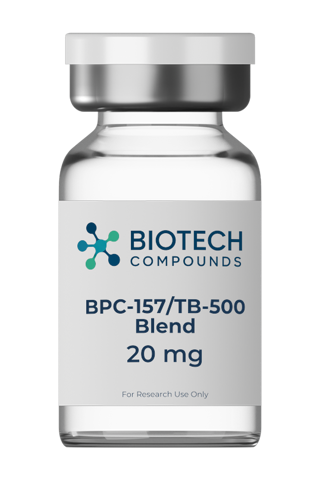
BPC-157 and TB-500 are both studied in tissue repair research but differ in origin and size. BPC-157 is a 15-amino acid fragment of a gastric juice protein. TB-500 is Thymosin Beta-4, a 43-amino acid protein found in nearly all cells that research has linked to actin regulation and cell migration. Biotech Compounds also offers the BPC-157/TB-500 Blend for protocols that study both together.
BPC-157 is supplied as a lyophilized powder and is soluble in sterile water or bacteriostatic water. The diluent is added slowly down the inside of the vial and the vial is swirled gently until the BPC-157 dissolves. It should never be shaken. The peptide is stable in acidic conditions, which research attributes to its origin in gastric juice, but gentle handling still preserves the solution best.
Lyophilized BPC-157 should be stored at -20 C, protected from light and moisture. After reconstitution, BPC-157 should be refrigerated at 2 to 8 C and protected from light, with repeated freeze thaw cycles avoided. Research has reported that BPC-157 is resistant to acidic degradation and remains stable in gastric juice, which distinguishes it from many other short peptides.
Yes. BPC-157 from Biotech Compounds is supplied at 99 percent or greater purity and is third-party tested. A Certificate of Analysis is available on the BPC-157 product page so researchers can review purity and identity results before beginning work. Each lot of BPC-157 is tested separately.
BPC-157 has a molecular weight of approximately 1419.5 g/mol and a molecular formula of C62H98N16O22. Its sequence is Gly-Glu-Pro-Pro-Pro-Gly-Lys-Pro-Ala-Asp-Asp-Ala-Gly-Leu-Val. The three consecutive proline residues at positions 3 to 5 give BPC-157 a constrained conformation that researchers have connected to its unusual stability.
No. BPC-157 from Biotech Compounds is sold strictly as a research material for laboratory research by qualified researchers and research organizations. Purchasers must be 21 years of age or older. BPC-157 is not a drug or a dietary supplement, and it is not intended for human or animal consumption.
You May Also Like