Research Compound

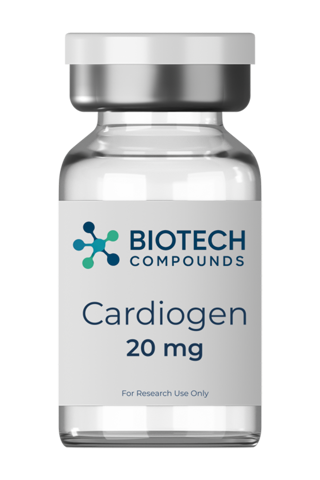
Cardiogen

Cardiogen is a synthetic tetrapeptide bioregulator (Ala-Glu-Asp-Arg) belonging to the Khavinson class of short regulatory peptides, studied for its tissue-specific effects on cardiac and cardiovascular cells.

Select Size
20mg
SKU: CA20
Batch: 202610-01-CA
$75.99
Ships today if ordered by 4PM EST
Est. Arrival: 09/16/2026
Volume Discounts
Qty: 1 - 4$75.99 each
Qty: 5 - 9$68.39 each(save $7.60)
Qty: 10+$60.79 each(save $15.20)
Quantity:
1
For Research Use Only. This product is intended for laboratory and scientific research purposes only. It is not a drug or dietary supplement and is not for human or veterinary consumption. Not intended to diagnose, treat, cure, or prevent any disease.
99%+ Purity
COA Included
Fast Shipping
USA Based

Product Details

Cardiogen is a water-soluble synthetic tetrapeptide with the amino acid sequence H-Ala-Glu-Asp-Arg-OH (AEDR), composed of alanine, glutamic acid, aspartic acid, and arginine. It belongs to the bioregulator class of short peptides developed by the Khavinson group at the St. Petersburg Institute of Bioregulation and Gerontology. Its small size and combination of acidic (Glu, Asp) and basic (Arg) residues are characteristic features explored in the context of cellular uptake and peptide interactions with intracellular and nuclear targets.


In preclinical and in vitro models, Cardiogen has been examined as a tissue-specific modulator of gene expression in cardiomyocytes and cardiac fibroblasts. Reported findings include modulation of fibroblast activity, upregulation of cytoskeletal and structural proteins (such as actin, vimentin, tubulin, and lamins), and effects on calcium-handling protein expression. It has been investigated as a model compound for studying short peptide–mediated regulation in cardiovascular tissue, age-related cardiac remodeling, and cellular repair and apoptosis pathways.


Disclaimer: This product is intended for laboratory and in vitro experimental use only. It is not a drug, food, or dietary supplement, and is not approved for human or veterinary use, including diagnosis, treatment, mitigation, or prevention of any disease. Not for human consumption.

Frequently Asked Questions About Cardiogen

Answers summarize published research and are provided for laboratory research purposes only.

Cardiogen is a synthetic tetrapeptide with the sequence Ala-Glu-Asp-Arg, written AEDR. It belongs to the bioregulator class of short regulatory peptides developed by the Khavinson group at the St. Petersburg Institute of Bioregulation and Gerontology. Cardiogen combines two acidic residues with one basic residue, a pattern researchers have explored in the context of cellular uptake. Biotech Compounds supplies Cardiogen as a lyophilized powder for laboratory research.
Research studies have described Cardiogen as a tissue-specific modulator of gene expression. In vitro studies have examined how the short peptide may enter cells and interact with intracellular and nuclear targets, a mechanism proposed for the Khavinson bioregulator class generally. Researchers have reported that Cardiogen influenced the expression of structural and signaling proteins in cardiac cell types rather than acting through a classical cell surface receptor.
The primary research area for Cardiogen is cardiac cell biology. In preclinical and in vitro models, researchers reported that Cardiogen was examined in cardiomyocytes and cardiac fibroblasts, with attention to fibroblast activity and the expression of cytoskeletal proteins such as actin, vimentin, tubulin, and lamins. Published research suggests Cardiogen has also been studied for effects on calcium-handling protein expression in heart tissue.
Beyond cardiomyocyte studies, Cardiogen has been investigated as a model compound for short peptide mediated regulation in cardiovascular tissue more broadly. In research studies, Cardiogen has been observed in models of age-related cardiac remodeling and in work on cellular repair and apoptosis pathways. Researchers have also used Cardiogen to study how tetrapeptides interact with DNA and chromatin in cell culture.
The evidence on Cardiogen comes from preclinical work, chiefly in vitro cell culture studies and tissue culture models, along with some animal model research from the Khavinson group. Human clinical trial data on Cardiogen is very limited. Cardiogen is not an approved medicine, and researchers should regard the published findings as investigational and preliminary.
Cardiogen and Vesugen are both Khavinson class bioregulator peptides sold by Biotech Compounds, but they target different tissues in research. Cardiogen is a tetrapeptide, AEDR, studied in cardiomyocyte and cardiac fibroblast models. Vesugen is a tripeptide that research has examined in vascular endothelial and blood vessel wall models. Laboratories studying the heart muscle itself choose Cardiogen; those studying vascular tissue choose Vesugen.
Cardiogen is supplied as a water-soluble lyophilized powder. Sterile water or bacteriostatic water is added slowly down the inside wall of the vial, and the vial is swirled gently until the Cardiogen dissolves. As a small tetrapeptide, Cardiogen dissolves readily, but shaking is still avoided as a matter of good practice. Bacteriostatic Water is available on the site as a diluent.
Lyophilized Cardiogen should be stored in a cool, dry, dark place, with -20 C preferred for long-term storage. After reconstitution, Cardiogen should be refrigerated at 2 to 8 C, protected from light, and not subjected to repeated freeze thaw cycles. Short peptides like Cardiogen are generally stable as dry powder, but prepared solutions should be used within a limited window.
Yes. Cardiogen from Biotech Compounds is supplied at 99 percent or greater purity and is third-party tested. A Certificate of Analysis is available on the Cardiogen product page so researchers can review identity and purity results before beginning work. Each lot of Cardiogen is tested independently.
Cardiogen has a molecular weight of approximately 489.49 g/mol and a molecular formula of C18H31N7O9. It is a four residue peptide composed of alanine, glutamic acid, aspartic acid, and arginine. This very low molecular weight places Cardiogen among the smallest peptides in the Biotech Compounds catalog, alongside the other Khavinson bioregulators.
No. Cardiogen from Biotech Compounds is sold strictly as a research material for laboratory research by qualified researchers and research organizations. Purchasers must be 21 years of age or older. Cardiogen is not a drug or a dietary supplement, and it is not intended for human or animal consumption.