Research Compound

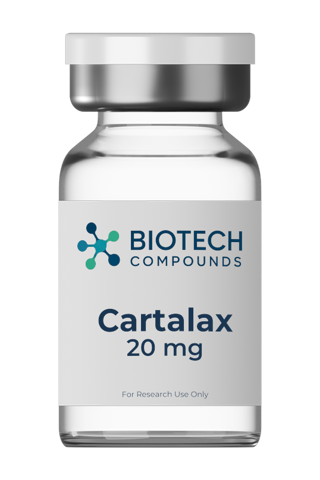
Cartalax

Cartalax is a synthetic ultrashort tripeptide (Ala-Glu-Asp) belonging to the Khavinson family of peptide bioregulators, studied primarily in cartilage and connective tissue model systems for its effects on fibroblast and chondrocyte activity.

Select Size
20mg
SKU: LAX20
Batch: 202610-01-LAX
$53.99
Ships today if ordered by 4PM EST
Est. Arrival: 09/18/2026
Volume Discounts
Qty: 1 - 4$53.99 each
Qty: 5 - 9$48.59 each(save $5.40)
Qty: 10+$43.19 each(save $10.80)
Quantity:
1
For Research Use Only. This product is intended for laboratory and scientific research purposes only. It is not a drug or dietary supplement and is not for human or veterinary consumption. Not intended to diagnose, treat, cure, or prevent any disease.
99%+ Purity
COA Included
Fast Shipping
USA Based

Product Details

Cartalax, also known as AED or T-31, is a synthetic tripeptide composed of the amino acid sequence Alanine-Glutamate-Aspartate. It is a tripeptide derivative originally developed in Russia and is classified among the Khavinson short-peptide bioregulators—a body of work investigating how 2–4 amino acid sequences may act as tissue-specific regulators that interact with DNA in the minor groove to influence gene expression without altering the underlying genetic code.


In published model systems, Cartalax has been examined for its influence on fibroblasts, which are found throughout cartilage, skin, blood vessels, and renal tissue. Investigations indicate it may affect cell proliferation and apoptosis through several molecular mechanisms, including increasing Ki-67 levels, decreasing p53 signaling, and modulating NF-κB signaling. Within the broader Khavinson framework, Cartalax has been investigated specifically for activity on chondrocytes—the cells responsible for producing and maintaining cartilage tissue—in preclinical models. It is structurally closely related to Sigumir (Ala-Glu-Asp-Arg), with which it has occasionally been studied in combination in joint-tissue protocols.


Cartalax has additionally been explored in the context of extracellular matrix regulation, tissue remodeling, and cellular senescence, and is frequently used as a defined, low-complexity peptide tool when tracking signaling and gene-expression markers in controlled in-vitro and preclinical setups.


Disclaimer: This product is intended strictly for laboratory and research use only. It is not for human consumption, not for diagnostic or therapeutic use, and not a drug, food, or dietary supplement. Not for use in humans or animals.

Frequently Asked Questions About Cartalax

Answers summarize published research and are provided for laboratory research purposes only.
Cartalax is a synthetic tripeptide with the sequence Ala-Glu-Asp, also listed as AED or T-31. It belongs to the Khavinson family of short peptide bioregulators developed in Russia. Research studies have examined Cartalax mainly in cartilage and connective tissue model systems, where researchers reported activity on fibroblasts and chondrocytes. Biotech Compounds supplies Cartalax as a lyophilized powder for laboratory research.
Published research on Khavinson bioregulators proposes that ultrashort peptides such as Cartalax bind DNA in the minor groove and influence gene expression without changing the genetic code. In cell culture studies, researchers reported that Cartalax was associated with higher Ki-67 levels, lower p53 signaling, and changes in NF-kB signaling. These reports describe proposed mechanisms observed in model systems rather than confirmed pathways.
Chondrocytes are the cells that produce and maintain cartilage tissue. In preclinical models, Cartalax has been investigated for tissue specific activity on chondrocytes, and researchers reported changes in cell proliferation and apoptosis markers. Within the Khavinson framework, Cartalax is treated as a cartilage directed bioregulator, and it has occasionally been studied alongside the related tetrapeptide Sigumir in joint tissue protocols.
Yes. Fibroblasts are found in cartilage, skin, blood vessels, and renal tissue. In published model systems, Cartalax has been examined for its influence on fibroblast proliferation and apoptosis. Research studies have also explored Cartalax in the context of extracellular matrix regulation, tissue remodeling, and cellular senescence, which is why Cartalax appears in aging focused peptide research programs.
The evidence base for Cartalax consists of in vitro cell culture work and preclinical model systems from the Khavinson bioregulator program. Researchers have used Cartalax as a defined, low complexity peptide tool for tracking signaling and gene expression markers. Cartalax has not been evaluated in large controlled clinical trials, and its reported effects remain investigational.
Cartalax and Cortagen are both Khavinson short peptide bioregulators, but they differ in sequence and target tissue. Cartalax is the tripeptide Ala-Glu-Asp studied in cartilage and connective tissue models. Cortagen is the tetrapeptide Ala-Glu-Asp-Pro, which research has associated with nervous tissue and neuronal metabolism. Researchers select between Cartalax and Cortagen based on the tissue system under study.
Cartalax is supplied as a lyophilized powder. In the laboratory, the vial is typically reconstituted with Bacteriostatic Water added slowly down the inside wall of the vial. The vial is then swirled gently until the Cartalax powder dissolves completely. Shaking should be avoided because agitation can damage peptide chains. Reconstitution volumes are chosen by the researcher based on the experimental design.
Lyophilized Cartalax should be kept in a cool, dry, dark place, and freezer storage is preferred for longer holding periods. After reconstitution, Cartalax should be refrigerated at 2 to 8 C and protected from light. Repeated freeze thaw cycles should be avoided. Short peptides of this size are generally stable when handled this way, but reconstituted solutions should be used within a short window.
Cartalax from Biotech Compounds is listed at 99 percent plus purity. Each lot is third party tested, and a Certificate of Analysis is available on the Cartalax product page so researchers can confirm identity and purity before use. Laboratories are encouraged to review the COA and keep it with their experimental records.
Cartalax has the molecular formula C12H19N3O8 and a molecular weight of approximately 333.29 g/mol. It is a three amino acid peptide composed of alanine, glutamic acid, and aspartic acid, which makes Cartalax one of the smallest peptides in the catalog. The low molecular weight is one reason researchers use Cartalax as a defined tool in gene expression studies.
No. Cartalax is sold strictly as a research material for laboratory research by qualified researchers and research organizations. Purchasers must be 21 or older. Cartalax is not a drug or dietary supplement, and it is not for human or animal consumption. Biotech Compounds supplies Cartalax for in vitro and preclinical investigation only.