Research Compound

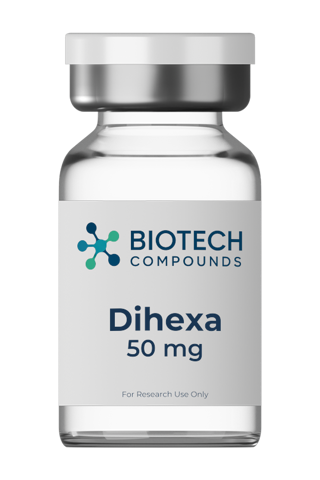
Dihexa

Dihexa is a synthetic oligopeptide derivative (N-hexanoic-Tyr-Ile-(6)-aminohexanoic amide), available as a lyophilized powder for laboratory research.

Select Size
10mg
SKU: DIH10
Batch: 202601-01-DIH
$53.99
Ships today if ordered by 4PM EST
Est. Arrival: 09/18/2026
Volume Discounts
Qty: 1 - 4$53.99 each
Qty: 5 - 9$48.59 each(save $5.40)
Qty: 10+$43.19 each(save $10.80)
Quantity:
1
For Research Use Only. This product is intended for laboratory and scientific research purposes only. It is not a drug or dietary supplement and is not for human or veterinary consumption. Not intended to diagnose, treat, cure, or prevent any disease.
99%+ Purity
COA Included
Fast Shipping
USA Based

Product Details

Dihexa (PNB-0408) is a synthetic oligopeptide: Hexanoyl-Tyr-Ile-Ahx-NH2. Two amino acids (Tyr, Ile) with N-terminal hexanoic acid cap and C-terminal 6-aminohexanoic acid amide.


Structurally derived from angiotensin IV. N-terminal hexanoyl and C-terminal modifications create more stable, lipophilic molecule. Characterized by oral bioavailability and ability to cross biological barriers. Due to lipophilic modifications, requires DMSO or organic solvent for initial dissolution. Not soluble in bacteriostatic water alone. May require mixed solvent systems.


Disclaimer: For laboratory and research purposes only. Not for human consumption.

Frequently Asked Questions About Dihexa

Answers summarize published research and are provided for laboratory research purposes only.
Dihexa, also known as PNB-0408, is a synthetic oligopeptide derivative with the structure Hexanoyl-Tyr-Ile-Ahx-NH2. It contains two amino acids, tyrosine and isoleucine, with an N-terminal hexanoic acid cap and a C-terminal 6-aminohexanoic acid amide. Dihexa is structurally derived from angiotensin IV. Research studies have examined Dihexa in rodent models of cognition and synaptic connectivity. Biotech Compounds supplies it as a lyophilized powder.
Published research reports that Dihexa binds hepatocyte growth factor, or HGF, and potentiates signaling through its receptor c-Met. In cell culture studies, researchers observed that Dihexa was associated with increased dendritic spine formation and new synaptic connections. Investigators describe Dihexa as an angiotensin IV derived molecule whose reported activity runs through the HGF and c-Met pathway rather than through angiotensin receptors.
The primary research area for Dihexa is cognitive neuroscience. In rodent studies, researchers reported that Dihexa was associated with improved performance in spatial learning and memory tasks, including in models of impaired cognition. These findings come from animal models and cell culture only. Dihexa remains an investigational compound used to study synaptogenesis and memory related signaling.
The N-terminal hexanoyl cap and the C-terminal aminohexanoic amide make Dihexa more stable and more lipophilic than the parent angiotensin IV fragment. Research studies have reported that these modifications gave Dihexa oral bioavailability and the ability to cross biological barriers, including the blood brain barrier, in animal models. This is a notable difference from most water soluble research peptides.
The evidence base for Dihexa consists of in vitro cell culture work and rodent studies from academic research laboratories. Dihexa has not been evaluated in human clinical trials and is not approved by the FDA or any other regulator. Its reported effects on synaptogenesis and cognition in animal models remain preclinical and investigational.
Dihexa and Semax are both studied in cognitive neuroscience, but they differ in structure and reported mechanism. Dihexa is a small lipophilic angiotensin IV derivative that research links to HGF and c-Met signaling. Semax is a water soluble heptapeptide derived from a fragment of ACTH, which researchers have associated with BDNF related pathways. Dihexa requires an organic solvent for dissolution, while Semax dissolves in water.
Dihexa is supplied as a lyophilized powder, but because of its lipophilic modifications it is not soluble in Bacteriostatic Water alone. Initial dissolution of Dihexa requires DMSO or another organic solvent, and a mixed solvent system may be needed to reach the final working concentration. The solvent is added slowly and the vial is swirled gently rather than shaken.
Lyophilized Dihexa should be stored in a cool, dry, dark place, with freezer storage preferred for longer holding periods. Once dissolved in DMSO or an organic solvent, Dihexa stock solutions should be kept frozen in small aliquots and protected from light. Repeated freeze thaw cycles should be avoided. Research reports describe Dihexa as a relatively stable molecule compared with unmodified peptides.
Dihexa from Biotech Compounds is listed at 99 percent plus purity. Each lot is third party tested, and a Certificate of Analysis is available on the Dihexa product page so researchers can confirm identity and purity before use. Laboratories are encouraged to review the COA and keep it with their experimental records.
Dihexa has the molecular formula C27H44N4O5 and a molecular weight of 504.66 g/mol. Its low molecular weight and hydrophobic caps set Dihexa apart from typical peptide chains. Because Dihexa contains only two natural amino acids plus synthetic end groups, researchers often describe it as a peptidomimetic small molecule rather than a conventional peptide.
No. Dihexa is sold strictly as a research material for laboratory research by qualified researchers and research organizations. Purchasers must be 21 or older. Dihexa is not a drug or dietary supplement, and it is not for human or animal consumption. Biotech Compounds supplies Dihexa for in vitro and preclinical investigation only.