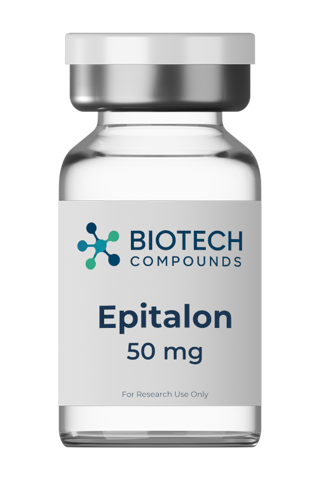
Research Compound
Epitalon
Epitalon is a synthetic tetrapeptide with the sequence Ala-Glu-Asp-Gly, available as a lyophilized powder for laboratory research.
Select Size
50mg
SKU: ET50
Batch: 202609-01-ET
$129.99
Ships today if ordered by 4PM EST
Est. Arrival: 09/18/2026
Volume Discounts
Qty: 1 - 4$129.99 each
Qty: 5 - 9$116.99 each(save $13.00)
Qty: 10+$103.99 each(save $26.00)
Quantity:
1
For Research Use Only. This product is intended for laboratory and scientific research purposes only. It is not a drug or dietary supplement and is not for human or veterinary consumption. Not intended to diagnose, treat, cure, or prevent any disease.
99%+ Purity
COA Included
Fast Shipping
USA Based
Product Details
Epitalon (Epithalon) is a synthetic tetrapeptide: Ala-Glu-Asp-Gly (AEDG). Four amino acids: L-alanine, L-glutamic acid, L-aspartic acid, and glycine.
Belongs to Khavinson peptides/bioregulators class. Two acidic amino acids (Glu, Asp) give net negative charge at physiological pH. Freely soluble in water and aqueous buffers. Store at -20°C.
Disclaimer: For laboratory and research purposes only. Not intended for human consumption.
Frequently Asked Questions About Epitalon
Answers summarize published research and are provided for laboratory research purposes only.
Epitalon, also written Epithalon, is a synthetic tetrapeptide with the sequence Ala-Glu-Asp-Gly, or AEDG. It belongs to the Khavinson family of short peptide bioregulators. Research studies have examined Epitalon mainly in the context of pineal gland function, melatonin rhythm, and telomere biology in cell culture and animal models. Biotech Compounds supplies Epitalon as a lyophilized powder for laboratory research.
In vitro studies have reported that Epitalon is associated with activation of telomerase and elongation of telomeres in cultured human cells. Published research from the bioregulator field also suggests that Epitalon interacts with the pineal gland and influences melatonin production in animal models. The two acidic residues in the AEDG sequence give Epitalon a net negative charge, which researchers have discussed in relation to its interaction with DNA and chromatin.
The primary research area for Epitalon is aging biology. In rodent studies and in cultured cells, researchers have reported findings related to telomere length, telomerase activity, and lifespan measures. Published research has also studied Epitalon in models of pineal function, where it has been observed to affect the nightly melatonin rhythm. These are laboratory findings, and Epitalon is supplied only for continued research.
Secondary research areas for Epitalon include retinal cell biology, where researchers have reported observations in animal models of retinal degeneration, and neuroendocrine regulation, where Epitalon has been examined for effects on gene expression in the pineal gland and other tissues. In vitro work has also looked at antioxidant enzyme activity in cultured cells exposed to Epitalon.
The evidence base for Epitalon comes from in vitro cell culture studies and animal models, together with a smaller body of older clinical observations published by the bioregulator research group that originated it. Epitalon is not an approved medicine, and its research remains investigational. Biotech Compounds supplies Epitalon so laboratories can continue to study these reported observations under controlled conditions.
Epitalon and Pinealon are both short Khavinson bioregulator peptides, but they differ in sequence and research focus. Epitalon is the tetrapeptide Ala-Glu-Asp-Gly and is most often studied for pineal function and telomere biology. Pinealon is the tripeptide Glu-Asp-Arg and has been studied primarily in models of brain cell function and oxidative stress. Both are supplied by Biotech Compounds as lyophilized powders for laboratory research.
Epitalon is supplied as a lyophilized powder that is freely soluble in water and aqueous buffers. To reconstitute, add Bacteriostatic Water or sterile water slowly down the inner wall of the vial, then swirl gently until the powder dissolves completely. Do not shake the vial. Because Epitalon dissolves readily, a clear solution normally forms within a short time at room temperature.
Store the sealed lyophilized Epitalon vial at -20 C in a dry, dark place. After reconstitution, keep the solution refrigerated at 2 to 8 C and protected from light. Avoid repeated freeze thaw cycles, and aliquot the solution if it will be used across several sessions. As a short tetrapeptide, Epitalon is reported to be relatively stable in solution when kept cold, but reconstituted material should still be used promptly.
Yes. Epitalon from Biotech Compounds is supplied at 99 percent or greater purity, and each lot is third-party tested for identity and purity by HPLC. The Certificate of Analysis for the lot is posted on the product page so researchers can review the analytical data before starting an experiment.
Epitalon has a molecular weight of approximately 390.35 g/mol and the molecular formula C14H22N4O9. It is a four-residue peptide made of L-alanine, L-glutamic acid, L-aspartic acid, and glycine. The two acidic side chains from glutamic acid and aspartic acid give Epitalon a net negative charge at physiological pH.
No. Epitalon is sold by Biotech Compounds strictly as a research material for laboratory research by qualified researchers and research organizations. Purchasers must be 21 or older. Epitalon is not a drug or dietary supplement, has not been approved by any regulatory agency, and is not for human or animal consumption.
You May Also Like