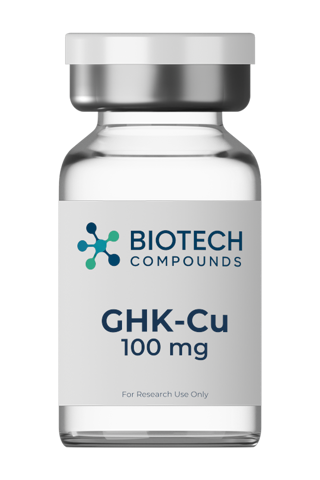
Research Compound
GHK-Cu
GHK-Cu is a tripeptide-copper complex consisting of glycine-histidine-lysine bound to a copper(II) ion, available as a lyophilized powder for laboratory research.
Select Size
100mg
SKU: CU100
Batch: 202609-01-CU
$43.99
Ships today if ordered by 4PM EST
Est. Arrival: 09/18/2026
Volume Discounts
Qty: 1 - 4$43.99 each
Qty: 5 - 9$39.59 each(save $4.40)
Qty: 10+$35.19 each(save $8.80)
Quantity:
1
For Research Use Only. This product is intended for laboratory and scientific research purposes only. It is not a drug or dietary supplement and is not for human or veterinary consumption. Not intended to diagnose, treat, cure, or prevent any disease.
99%+ Purity
COA Included
Fast Shipping
USA Based
Product Details
GHK-Cu is a tripeptide-copper complex: Gly-His-Lys coordinated to copper(II) ion. Copper binding occurs through histidine imidazole nitrogen and N-terminal amino group, forming stable 1:1 complex.
Provided as lyophilized powder with characteristic blue coloration. Soluble in sterile water or bacteriostatic water. Store at -20°C protected from light and moisture.
Disclaimer: For laboratory and research purposes only. Not intended for human consumption.
Frequently Asked Questions About GHK-Cu
Answers summarize published research and are provided for laboratory research purposes only.
GHK-Cu is a tripeptide-copper complex made of glycine, histidine, and lysine bound to a copper(II) ion in a stable 1:1 complex. The GHK sequence occurs naturally in human plasma. Research studies have examined GHK-Cu in models of skin biology, tissue repair, and gene expression. Biotech Compounds supplies GHK-Cu as a blue lyophilized powder for laboratory research.
In vitro studies have reported that GHK-Cu acts as a carrier that delivers copper to cells while the peptide portion signals through its own pathways. Research studies have observed that GHK-Cu is associated with increased collagen and glycosaminoglycan synthesis in cultured fibroblasts and with changes in the expression of many genes. The copper binds through the histidine imidazole nitrogen and the N-terminal amino group.
The primary research area for GHK-Cu is skin and connective tissue biology. In cell culture and animal models, researchers have reported that GHK-Cu is associated with fibroblast activity, collagen production, and remodeling of the extracellular matrix. Published research has also examined GHK-Cu in models of wound repair, where it has been studied for its effect on the speed and quality of tissue closure in animals.
Beyond skin, GHK-Cu has been studied in hair follicle models, where researchers have reported observations on follicle size and growth phase in animal and tissue studies. Gene expression research has examined how GHK-Cu changes the activity of genes linked to inflammation, antioxidant defense, and DNA repair in cultured cells. In vitro work has also looked at GHK-Cu in models of lung and nerve tissue.
The evidence for GHK-Cu comes from in vitro cell culture work, animal models, and a number of small clinical studies of topical cosmetic formulations. GHK-Cu is widely used as a cosmetic ingredient but is not an approved drug. Biotech Compounds supplies GHK-Cu only for laboratory research so that investigators can continue to study the reported observations under controlled conditions.
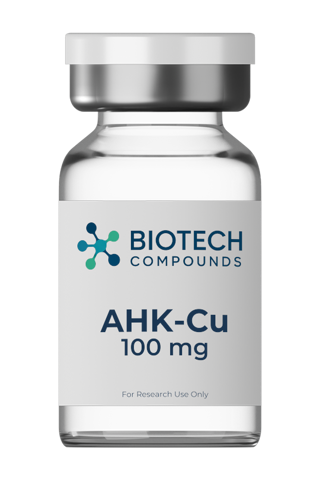
GHK-Cu and AHK-Cu are both copper tripeptide complexes, but their sequences differ. GHK-Cu is glycine-histidine-lysine bound to copper and is the more widely studied of the two, with research spanning skin, collagen, and gene expression. AHK-Cu is alanine-histidine-lysine bound to copper and has been studied mainly in hair follicle models. Both are available from Biotech Compounds as lyophilized powders for laboratory research.
GHK-Cu is supplied as a lyophilized powder that is soluble in sterile water or Bacteriostatic Water. Allow the vial to reach room temperature, then add the liquid slowly against the inner wall of the vial and swirl gently until fully dissolved. Do not shake. The reconstituted GHK-Cu solution has a characteristic blue color from the bound copper ion, which is normal and expected.
Store lyophilized GHK-Cu at -20 C, protected from light and moisture. After reconstitution, keep the solution refrigerated at 2 to 8 C, protect it from light, and avoid repeated freeze thaw cycles. Research on copper peptides has reported that the GHK-Cu complex is relatively stable in solution when kept cold, but a color change or cloudiness suggests the material should not be used.
The blue color of GHK-Cu comes from the copper(II) ion coordinated to the peptide. Copper(II) complexes with nitrogen donor ligands typically absorb light in a way that gives a blue or blue-violet appearance. In GHK-Cu the copper is held by the histidine imidazole nitrogen and the N-terminal amine of glycine, and this coordination is what produces the color in both the powder and the solution.
Yes. GHK-Cu from Biotech Compounds is supplied at 99 percent or greater purity. Each lot is third-party tested for identity and purity, and the Certificate of Analysis is available on the product page. Researchers can review the analytical results before using GHK-Cu in a cell culture or animal model experiment.
GHK-Cu has a molecular weight of approximately 404.0 Da and the molecular formula C14H24CuN6O4. The formula reflects the three amino acids glycine, histidine, and lysine plus one copper atom held in a 1:1 complex. GHK-Cu is also an ingredient in the Glow and KLOW blends sold by Biotech Compounds, where it is combined with BPC-157 and TB-500, which is Thymosin Beta-4.
No. GHK-Cu is sold by Biotech Compounds strictly as a research material for laboratory research by qualified researchers and research organizations. Purchasers must be 21 or older. GHK-Cu is not a drug or dietary supplement, has not been approved by any regulatory agency as a drug, and is not for human or animal consumption.
You May Also Like