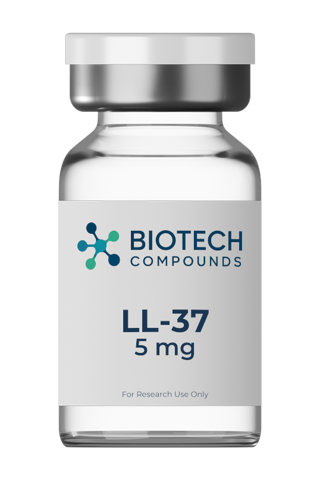
Research Compound
LL-37
LL-37 is a 37-amino acid peptide corresponding to the C-terminal portion of human cathelicidin (hCAP18), available as a lyophilized powder for laboratory research.
Select Size
5mg
SKU: 375
Batch: 202601-01-375
$43.99
Ships today if ordered by 4PM EST
Est. Arrival: 09/18/2026
Volume Discounts
Qty: 1 - 4$43.99 each
Qty: 5 - 9$39.59 each(save $4.40)
Qty: 10+$35.19 each(save $8.80)
Quantity:
1
For Research Use Only. This product is intended for laboratory and scientific research purposes only. It is not a drug or dietary supplement and is not for human or veterinary consumption. Not intended to diagnose, treat, cure, or prevent any disease.
99%+ Purity
COA Included
Fast Shipping
USA Based
Product Details
LL-37 is a 37-amino acid cationic peptide corresponding to amino acids 134-170 of hCAP18. Named for two N-terminal leucine residues. Characterized by amphipathic alpha-helical structure.
Only human cathelicidin family member. Adopts alpha-helix in membrane-mimetic environments with hydrophobic and cationic faces creating amphipathic character. Soluble in sterile water or dilute acetic acid. Store at -20°C.
Disclaimer: For laboratory and research use only. Not for human or veterinary use.
Frequently Asked Questions About LL-37
Answers summarize published research and are provided for laboratory research purposes only.
LL-37 is a 37 amino acid cationic peptide that corresponds to residues 134 to 170 of human cathelicidin, also called hCAP18. It is the only cathelicidin family member found in humans and takes its name from the two leucine residues at its N-terminus. Research studies have examined LL-37 mainly for antimicrobial activity, and published research has also explored its role in immune signaling and tissue repair models.
In research studies, LL-37 has been observed to fold into an amphipathic alpha helix when it contacts membrane like environments, with one hydrophobic face and one positively charged face. Researchers have reported that this structure lets LL-37 bind negatively charged microbial membranes and disrupt them. Published research also describes LL-37 interacting with host cell receptors, which is the basis for its reported immunomodulatory activity in vitro.
Antimicrobial activity is the primary research area for LL-37. In vitro studies have examined LL-37 against a wide range of bacteria, including both gram positive and gram negative species, and researchers have also reported activity against some fungi and enveloped viruses in cell culture. Published research has additionally looked at LL-37 in biofilm models, where it has been observed to interfere with biofilm formation on laboratory surfaces.
Beyond microbes, LL-37 has been studied in models of wound closure and immune regulation. In cell culture, researchers have reported that LL-37 influences keratinocyte and endothelial cell migration, and in animal models it has been examined for effects on re-epithelialization and new blood vessel formation. Published research also describes LL-37 acting as a chemoattractant for immune cells and modulating cytokine release in vitro.
Most of what is known about LL-37 comes from in vitro work, cell culture experiments, and animal models. Human data on LL-37 largely come from observational studies that measure the natural peptide in tissue and fluid samples rather than from trials of a synthetic product. LL-37 is not an approved drug anywhere, and its research status remains investigational. Findings from these models should not be extrapolated beyond the laboratory.
LL-37 and KPV are both studied in inflammation and barrier research, but they are very different molecules. LL-37 is a 37 amino acid antimicrobial peptide from human cathelicidin, and research has focused on its direct activity against microbes plus immune signaling. KPV is a three amino acid fragment of alpha MSH with no membrane disrupting activity, and research studies have examined it mainly for anti inflammatory signaling through melanocortin pathways. Biotech Compounds offers both as separate research materials.
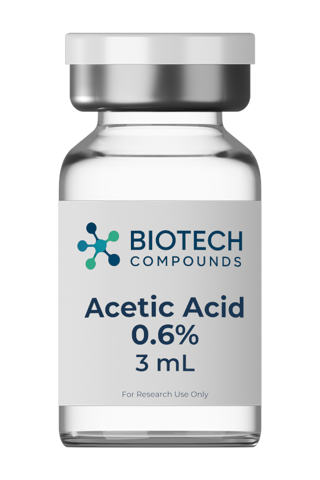
LL-37 is supplied as a lyophilized powder. For research preparation, the powder is dissolved in sterile water or dilute acetic acid, since the peptide is soluble in both. Biotech Compounds also carries Acetic Acid 0.6 percent as a reconstitution vehicle. The diluent should be added slowly down the inside of the vial and the vial swirled gently until the powder dissolves. Shaking should be avoided because LL-37 is a cationic peptide that can aggregate or foam under agitation.
Lyophilized LL-37 should be stored at minus 20 C in a dry, dark location, and the sealed vial should be allowed to reach room temperature before opening to avoid condensation. After reconstitution, LL-37 solutions should be refrigerated at 2 to 8 C and protected from light. Researchers commonly split reconstituted LL-37 into single use aliquots and freeze them, because repeated freeze thaw cycles are reported to reduce peptide integrity.
Yes. LL-37 from Biotech Compounds is supplied at 99 percent or greater purity, and each lot is third-party tested to confirm identity and purity. A Certificate of Analysis for LL-37 is available on the product page so researchers can review the test results before use and match the lot number on the vial to the certificate.
LL-37 has a molecular formula of C205H340N60O53 and a molecular weight of approximately 4493.33 g/mol. It contains 37 amino acids and carries a net positive charge at neutral pH because of its many lysine and arginine residues. These values are listed in the specifications on the LL-37 product page and on the Certificate of Analysis.
Cathelicidins are a family of host defense peptides that are stored as inactive precursors with a conserved cathelin domain. In humans the single cathelicidin precursor is hCAP18, and LL-37 is the active fragment released from its C-terminal end. Research studies have shown that this cleavage step is carried out by proteases and that LL-37 is the main mature form found in human tissue samples.
No. LL-37 is not an approved drug and is not a dietary supplement. Biotech Compounds sells LL-37 strictly as a research material for laboratory research by qualified researchers and research organizations. Purchasers must be 21 years of age or older. LL-37 is not for human or animal consumption and is not intended for any therapeutic, diagnostic, or clinical application.