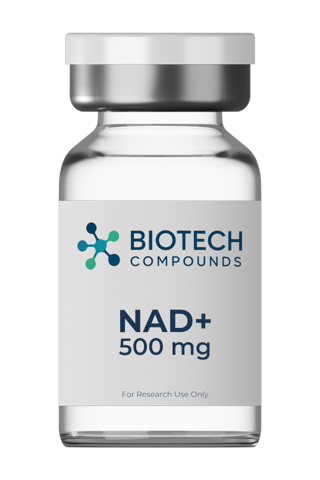
Research Compound
NAD+
NAD+ (Nicotinamide Adenine Dinucleotide) is a dinucleotide coenzyme, available as a lyophilized powder for laboratory research.
Select Size
500mg
SKU: NJ500
Batch: 202609-01-NAD
$37.99
Ships today if ordered by 4PM EST
Est. Arrival: 09/18/2026
Volume Discounts
Qty: 1 - 4$37.99 each
Qty: 5 - 9$34.19 each(save $3.80)
Qty: 10+$30.39 each(save $7.60)
Quantity:
1
For Research Use Only. This product is intended for laboratory and scientific research purposes only. It is not a drug or dietary supplement and is not for human or veterinary consumption. Not intended to diagnose, treat, cure, or prevent any disease.
99%+ Purity
COA Included
Fast Shipping
USA Based
Product Details
NAD+ (oxidized form) is a dinucleotide coenzyme: adenosine monophosphate (AMP) and nicotinamide mononucleotide (NMN) joined via phosphoanhydride bond.
Contains adenine base, two ribose sugars, two phosphate groups, and nicotinamide moiety. Electron carrier alternating between NAD+ and NADH forms. Soluble in water. Store at -20°C protected from light, oxygen, and moisture. Use reconstituted solutions promptly.
Disclaimer: For laboratory and research purposes only. Not intended for human consumption.
Frequently Asked Questions About NAD+
Answers summarize published research and are provided for laboratory research purposes only.
NAD+ is nicotinamide adenine dinucleotide in its oxidized form, a coenzyme found in every living cell. It is built from adenosine monophosphate and nicotinamide mononucleotide joined through a phosphoanhydride bond. Research studies have examined NAD+ as the central electron carrier of cellular metabolism, as a substrate for sirtuin and PARP enzymes, and as a molecule whose levels decline in aging models.
In research studies, NAD+ has been observed to shuttle electrons by cycling between its oxidized form, NAD+, and its reduced form, NADH. Researchers have reported that this cycle powers glycolysis, the citric acid cycle, and mitochondrial ATP production. Published research also describes NAD+ being consumed by sirtuins, PARP enzymes, and CD38, which link NAD+ availability to gene regulation, DNA repair, and cell signaling in cell culture and animal models.
Mitochondrial function is a primary research area for NAD+. In cell culture and animal models, researchers have reported that restoring NAD+ levels improves mitochondrial respiration and supports the activity of sirtuin enzymes that regulate mitochondrial biogenesis. Rodent studies have examined whether raising NAD+ reverses age related declines in muscle and other tissues. Published research suggests that the ratio of NAD+ to NADH is a key readout of metabolic state in these models.
Aging is a second major research area for NAD+. Research studies have shown that NAD+ levels fall with age in tissue samples from multiple species, and researchers have proposed that this decline contributes to reduced DNA repair and sirtuin activity. In animal models, investigators reported that boosting NAD+ extended healthspan measures such as endurance and metabolic markers. Clinical trials have mostly used NAD+ precursors, and these studies are ongoing.
NAD+ is one of the most extensively studied molecules in biochemistry, with decades of in vitro, cell culture, and animal model work. Human studies exist, but most clinical trials have examined NAD+ precursors such as nicotinamide riboside and nicotinamide mononucleotide rather than NAD+ itself. NAD+ is not an approved drug. Biotech Compounds supplies NAD+ as a research grade material for laboratory assays and models.
NAD+ and MOTS-c are both used in mitochondrial and aging research, but they are unrelated molecules. NAD+ is a dinucleotide coenzyme that carries electrons and feeds sirtuin and PARP enzymes. MOTS-c is a 16 amino acid peptide encoded in mitochondrial DNA that research studies have shown activates AMPK and regulates nuclear gene expression. Biotech Compounds offers both, and researchers sometimes examine them together in metabolic models.
NAD+ is supplied as a lyophilized powder that dissolves in water. For research preparation, sterile water or Bacteriostatic Water is added slowly and the vial is swirled gently until clear. NAD+ is hygroscopic, so the vial should be opened only after it has reached room temperature and should be closed promptly. NAD+ solutions are less stable than the dry powder, so researchers prepare fresh solutions and use them without delay.
Lyophilized NAD+ should be stored at minus 20 C and protected from light, oxygen, and moisture, all of which degrade it. After reconstitution, NAD+ should be refrigerated at 2 to 8 C, protected from light, and used promptly. Research literature reports that NAD+ in solution hydrolyzes over time, especially in alkaline conditions and at warmer temperatures, so long term storage of NAD+ solutions is not recommended and freeze thaw cycles should be avoided.
Yes. NAD+ from Biotech Compounds is supplied at 99 percent or greater purity, and each lot is third-party tested to confirm identity and purity. A Certificate of Analysis for NAD+ is available on the product page. Researchers can compare the lot number on the vial with the certificate before use.
NAD+ has a molecular formula of C21H27N7O14P2 and a molecular weight of approximately 663.4 g/mol. The molecule contains an adenine base, a nicotinamide group, two ribose sugars, and two phosphate groups. These values are listed in the specifications on the NAD+ product page and on the Certificate of Analysis.
No. NAD+ is not a peptide. It is a dinucleotide coenzyme made of nucleotides rather than amino acids, which is why it behaves differently from the peptides in the Biotech Compounds catalog. It is more sensitive to moisture and oxidation than most lyophilized peptides, and its solutions are less stable. Researchers working with NAD+ treat it more like a reagent for biochemical assays than like a signaling peptide.
No. NAD+ from Biotech Compounds is not an approved drug and is not a dietary supplement. It is sold strictly as a research material for laboratory research by qualified researchers and research organizations. Purchasers must be 21 years of age or older. NAD+ is not for human or animal consumption and is not intended for any therapeutic, diagnostic, or clinical application.
You May Also Like