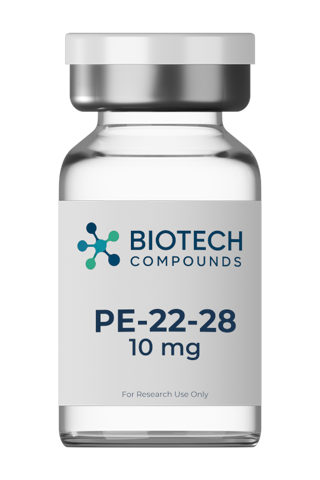
PE-22-28
PE-22-28 (Gly-Val-Ser-Trp-Gly-Leu-Arg) is a synthetic heptapeptide corresponding to residues 22-28 of the spadin sequence, making it a shortened spadin analog and the smallest fragment of that sequence characterized as retaining TREK-1 channel activity in vitro. CAS No.: 1801959-12-5. In electrophysiology and channel-binding assays it is described as a selective antagonist of the TREK-1 two-pore-domain potassium channel, with a reported in vitro IC50 on the order of 0.12 nM. Supplied as a lyophilized reference material for ion-channel pharmacology assays, cell-culture receptor studies, peptide-stability work, and HPLC or LC-MS/MS method development and purity determination. For research and laboratory use only; not for human or animal consumption.
Product Details
PE-22-28 is a seven-amino-acid synthetic peptide (Gly-Val-Ser-Trp-Gly-Leu-Arg) derived from spadin, a peptide cleaved from the propeptide region of sortilin. The sequence corresponds to the 22nd through 28th residues of spadin — the origin of its name — and was identified through screening of spadin degradation products as the minimal sequence characterized as retaining TREK-1 channel inhibitory activity in vitro. CAS No.: 1801959-12-5.
TREK-1 is a TWIK-related two-pore-domain potassium channel and a well-studied target in ion-channel pharmacology. In patch-clamp electrophysiology and channel-binding assays, PE-22-28 is characterized as a selective antagonist of this channel, with a reported in vitro IC50 on the order of 0.12 nM compared with roughly 40-60 nM for spadin measured under comparable conditions. Its reported stability in buffered laboratory matrices is likewise longer than that of spadin — on the order of 23 hours versus approximately 7 hours — a property relevant to the design of extended-timepoint assay protocols.
In cell-culture research the peptide is employed as a tool compound for probing two-pore-domain potassium channel pharmacology and for tracking expression of the postsynaptic density marker PSD-95 in cultured neuronal preparations. Because it is a short, well-defined single-sequence heptapeptide, it also serves as a convenient reference standard in reversed-phase HPLC and LC-MS/MS work, including retention-time matching, identity confirmation, purity determination, and peptide degradation and stability studies.
Disclaimer: PE-22-28 is supplied strictly for research and laboratory use only. This product is not a drug, dietary supplement, or medical device. It is not intended for human or animal consumption, and not for therapeutic, diagnostic, or clinical application. It has not been evaluated by the FDA, and no statement here should be read as a claim to diagnose, treat, cure, or prevent any condition. All handling should be performed by qualified researchers in accordance with applicable laboratory safety protocols and institutional guidelines.
Frequently Asked Questions About PE-22-28
Answers summarize published research and are provided for laboratory research purposes only.