Research Compound

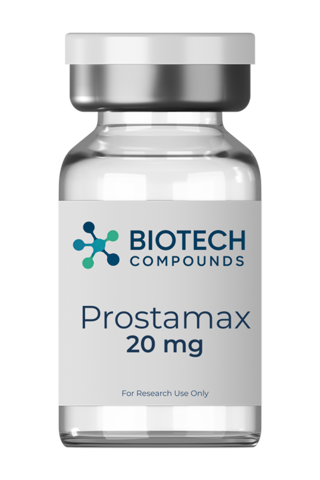
Prostamax

Prostamax (KEDP) is a synthetic short-chain tetrapeptide (Lys-Glu-Asp-Pro) belonging to the Khavinson class of tissue-specific peptide bioregulators, studied in connection with prostate and genitourinary tissue.

Select Size
20mg
SKU: MAX20
Batch: 202607-01-MAX
$161.99
Ships today if ordered by 4PM EST
Est. Arrival: 09/18/2026
Volume Discounts
Qty: 1 - 4$161.99 each
Qty: 5 - 9$145.79 each(save $16.20)
Qty: 10+$129.59 each(save $32.40)
Quantity:
1
For Research Use Only. This product is intended for laboratory and scientific research purposes only. It is not a drug or dietary supplement and is not for human or veterinary consumption. Not intended to diagnose, treat, cure, or prevent any disease.
99%+ Purity
COA Included
Fast Shipping
USA Based

Product Details

Prostamax is a defined-sequence synthetic tetrapeptide composed of lysine, glutamic acid, aspartic acid, and proline (Lys-Glu-Asp-Pro; KEDP). It is produced by solid-phase peptide synthesis and characterized as a member of the Khavinson family of short-peptide bioregulators originally developed for prostate-associated investigation.


Unlike receptor-mediated signaling peptides, Prostamax appears to function through structural modulation of the DNA-protein complex, with characterized activity centered on chromatin organization, gene expression, and tissue-specific cellular responses. It has been reported to activate ribosomal genes, decondense densely packed chromatin, and release genes repressed by age-specific chromatin condensation, with one model noting induced decondensation in chromosome 1 pericentromeric regions. These mechanisms position it as a tool for examining epigenetic regulation and chromatin dynamics in prostate cell cultures and lymphocyte-based systems. 


Disclaimer: This product is supplied strictly as a research compound for laboratory use only. Not for human consumption. Not a drug, food, or dietary supplement. Not intended to diagnose, treat, cure, or prevent any disease.

Frequently Asked Questions About Prostamax

Answers summarize published research and are provided for laboratory research purposes only.
Prostamax is a synthetic tetrapeptide with the sequence Lys-Glu-Asp-Pro, abbreviated KEDP. It is a member of the Khavinson family of short tissue-specific peptide bioregulators and is produced by solid-phase peptide synthesis. Research studies have examined Prostamax mainly in prostate cell cultures and in lymphocyte systems as a tool for studying chromatin organization and gene expression. Biotech Compounds supplies Prostamax as a lyophilized powder for laboratory research.
Unlike peptides that act through a cell surface receptor, Prostamax is thought to act on the DNA-protein complex directly. Researchers have reported that Prostamax can decondense tightly packed chromatin, activate ribosomal genes, and release genes that had become silenced by age-related chromatin condensation. In one lymphocyte model, investigators observed decondensation in the pericentromeric region of chromosome 1. This structural mechanism is why Prostamax is used in epigenetic research.
The primary research area for Prostamax is prostate and genitourinary tissue, which is the tissue the peptide was originally designed around. In cell culture studies, researchers have reported that Prostamax influenced proliferation and gene expression patterns in prostate cells, and animal studies in the bioregulator literature have described changes in prostate tissue structure and inflammatory markers. These studies treat Prostamax as a tissue-specific regulator rather than a drug candidate.
A second research area for Prostamax is chromatin dynamics in human lymphocyte cultures. In these in vitro studies, researchers reported that Prostamax caused visible decondensation of heterochromatin and reactivation of ribosomal RNA genes, particularly in cells from older donors where chromatin is more condensed. This work is used to investigate how short peptides may interact with DNA and whether age-related chromatin changes are reversible in a laboratory setting.
Most Prostamax evidence is preclinical. It comes from in vitro cell culture work, cytogenetic studies on lymphocytes, and a smaller number of rodent studies, largely published by Russian bioregulator research groups. Prostamax has not completed large controlled clinical trials and is not an approved drug in the United States. It is considered an investigational research compound, and researchers should treat published findings as early-stage.
Prostamax and Vesugen are both short Khavinson bioregulator peptides sold by Biotech Compounds, but they were built around different tissues. Prostamax is the tetrapeptide Lys-Glu-Asp-Pro and is studied in prostate and genitourinary tissue models. Vesugen is the tripeptide Lys-Glu-Asp and is studied in vascular endothelium models. The two share the Lys-Glu-Asp core, and researchers select one or the other based on the tissue system under investigation.
Prostamax comes as a lyophilized powder that dissolves readily in water. For laboratory use, Bacteriostatic Water is added slowly along the inside wall of the vial rather than sprayed directly onto the powder. The vial is then rotated gently until the solution is clear. Prostamax should never be shaken, since vigorous agitation can damage peptide bonds. Sterile technique and alcohol-wiped stoppers help keep the reconstituted Prostamax free of contamination.
Lyophilized Prostamax should be kept at minus 20 C in a sealed vial, away from light and moisture. After reconstitution, Prostamax should be refrigerated at 2 to 8 C, protected from light, and used within a limited period. Repeated freeze and thaw cycles should be avoided because they reduce peptide integrity. Handling the vial in a cool, dry laboratory environment helps Prostamax remain stable across a research course.
Yes. Prostamax from Biotech Compounds is listed at 99 percent or higher purity and is third-party tested to confirm identity and purity. A Certificate of Analysis is available on the Prostamax product page, letting researchers review lot-specific results before the peptide is used. This documentation supports reproducibility and gives research organizations a record for their internal quality process.
Prostamax has the molecular formula C20H33N5O9 and a molecular weight of approximately 487.5 g/mol. As a four-residue peptide it is a small, highly polar molecule, with a basic lysine at one end, two acidic residues in the middle, and a proline at the C-terminus. Researchers cite this compact, charged structure when discussing how Prostamax may pass into the nucleus and interact with chromatin.
No. Prostamax is not an approved drug and is not a dietary supplement. Biotech Compounds sells Prostamax strictly as a research material for laboratory research by qualified researchers and research organizations. Purchasers must be 21 years of age or older. Prostamax is not intended for human or animal consumption and is not intended to diagnose, treat, cure, or prevent any disease.