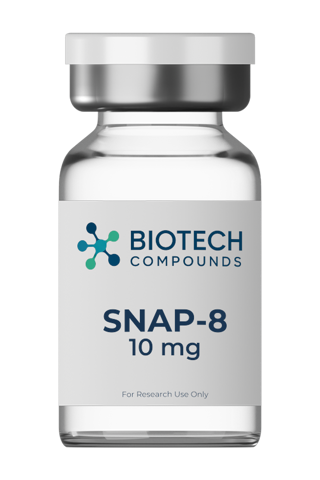
Research Compound
SNAP-8
SNAP-8 (Acetyl Octapeptide-3) is a synthetic octapeptide acetylated at the N-terminus, available as a lyophilized powder for laboratory research.
Select Size
10mg
SKU: NP810
Batch: 202610-01-NP8
$32.99
Ships today if ordered by 4PM EST
Est. Arrival: 09/18/2026
Volume Discounts
Qty: 1 - 4$32.99 each
Qty: 5 - 9$29.69 each(save $3.30)
Qty: 10+$26.39 each(save $6.60)
Quantity:
1
For Research Use Only. This product is intended for laboratory and scientific research purposes only. It is not a drug or dietary supplement and is not for human or veterinary consumption. Not intended to diagnose, treat, cure, or prevent any disease.
99%+ Purity
COA Included
Fast Shipping
USA Based
Product Details
SNAP-8 (Acetyl Octapeptide-3) is a synthetic eight-amino acid peptide with N-terminal acetylation. Elongated version of Argireline (Acetyl Hexapeptide-3) with two additional amino acids.
Belongs to synthetic signal peptides mimicking SNAP-25 protein segments. N-terminal acetylation caps amino terminus. Soluble in water. Store at -20°C protected from light and moisture.
Disclaimer: For laboratory and research purposes only. Not intended for human consumption.
Frequently Asked Questions About SNAP-8
Answers summarize published research and are provided for laboratory research purposes only.
SNAP-8, also called Acetyl Octapeptide-3, is a synthetic eight amino acid peptide capped with an acetyl group at the N-terminus. It is an elongated version of the hexapeptide Argireline with two additional residues. SNAP-8 belongs to a family of signal peptides that mimic a segment of the SNAP-25 protein. Research on SNAP-8 has centered on cosmetic and dermatological science, where in vitro studies have examined its influence on neurotransmitter release in cell models.
In vitro studies have reported that SNAP-8 mimics the N-terminal region of SNAP-25, a protein required for assembly of the SNARE complex. Researchers have described SNAP-8 competing for a position in that complex, which in cell models was observed to destabilize it and reduce vesicle docking. Published research suggests this lowers neurotransmitter release in the models tested. The peptide is studied as a topical signal molecule rather than a systemic compound.
The primary research area for SNAP-8 is cosmetic formulation science. Researchers have applied SNAP-8 to reconstituted skin models and cell cultures to measure its effect on muscle contraction signaling and on the appearance of expression lines in laboratory skin equivalents. In these studies SNAP-8 has been reported to act as a milder alternative to protein toxins that target the same SNARE machinery. The work is almost entirely in vitro and formulation based.
Beyond expression line models, SNAP-8 has been examined in formulation stability and skin penetration studies. Researchers have compared SNAP-8 with its shorter parent Argireline to see whether the two extra amino acids change potency in cell assays, and published research suggests the octapeptide showed stronger activity in some of those comparisons. Other laboratory work has looked at SNAP-8 in combination with other cosmetic peptides in topical delivery systems.
Evidence for SNAP-8 comes mainly from in vitro work, including cell culture assays that measure neurotransmitter release and reconstituted skin models. Some cosmetic formulation studies have used instrumental skin measurements on volunteer panels, but SNAP-8 is not an approved drug and has not gone through pharmaceutical clinical trials. Its status is that of a cosmetic research ingredient. Biotech Compounds supplies SNAP-8 as a research material for laboratory investigation only.
SNAP-8 and GHK-Cu are both studied in skin research but work through unrelated pathways. SNAP-8 is an acetylated octapeptide that in vitro studies have reported to interfere with SNARE complex assembly and neurotransmitter release. GHK-Cu is a copper binding tripeptide that researchers have associated with collagen synthesis and tissue remodeling signals in cell culture. SNAP-8 is a signaling mimic, while GHK-Cu is a copper carrier, so the two are often compared side by side in formulation research.
SNAP-8 is supplied as a lyophilized powder and is soluble in water. For laboratory use, Bacteriostatic Water or sterile water is added slowly down the inside wall of the vial rather than sprayed directly onto the powder. The vial is then rotated or gently swirled until the SNAP-8 dissolves into a clear solution. The vial should never be shaken, since agitation can damage peptide chains and produce foam.
Lyophilized SNAP-8 should be stored at minus 20 C, protected from light and moisture, and kept sealed until use. Once reconstituted, SNAP-8 solution should be refrigerated at 2 to 8 C, kept away from light, and used within a short window. Repeated freezing and thawing of the solution should be avoided. Cosmetic formulation research has reported that SNAP-8 is reasonably stable in aqueous systems compared with many longer peptides, which is one reason it is used in topical work.
Yes. SNAP-8 from Biotech Compounds is listed at 99 percent or higher purity and each lot is tested by an independent laboratory. The Certificate of Analysis for SNAP-8 is available on the product page and reports identity and purity results for the batch. Researchers are encouraged to review the COA and match the lot number on the vial before starting an experiment.
SNAP-8 has the molecular formula C41H65N9O10 and a molecular weight of approximately 867.0 g/mol. It is an octapeptide, meaning eight amino acids, with an acetyl cap on the N-terminus. The added acetyl group is what distinguishes Acetyl Octapeptide-3 from an unmodified octapeptide of the same sequence and is included to improve stability of the SNAP-8 molecule in formulation.
SNAP-8 from Biotech Compounds is sold strictly as a research material for laboratory research by qualified researchers and research organizations. Purchasers must be 21 years of age or older. SNAP-8 sold here is not a drug, a cosmetic, or a dietary supplement, and it has not been approved by any regulatory agency for human use. It is not for human or animal consumption or topical application outside of a laboratory setting.
You May Also Like