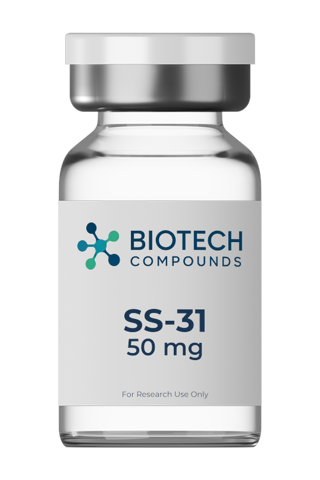
Research Compound
SS-31
SS-31 (Elamipretide) is a synthetic tetrapeptide classified as a mitochondria-targeting peptide, available as a lyophilized powder for laboratory research.
Select Size
50mg
SKU: 2S50
Batch: 202609-01-SS31
$99.99
Ships today if ordered by 4PM EST
Est. Arrival: 09/18/2026
Volume Discounts
Qty: 1 - 4$99.99 each
Qty: 5 - 9$89.99 each(save $10.00)
Qty: 10+$79.99 each(save $20.00)
Quantity:
1
For Research Use Only. This product is intended for laboratory and scientific research purposes only. It is not a drug or dietary supplement and is not for human or veterinary consumption. Not intended to diagnose, treat, cure, or prevent any disease.
99%+ Purity
COA Included
Fast Shipping
USA Based
Product Details
SS-31 (Elamipretide, Bendavia, MTP-131) is a synthetic tetrapeptide: D-Arg-2',6'-dimethyltyrosine(Dmt)-Lys-Phe-NH2. Features alternating aromatic and basic residues characteristic of Szeto-Schiller peptide family.
Contains D-arginine and non-natural Dmt. C-terminus amidated. Confers cell permeability and mitochondrial localization through cardiolipin interaction. Soluble in sterile water. Store at -20°C.
Disclaimer: For laboratory and research purposes only. Not intended for human consumption.
Frequently Asked Questions About SS-31
Answers summarize published research and are provided for laboratory research purposes only.
SS-31, also known as Elamipretide, Bendavia, or MTP-131, is a synthetic tetrapeptide from the Szeto-Schiller peptide family. Its sequence is D-Arg, dimethyltyrosine, Lys, Phe with an amidated C-terminus, an alternating pattern of aromatic and basic residues. SS-31 is classified as a mitochondria targeting peptide. Research studies have examined SS-31 in models of mitochondrial dysfunction, energy metabolism, and oxidative stress across cell culture and animal work.
Research studies have shown that SS-31 crosses cell membranes and concentrates on the inner mitochondrial membrane, where it binds cardiolipin, a phospholipid unique to that membrane. Researchers have reported that this cardiolipin interaction stabilizes cristae structure and the electron transport chain. In cell models, SS-31 has been observed to improve ATP production efficiency and reduce the formation of reactive oxygen species. The D-arginine and dimethyltyrosine residues are credited with cell permeability.
The main research focus for SS-31 has been mitochondrial bioenergetics in heart and skeletal muscle. In rodent models, researchers have reported that SS-31 preserved mitochondrial function in cardiac tissue subjected to ischemia and reperfusion. Animal studies of aging muscle have examined whether SS-31 restores mitochondrial respiration and exercise capacity. These studies treat SS-31 as a tool compound for understanding how cardiolipin integrity affects cellular energy supply.
Secondary research on SS-31 includes kidney models, retinal and ocular cell studies, and neuroscience work. In animal models, researchers have reported that SS-31 reduced markers of oxidative injury in kidney tissue after ischemic stress. Cell culture studies have examined SS-31 in retinal pigment epithelium exposed to oxidative challenge. Published research has also explored SS-31 in brain mitochondria, including models of age related decline in mitochondrial respiration.
Evidence for SS-31 spans in vitro cell culture, isolated mitochondria preparations, rodent and larger animal models, and human clinical trials. Under the name elamipretide, SS-31 has been studied in phase 2 and phase 3 clinical programs in mitochondrial research. It remains an investigational compound and is not an approved drug in the United States. Biotech Compounds supplies SS-31 as a research grade material for laboratory investigation of these mechanisms.
SS-31 and MOTS-c are both studied in mitochondrial research but differ in origin and mechanism. SS-31 is a synthetic tetrapeptide that research studies have shown binds cardiolipin on the inner mitochondrial membrane and stabilizes the electron transport chain. MOTS-c is a peptide encoded within mitochondrial DNA itself, and researchers have reported that it acts as a signaling molecule through AMPK related pathways in the cytoplasm and nucleus. SS-31 acts structurally, MOTS-c acts as a messenger.
SS-31 is supplied as a lyophilized powder and is soluble in sterile water. To reconstitute, Bacteriostatic Water or sterile water is added slowly along the inner wall of the vial so it runs down onto the SS-31 powder. The vial is then gently swirled or rolled until the solution is clear. The vial should not be shaken, because vigorous agitation can fragment the peptide and reduce the quality of the SS-31 solution.
Lyophilized SS-31 should be stored at minus 20 C in a sealed vial, protected from light and moisture. After reconstitution, SS-31 solution should be kept refrigerated at 2 to 8 C, protected from light, and used within a short period. Freeze thaw cycles of the reconstituted SS-31 should be avoided. Pharmacokinetic research has reported that SS-31 has a relatively short plasma half-life in animal models, which is why laboratory protocols prepare fresh solution when possible.
Yes. SS-31 from Biotech Compounds is listed at 99 percent or higher purity, and every lot is tested by an independent laboratory. The Certificate of Analysis for SS-31 is posted on the product page and documents identity and purity for that batch. Researchers should confirm the lot number on the SS-31 vial matches the COA before use in an experiment.
SS-31 has the molecular formula C32H44N6O8 and a molecular weight of approximately 628.7 g/mol. It is a tetrapeptide, meaning four amino acids, but two of those residues are non-natural: a D-arginine and a 2,6-dimethyltyrosine. The C-terminus of SS-31 is amidated. These modifications are the reason SS-31 resists rapid degradation by peptidases in the models where it has been studied.
No. SS-31 from Biotech Compounds is sold strictly as a research material for laboratory research by qualified researchers and research organizations. Purchasers must be 21 years of age or older. SS-31 sold here is not a drug or a dietary supplement, has not been approved by the FDA, and is not for human or animal consumption. It is intended only for in vitro and laboratory investigation.
You May Also Like