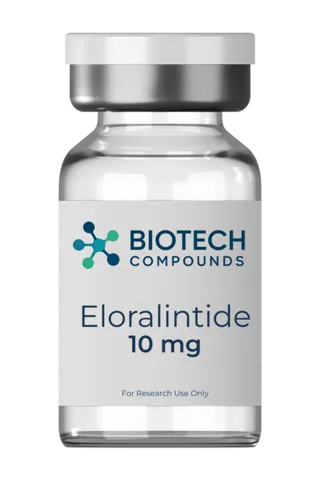
Eloralintide
Eloralintide is a synthetic 37-amino acid acylated analog of human amylin, classified as a selective amylin receptor agonist, available as a lyophilized powder for laboratory research.
Product Details
Eloralintide is a synthetic 37-amino acid analog of human amylin, the pancreatic islet hormone co-secreted with insulin from beta cells. It is supplied as a lyophilized powder for laboratory research.
Structure. The peptide is C-terminally amidated and constrained by a methylene bridge between Cys2 and Cys7 in place of the native disulfide. Ornithine at position 11, alpha-methyl-phenylalanine at position 15 and N-methyl-asparagine at position 22 replace the corresponding native residues to limit proteolysis and aggregation. A C20 fatty diacid is attached at Lys26 through a gamma-Glu-gamma-Glu linker, a lipidation strategy used to promote reversible serum albumin binding and prolong circulating exposure.
Receptor profile. Amylin receptors are heterodimers of the calcitonin receptor paired with a receptor activity modifying protein, giving AMY1R, AMY2R and AMY3R. Eloralintide behaves as a full agonist across the human receptor set with a reported EC50 of 23.9 pM at AMY1R and 253.8 pM at AMY3R, roughly 11 to 12 fold selectivity for AMY1R over AMY3R and over the unmodified calcitonin receptor. That receptor bias is the structural distinction from dual amylin and calcitonin receptor agonists, which engage the calcitonin receptor with comparable potency.
Research context. Amylin signaling in the area postrema and nucleus of the solitary tract is studied in connection with meal termination, satiation signaling, gastric emptying and glucagon regulation. Selective amylin receptor agonists are used to separate amylin-mediated effects from calcitonin receptor engagement, and to examine amylin pathway pharmacology alone or alongside incretin receptor agonist mechanisms in metabolic research models.
Handling. Molecular formula C201H319N49O65S2, molecular weight 4,526.10 g/mol, CAS 2883634-40-8. Purity 99 percent or greater by HPLC with a certificate of analysis. Store the sealed lyophilized vial at -20°C away from moisture and light. Reconstitute with bacteriostatic or sterile water directed against the inner wall of the vial, swirl gently rather than shaking, and hold reconstituted material at 2 to 8°C.
Frequently Asked Questions
What is Eloralintide?
Eloralintide is a synthetic 37-amino acid analog of human amylin engineered for selective activation of the amylin 1 receptor. It is supplied as a lyophilized research powder in a 10mg vial.
Eloralintide vs Cagrilintide: what is the difference?
Both are lipidated long-acting synthetic amylin analogs, and both carry a C20 fatty diacid for albumin binding, but they are built to different receptor targets. Cagrilintide is a 39-amino acid dual amylin and calcitonin receptor agonist, meaning it activates the amylin receptors and the calcitonin receptor at comparable potency. Eloralintide is a 37-amino acid selective amylin receptor agonist that favors AMY1R by roughly 11 to 12 fold over AMY3R and over the calcitonin receptor. Structurally, eloralintide keeps the native 37-residue amylin length with a methylene bridge replacing the Cys2-Cys7 disulfide plus three non-canonical residues, while cagrilintide extends the backbone to 39 residues and retains a Cys3-Cys8 disulfide. In published preclinical comparisons the selective profile tracked with less conditioned taste avoidance at a comparable body-weight effect, which is the mechanistic question most laboratory comparisons of the two compounds are designed to probe.
What is the molecular formula and molecular weight?
The molecular formula is C201H319N49O65S2 and the molecular weight is 4,526.10 g/mol. CAS number 2883634-40-8.
Why is Eloralintide described as selective?
Amylin receptors are formed when the calcitonin receptor pairs with a RAMP accessory protein, so the calcitonin receptor is the shared core and most amylin analogs also activate it. Eloralintide was optimized to preferentially activate the RAMP1-containing AMY1R complex, which lets investigators attribute an observed effect to amylin receptor signaling rather than to calcitonin receptor activity.
How should this material be stored and reconstituted?
Keep the sealed vial at -20°C, protected from moisture and light. Reconstitute with bacteriostatic or sterile water, adding the diluent slowly against the inner wall of the vial and swirling rather than shaking to avoid shearing the peptide. Hold the reconstituted solution at 2 to 8°C and avoid repeated freeze-thaw cycles.
Is a certificate of analysis included?
Yes. Every lot ships with third-party analysis covering identity, content and purity, and lot certificates are published on the Certificates of Analysis page.
Can Eloralintide be studied alongside incretin receptor agonists?
Amylin pathway pharmacology is frequently examined in parallel with GLP-1 and GIP receptor agonist mechanisms in metabolic research models, because the pathways act through distinct receptor families. Any such work is laboratory research only.
Is this product intended for human use?
No. This is a research chemical supplied for laboratory and scientific use only.
Disclaimer: For laboratory research purposes only. Not intended for human consumption. This material is not a drug, food or dietary supplement, is not approved for human, veterinary or household use, and is not intended to diagnose, treat, cure or prevent any disease.
Frequently Asked Questions About Eloralintide
Answers summarize published research and are provided for laboratory research purposes only.