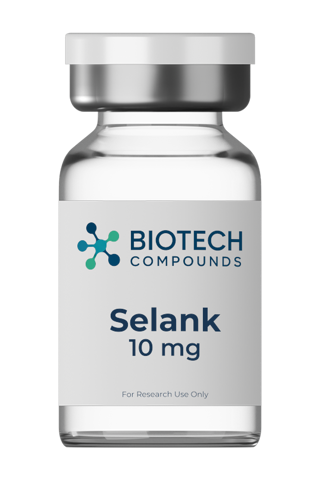
Research Compound
Selank
Selank is a synthetic heptapeptide consisting of tuftsin sequence with C-terminal Pro-Gly-Pro extension, available as a lyophilized powder for laboratory research.
Select Size
10mg
SKU: SK10
Batch: 202609-01-SK
$37.99
Ships today if ordered by 4PM EST
Est. Arrival: 09/18/2026
Volume Discounts
Qty: 1 - 4$37.99 each
Qty: 5 - 9$34.19 each(save $3.80)
Qty: 10+$30.39 each(save $7.60)
Quantity:
1
For Research Use Only. This product is intended for laboratory and scientific research purposes only. It is not a drug or dietary supplement and is not for human or veterinary consumption. Not intended to diagnose, treat, cure, or prevent any disease.
99%+ Purity
COA Included
Fast Shipping
USA Based
Product Details
Selank is a synthetic heptapeptide: Thr-Lys-Pro-Arg-Pro-Gly-Pro. Based on tuftsin (Thr-Lys-Pro-Arg) from IgG Fc region with added Pro-Gly-Pro extension.
The Pro-Gly-Pro motif (shared with Semax) alters stability and degradation profile. Multiple proline residues introduce conformational constraints. Soluble in sterile water or bacteriostatic water. Store at -20°C.
Disclaimer: For laboratory and research purposes only. Not intended for human consumption.
Frequently Asked Questions About Selank
Answers summarize published research and are provided for laboratory research purposes only.
Selank is a synthetic heptapeptide with the sequence Thr-Lys-Pro-Arg-Pro-Gly-Pro. It is built from tuftsin, a natural four amino acid fragment of the IgG antibody, with a Pro-Gly-Pro extension added to slow degradation. Research studies have examined Selank mainly in rodent models of anxiety-like behavior and secondarily in immune and cytokine studies. Biotech Compounds supplies Selank as a lyophilized powder for laboratory research.
Researchers have proposed several overlapping mechanisms for Selank. In rodent studies, Selank has been reported to modulate GABA receptor signaling and to change the expression of genes involved in GABAergic transmission. Published research also suggests that Selank inhibits enzymes that break down enkephalins, raising levels of these natural peptides, and that it increases brain-derived neurotrophic factor in brain tissue. These effects are the basis of its anxiolytic research profile.
The primary research area for Selank is anxiety-like behavior. In rodent studies using tests such as the elevated plus maze and open field, researchers reported that animals given Selank spent more time in exposed areas and showed fewer stress-related behaviors than controls. Clinical studies conducted in Russia have also examined Selank in human subjects and reported changes on anxiety rating scales, which led to its registration there.
Yes. Because Selank is derived from tuftsin, an immune-active peptide, a second research area looks at immune signaling. In vitro and animal studies have reported that Selank changes the expression of cytokine genes such as interleukin-6 and shifts the balance of T helper cell signaling. Researchers have also examined Selank in models of viral challenge, where it was observed to influence interferon-related gene expression.
Selank evidence comes from rodent behavioral studies, gene expression work in brain tissue, in vitro immune assays, and a number of human clinical studies performed in Russia, where Selank is registered as a nasal product. Selank is not an approved drug in the United States and has not been through the United States clinical trial process. Outside Russia it is considered an investigational research peptide.
Selank and Semax are both synthetic heptapeptides sold by Biotech Compounds that end in the same Pro-Gly-Pro stabilizing motif, but they come from different parent molecules. Selank is based on the immune peptide tuftsin and is studied mainly for anxiolytic and immune effects. Semax is based on a fragment of ACTH and is studied mainly for cognition, attention, and neuroprotection. Researchers often study them side by side because of their shared origin in Russian peptide research.
Selank is a lyophilized powder that dissolves in sterile water or Bacteriostatic Water. For laboratory preparation, the water is added slowly along the inside wall of the vial so the stream does not hit the powder. The vial is then swirled gently until the solution is clear. Selank should never be shaken. Cleaning the stopper with an alcohol wipe before each draw helps keep the reconstituted Selank free of contamination.
Lyophilized Selank should be kept at minus 20 C, sealed and protected from light and moisture. After reconstitution, Selank should be refrigerated at 2 to 8 C and protected from light. Repeated freeze and thaw cycles should be avoided. Research has reported that the Pro-Gly-Pro tail makes Selank more resistant to enzymatic breakdown than tuftsin itself, but that stability applies in biological fluid and does not replace cold storage in the laboratory.
Yes. Selank from Biotech Compounds is listed at 99 percent or higher purity and is third-party tested to confirm identity and purity. A Certificate of Analysis for Selank is available on the product page so researchers can check the results for the lot they receive. This documentation supports reproducible studies and gives research organizations a record for their quality files.
Selank has the molecular formula C33H57N11O9 and a molecular weight of approximately 751.9 g/mol. It contains seven amino acids, including three proline residues that introduce conformational rigidity into the chain. The basic lysine and arginine residues give Selank a positive net charge in solution, which researchers cite when explaining its solubility in water and its interaction with cell membranes.
No. Selank is not an approved drug in the United States and is not a dietary supplement. Biotech Compounds sells Selank strictly as a research material for laboratory research by qualified researchers and research organizations. Purchasers must be 21 years of age or older. Selank is not intended for human or animal consumption and is not intended to diagnose, treat, cure, or prevent any disease.
You May Also Like