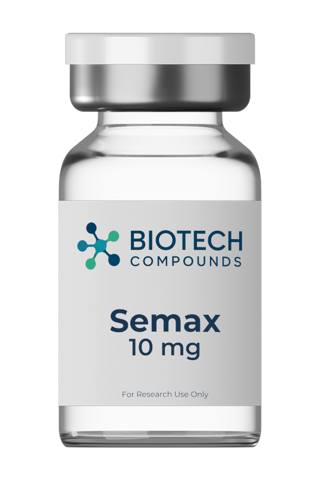
Research Compound
Semax
Semax is a synthetic heptapeptide derived from ACTH(4-10) fragment with C-terminal Pro-Gly-Pro extension, available as a lyophilized powder for laboratory research.
Select Size
10mg
SKU: XA10
Batch: 202609-01-XA
$32.99
Ships today if ordered by 4PM EST
Est. Arrival: 09/16/2026
Volume Discounts
Qty: 1 - 4$32.99 each
Qty: 5 - 9$29.69 each(save $3.30)
Qty: 10+$26.39 each(save $6.60)
Quantity:
1
For Research Use Only. This product is intended for laboratory and scientific research purposes only. It is not a drug or dietary supplement and is not for human or veterinary consumption. Not intended to diagnose, treat, cure, or prevent any disease.
99%+ Purity
COA Included
Fast Shipping
USA Based
Product Details
Semax is a synthetic heptapeptide: Met-Glu-His-Phe-Pro-Gly-Pro. Based on ACTH(4-10) fragment with added C-terminal Pro-Gly-Pro sequence for altered stability.
Contains phenylalanine, methionine (oxidation-susceptible), and distinctive Pro-Gly-Pro motif providing conformational constraints. Soluble in sterile water or bacteriostatic water. Store at -20°C protected from light; minimize air exposure.
Disclaimer: For laboratory and research purposes only. Not intended for human consumption.
Frequently Asked Questions About Semax
Answers summarize published research and are provided for laboratory research purposes only.
Semax is a synthetic heptapeptide with the sequence Met-Glu-His-Phe-Pro-Gly-Pro. It is derived from the 4 to 10 fragment of adrenocorticotropic hormone, ACTH, with a Pro-Gly-Pro tail added to slow its breakdown. Research studies have examined Semax mainly in models of memory, attention, and neuroprotection after reduced blood flow to the brain. Biotech Compounds supplies Semax as a lyophilized powder for laboratory research.
Researchers have reported that Semax keeps the neuroactive part of the ACTH fragment while losing the hormonal activity that would stimulate the adrenal glands. In rodent studies, Semax has been observed to raise levels of brain-derived neurotrophic factor and nerve growth factor and to increase expression of their receptors in brain tissue. Published research also suggests Semax modulates dopamine and serotonin signaling, which is cited to explain its effects on attention in animal models.
The primary research area for Semax is cognition. In rodent learning tasks, researchers reported that animals given Semax acquired conditioned responses faster and retained them longer than controls. Studies have also examined Semax in models of attention and reported changes in exploratory behavior and task performance. Clinical studies in Russia have evaluated Semax in human subjects on measures of attention and memory, contributing to its registration there.
Yes. A second major research area for Semax is neuroprotection. In rodent models of experimental brain ischemia, researchers reported that Semax changed the expression of genes involved in inflammation, vascular growth, and neuronal survival in the affected tissue. Clinical work in Russia has also examined Semax in patients after acute reduction in cerebral blood flow. These studies treat Semax as a tool for understanding neurotrophic signaling during injury.
Semax evidence comes from rodent behavioral studies, gene expression profiling in brain tissue, in vitro receptor work, and human clinical studies conducted in Russia, where Semax is registered as a nasal product. Semax is not an approved drug in the United States and has not gone through the United States clinical trial process. Outside Russia it is treated as an investigational research peptide.
Semax and Selank are companion heptapeptides sold by Biotech Compounds that share the same Pro-Gly-Pro stabilizing tail but come from different parents. Semax is derived from a fragment of ACTH and is studied for cognition, attention, and neuroprotection. Selank is derived from the immune peptide tuftsin and is studied for anxiolytic and immune effects. Because they were developed by the same Russian research institute, researchers frequently compare them in the same study designs.
Semax is a lyophilized powder that dissolves in sterile water or Bacteriostatic Water. The water is added slowly along the inside of the vial so it does not strike the powder directly, and the vial is swirled gently until the solution is clear. Semax should never be shaken. Because Semax contains a methionine residue that can oxidize, the vial should be opened briefly and air exposure kept to a minimum during preparation.
Lyophilized Semax should be stored at minus 20 C, sealed and protected from light. After reconstitution, Semax should be refrigerated at 2 to 8 C, kept in the dark, and used within a limited window. Repeated freeze and thaw cycles should be avoided. The methionine in Semax is sensitive to oxidation, so limiting headspace and air contact in the vial helps preserve the peptide during a research course.
Yes. Semax from Biotech Compounds is listed at 99 percent or higher purity and is third-party tested to verify identity and purity. A Certificate of Analysis for Semax is available on the product page so researchers can review lot-specific results before the peptide goes into a study. This documentation supports reproducible experiments and provides a quality record for research organizations.
Semax has the molecular formula C37H51N9O10S. The sulfur in the formula comes from the methionine residue at the N-terminus. Semax is a seven amino acid peptide with aromatic phenylalanine and histidine residues and a Pro-Gly-Pro motif that introduces conformational constraint into the chain. The exact molecular weight for the lot is reported on the Certificate of Analysis for Semax.
No. Semax is not an approved drug in the United States and is not a dietary supplement. Biotech Compounds sells Semax strictly as a research material for laboratory research by qualified researchers and research organizations. Purchasers must be 21 years of age or older. Semax is not intended for human or animal consumption and is not intended to diagnose, treat, cure, or prevent any disease.
You May Also Like