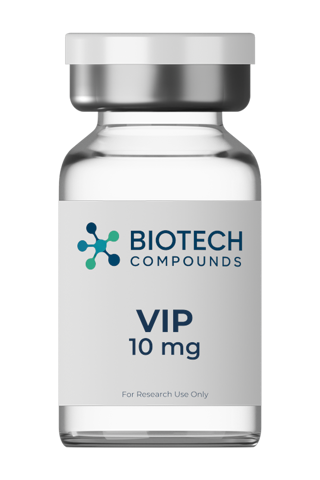
Research Compound
VIP
VIP (Vasoactive Intestinal Peptide) is a 28-amino acid neuropeptide, available as a lyophilized powder for laboratory research.
Select Size
10mg
SKU: VIP
Batch: 202601-01-VP
$75.99
Ships today if ordered by 4PM EST
Est. Arrival: 09/18/2026
Volume Discounts
Qty: 1 - 4$75.99 each
Qty: 5 - 9$68.39 each(save $7.60)
Qty: 10+$60.79 each(save $15.20)
Quantity:
1
For Research Use Only. This product is intended for laboratory and scientific research purposes only. It is not a drug or dietary supplement and is not for human or veterinary consumption. Not intended to diagnose, treat, cure, or prevent any disease.
99%+ Purity
COA Included
Fast Shipping
USA Based
Product Details
VIP is a 28-amino acid neuropeptide with C-terminal amidation. Belongs to glucagon/secretin superfamily with homology to secretin, glucagon, and PACAP.
Random coil N-terminal structure, alpha-helical C-terminal structure. VPAC1 and VPAC2 receptor agonist (class B GPCRs). Soluble in sterile water or bacteriostatic water. Store at -20°C.
Disclaimer: For laboratory and scientific use only. Not intended for human consumption.
Frequently Asked Questions About VIP
Answers summarize published research and are provided for laboratory research purposes only.
VIP, short for Vasoactive Intestinal Peptide, is a 28 amino acid neuropeptide with an amidated C-terminus. It belongs to the glucagon and secretin superfamily and shares sequence homology with secretin, glucagon, and PACAP. VIP is an agonist at the VPAC1 and VPAC2 receptors. Research studies have examined VIP in vascular and airway smooth muscle models, immune regulation, gut motility, and neuroscience, including the circadian clock.
Research studies have shown that VIP binds the VPAC1 and VPAC2 receptors, both class B G-protein coupled receptors, and raises intracellular cAMP. Researchers have reported that this signaling relaxes vascular and airway smooth muscle in tissue preparations, which is the origin of the vasoactive name. In immune cell culture, VIP has been observed to shift cytokine production toward an anti-inflammatory profile. Published research also describes VIP acting as a neurotransmitter in the gut and brain.
The primary research area for VIP is the vascular and pulmonary system. In animal models, researchers have reported that VIP dilated blood vessels and relaxed airway smooth muscle. Lung research has examined VIP for its effects on alveolar cells under inflammatory stress, and a synthetic form of the peptide known as aviptadil has been studied in clinical trials in pulmonary research. These studies treat VIP as a reference VPAC receptor ligand.
Secondary research on VIP includes neuroscience and gastroenterology. In rodent models, researchers have reported that VIP signaling in the suprachiasmatic nucleus synchronizes the cells that generate circadian rhythms. Gut research has examined VIP as a regulator of intestinal secretion and motility. Immunology studies have looked at VIP in models of autoimmune inflammation, where researchers have reported changes in T-cell balance. These areas remain largely preclinical.
VIP has been studied for decades, so evidence includes in vitro receptor pharmacology, isolated tissue preparations, animal models, and human clinical trials of the synthetic form aviptadil. Aviptadil is an investigational drug and has been approved in a small number of countries for specific uses, but VIP is not an FDA approved drug in the United States. Biotech Compounds supplies VIP as a research grade lyophilized peptide for laboratory investigation only.
VIP and Vesugen are both studied in vascular research but are very different molecules. VIP is a 28 amino acid neuropeptide, and research studies have shown it acts through VPAC receptors and cAMP to relax smooth muscle. Vesugen is a three amino acid Khavinson bioregulator, and researchers have studied it for proposed effects on gene expression in endothelial cells. VIP is a receptor agonist with a fast signaling effect, while Vesugen is studied as a slow acting regulatory peptide.
VIP is supplied as a lyophilized powder and is soluble in sterile water or Bacteriostatic Water. To reconstitute, the diluent is added slowly down the inner wall of the vial so it flows onto the VIP powder without splashing. The vial is then gently swirled or rolled until the solution is clear. VIP should never be shaken, since a 28 amino acid peptide is easily damaged by agitation and foaming.
Lyophilized VIP should be stored at minus 20 C in a sealed vial, protected from light and moisture. After reconstitution, VIP solution should be refrigerated at 2 to 8 C, protected from light, and used within a short period. Freeze thaw cycles should be avoided. Pharmacokinetic research has reported that VIP has a very short half-life in circulation, on the order of minutes, because it is rapidly cleaved by peptidases, so fresh solution is preferred.
Yes. VIP from Biotech Compounds is listed at 99 percent or higher purity and every lot is tested by an independent laboratory. The Certificate of Analysis for VIP is available on the product page and reports identity and purity results for the batch. Researchers should confirm the lot number on the VIP vial matches the posted COA before beginning an experiment.
VIP has a molecular weight of 3325.8 g/mol and the molecular formula C147H238N44O42S. It is a 28 amino acid peptide with an amidated C-terminus. The single sulfur atom comes from a methionine residue in the sequence. Structural studies have described VIP as having a flexible random coil N-terminal region and an alpha helical C-terminal region, and researchers have reported that the helical portion is what anchors VIP to its receptors.
Research studies have shown that VIP binds two receptors, VPAC1 and VPAC2, with similar affinity. Both are class B G-protein coupled receptors that signal mainly through cAMP. Researchers have reported that VPAC1 is abundant in the gut, liver, and lung, while VPAC2 is found in smooth muscle and in the suprachiasmatic nucleus. VIP also binds the PAC1 receptor, but published research describes that interaction as much weaker than the binding of PACAP to the same receptor.
No. VIP from Biotech Compounds is sold strictly as a research material for laboratory research by qualified researchers and research organizations. Purchasers must be 21 years of age or older. VIP sold here is not a drug or a dietary supplement, is not the investigational product aviptadil, has not been approved by the FDA, and is not for human or animal consumption. It is intended only for laboratory investigation.
You May Also Like