Research Compound

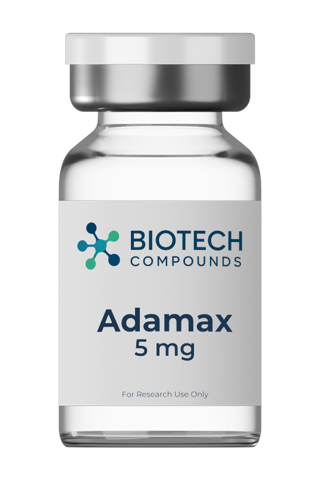
Adamax

Adamax (Ac-Met-Glu-His-Phe-Pro-Gly-Pro-Ala-Gly-NH2) is a synthetic nine-amino-acid peptide and structural analog of Semax, which is itself derived from the ACTH(4-10) fragment. It carries two defining structural modifications: an N-terminal acetyl group and a bulky lipophilic C-terminal adamantane (diamondoid) group, the motif characteristic of Peptide 021. Both modifications are studied in vitro for the resistance they confer to exopeptidase cleavage and for their effect on measured peptide half-life in serum-stability assays. Supplied as a lyophilized reference material for peptide chemistry, proteolytic-stability and degradation assays, cell-culture receptor-binding studies, and HPLC or LC-MS/MS identity and purity determination. For research and laboratory use only; not for human or animal consumption.

Select Size
5mg
SKU: ADA5
Batch: 201607-01-ADA5
$85.99
Ships today if ordered by 4PM EST
Est. Arrival: 09/18/2026
Volume Discounts
Qty: 1 - 4$85.99 each
Qty: 5 - 9$77.39 each(save $8.60)
Qty: 10+$68.79 each(save $17.20)
Quantity:
1
For Research Use Only. This product is intended for laboratory and scientific research purposes only. It is not a drug or dietary supplement and is not for human or veterinary consumption. Not intended to diagnose, treat, cure, or prevent any disease.
99%+ Purity
COA Included
Fast Shipping
USA Based

Product Details

Adamax is a nine-amino-acid synthetic peptide (Ac-Met-Glu-His-Phe-Pro-Gly-Pro-Ala-Gly-NH2) structurally derived from Semax, itself an analog of the ACTH(4-10) fragment originally characterized at the Institute of Molecular Genetics of the Russian Academy of Sciences. Adamax differs from the parent Semax sequence at both termini: an acetyl group is placed on the N-terminus, forming the N-acetyl-Semax intermediate, and a bulky lipophilic adamantane diamondoid group is placed on the C-terminus — the structural motif characteristic of Peptide 021.


These two modifications define the chemistry of the molecule. N-terminal acetylation caps the free alpha-amine and reduces susceptibility to aminopeptidase cleavage, while the adamantane group provides steric bulk that shields the C-terminus from carboxypeptidase activity. In in vitro degradation panels and serum-stability assays these features are the variables under study when comparing measured half-life against the unmodified Semax sequence; the adamantane group additionally raises the lipophilicity of the molecule, a parameter commonly assessed in permeability and partition-coefficient assays.


In cell-culture and receptor work Adamax is used as a tool compound for in vitro investigation of brain-derived neurotrophic factor (BDNF) expression and TrkB receptor binding in cultured cell systems, along with dopaminergic and serotonergic receptor interactions measured in binding panels. Its fully defined sequence and terminal modifications also make it a useful reference standard in reversed-phase HPLC and LC-MS/MS work, including retention-time matching, structural confirmation of acetylation and adamantane conjugation, and purity determination.


Disclaimer: Adamax is supplied strictly for research and laboratory use only. This product is not a drug, dietary supplement, or medical device. It is not intended for human or animal consumption, and not for therapeutic, diagnostic, or clinical application. It has not been evaluated by the FDA, and no statement here should be read as a claim to diagnose, treat, cure, or prevent any condition. All handling should be performed by qualified researchers in accordance with applicable laboratory safety protocols and institutional guidelines.

Frequently Asked Questions About Adamax

Answers summarize published research and are provided for laboratory research purposes only.
Adamax is a synthetic nine-amino-acid peptide and a structural analog of Semax, which itself descends from the ACTH(4-10) fragment. Adamax carries an acetyl group on the N-terminus and a bulky adamantane group on the C-terminus. In research settings, Adamax is used as a tool compound for in vitro stability work, neurotrophic factor signaling, and receptor-binding panels. Biotech Compounds supplies it as a lyophilized powder for laboratory research.
In vitro studies have examined how the two terminal changes in Adamax affect its resistance to breakdown. Researchers have reported that N-terminal acetylation shields the peptide from aminopeptidase cleavage, while the adamantane group at the C-terminus adds steric bulk that protects against carboxypeptidase activity. In serum-stability assays, these features are the variables under study when the measured half-life of Adamax is compared with unmodified Semax.
The primary research area for Adamax is peptide stability and degradation chemistry. Published research on adamantane-modified peptides suggests that the diamondoid group raises lipophilicity and slows enzymatic cleavage, and Adamax is used in serum-stability, permeability, and partition-coefficient assays to test that idea. Its fully defined sequence also makes Adamax a convenient reference standard in HPLC and LC-MS work.
Yes. A secondary research area for Adamax is neurotrophic signaling in cultured cells. In cell-culture studies, researchers have used Adamax as a tool compound to investigate brain-derived neurotrophic factor, or BDNF, expression and TrkB receptor binding. Research on the parent peptide Semax has reported changes in BDNF levels in animal models, and Adamax is studied to see how the modified structure performs in the same in vitro systems.
Evidence for Adamax comes mainly from in vitro work, including serum-stability assays, cultured-cell receptor-binding panels, and analytical chemistry studies. Much of the broader background comes from research on Semax, the parent peptide, which has been studied in animal models and in clinical settings in Russia. Adamax itself is an investigational research compound without clinical trial data and is not approved anywhere.
Semax is the parent seven-amino-acid peptide derived from ACTH(4-10), and Adamax extends it to nine residues with an N-terminal acetyl cap and a C-terminal adamantane group. Research studies have shown that Semax degrades relatively quickly in serum. In vitro studies have examined Adamax specifically to measure how much the added terminal groups slow that degradation and increase lipophilicity compared with Semax, which is sold separately on Biotech Compounds.
Adamax is supplied as a lyophilized powder. To reconstitute it, a researcher slowly adds Bacteriostatic Water down the inside wall of the vial and swirls gently until the powder is fully dissolved. The vial should never be shaken. Because the adamantane group makes Adamax more lipophilic than Semax, allowing extra time for the powder to dissolve is a sensible practice. Final solvent volume depends on the concentration required by the assay.
Lyophilized Adamax should be stored in a cool, dry, dark place, and freezer storage is the common laboratory choice for long-term holding. Once reconstituted, Adamax solution should be refrigerated at 2 to 8 C and protected from light. Repeated freeze and thaw cycles should be avoided. Research studies have reported that the terminal modifications of Adamax improve stability in serum, but standard cold-chain handling is still recommended for working solutions.
Yes. Adamax from Biotech Compounds is listed at 99 percent or higher purity and is third-party tested. A Certificate of Analysis for the current lot is available on the Adamax product page, giving researchers HPLC and mass spectrometry results to confirm identity, acetylation, adamantane conjugation, and purity before use. Lot-level testing supports reproducible results across experiments.
Adamax has a molecular weight of 1032.23 g/mol and the molecular formula C50H69N11O11S. Its sequence is Ac-Met-Glu-His-Phe-Pro-Gly-Pro-Ala-Gly-NH2, a nine-residue chain with an acetylated N-terminus and an amidated C-terminus carrying the adamantane group. The single sulfur atom in the formula comes from the methionine residue at the start of the Adamax sequence.
No. Adamax is not approved for human use and is sold strictly as a research material for laboratory research by qualified researchers and research organizations. Purchasers must be 21 years of age or older. Adamax is not a drug or dietary supplement, and it is not intended for human or animal consumption.