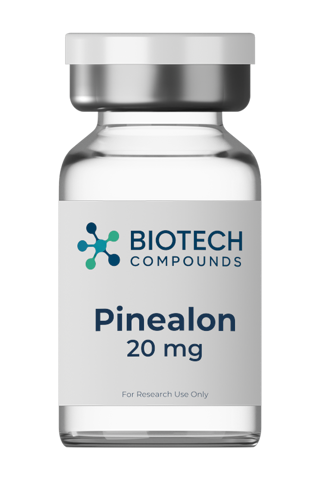
Research Compound
Pinealon
Pinealon is a synthetic tripeptide with the sequence Glu-Asp-Arg (EDR), available as a lyophilized powder for laboratory research.
Select Size
20mg
SKU: P20
Batch: 202610-01-P20
$42.99
Ships today if ordered by 4PM EST
Est. Arrival: 09/18/2026
Volume Discounts
Qty: 1 - 4$42.99 each
Qty: 5 - 9$38.69 each(save $4.30)
Qty: 10+$34.39 each(save $8.60)
Quantity:
1
For Research Use Only. This product is intended for laboratory and scientific research purposes only. It is not a drug or dietary supplement and is not for human or veterinary consumption. Not intended to diagnose, treat, cure, or prevent any disease.
99%+ Purity
COA Included
Fast Shipping
USA Based
Product Details
Pinealon is a synthetic tripeptide: L-glutamic acid, L-aspartic acid, and L-arginine (Glu-Asp-Arg / EDR). Belongs to the class of short regulatory peptides known as Khavinson peptides.
Low molecular weight with highly polar, charged amino acid composition. Two acidic residues (Glu, Asp) and one basic residue (Arg) give distinct electrostatic properties. Freely soluble in water. Store at -20°C protected from light and moisture.
Disclaimer: For laboratory and research purposes only. Not intended for human consumption.
Frequently Asked Questions About Pinealon
Answers summarize published research and are provided for laboratory research purposes only.
Pinealon is a synthetic tripeptide made of glutamic acid, aspartic acid, and arginine, written Glu-Asp-Arg or EDR. It belongs to the family of short regulatory peptides known as Khavinson peptides, which were developed as tissue-specific bioregulators. Research studies have examined Pinealon mainly in models of brain aging, oxidative stress, and neuronal cell survival. It is supplied as a lyophilized powder for laboratory research.
Researchers have proposed that Pinealon, like other short Khavinson peptides, is small enough to enter cells and interact directly with DNA and chromatin. In vitro studies have reported that Pinealon can change the expression of genes linked to cell survival and neuronal differentiation. Published research also suggests the peptide reduces reactive oxygen species in stressed cells, which is the mechanism most often cited in Pinealon studies.
The primary research area for Pinealon is neuroprotection. In cell culture studies, researchers reported that Pinealon reduced markers of oxidative damage and cell death in neurons exposed to stress. In rodent models of prenatal hypoxia, studies have observed better performance on learning and memory tasks in animals given Pinealon compared with untreated animals. These findings are the reason Pinealon appears in neuroscience and aging research.
Yes. A secondary line of Pinealon research looks at cellular aging. In vitro studies have examined how Pinealon affects the expression of genes involved in proliferation, apoptosis, and differentiation in aging cell cultures, including neuronal and pineal tissue lines. Researchers working in the Khavinson bioregulator tradition have reported that Pinealon and related short peptides appear to restore some age-associated changes in these culture systems.
The evidence for Pinealon comes mostly from in vitro cell culture work and rodent studies, much of it published by Russian research groups. There are also small human observational reports in the bioregulator literature, but Pinealon has not gone through large controlled clinical trials and is not an approved drug in the United States. Pinealon should be considered an investigational research compound with a limited but growing body of preclinical data.
Pinealon and Epitalon are both short synthetic Khavinson peptides sold by Biotech Compounds, but they differ in sequence and research focus. Pinealon is the tripeptide Glu-Asp-Arg and is studied mainly for neuroprotection and brain aging. Epitalon is the tetrapeptide Ala-Glu-Asp-Gly and is studied mainly for telomerase activity and pineal gland function in aging models. Researchers choose between them based on which tissue system a study is examining.
Pinealon is supplied as a lyophilized powder that is freely soluble in water because of its highly polar, charged amino acids. For laboratory preparation, Bacteriostatic Water is added slowly down the inside wall of the vial. The vial is then swirled gently until the powder dissolves. Pinealon should never be shaken, since agitation can degrade peptides. Sterile technique and a clean work surface are recommended for every reconstitution.
Lyophilized Pinealon should be stored at minus 20 C, protected from light and moisture, and kept sealed until use. Once reconstituted, Pinealon should be refrigerated at 2 to 8 C and used within a limited window. Repeated freeze and thaw cycles should be avoided because they can break down the peptide. Keeping the vial away from light and heat helps preserve the stability of Pinealon in the laboratory.
Yes. Pinealon from Biotech Compounds is listed at 99 percent or higher purity and is third-party tested to verify identity and purity. A Certificate of Analysis is available on the Pinealon product page so researchers can review the testing results for each lot before it is used in a study. This documentation supports reproducible laboratory work and lets research organizations keep records for their own quality systems.
Pinealon has the molecular formula C15H24N6O8 and a molecular weight of approximately 416.39 g/mol. It is one of the smallest peptides in the Biotech Compounds catalog, with only three amino acids. The low molecular weight and the presence of two acidic residues and one basic residue give Pinealon distinct electrostatic properties, which researchers cite when explaining how the peptide may interact with DNA and cell membranes.
No. Pinealon is not an approved drug and is not a dietary supplement. Biotech Compounds sells Pinealon strictly as a research material for laboratory research by qualified researchers and research organizations. Purchasers must be 21 years of age or older. Pinealon is not intended for human or animal consumption and is not intended to diagnose, treat, cure, or prevent any disease.
You May Also Like