Research Compound

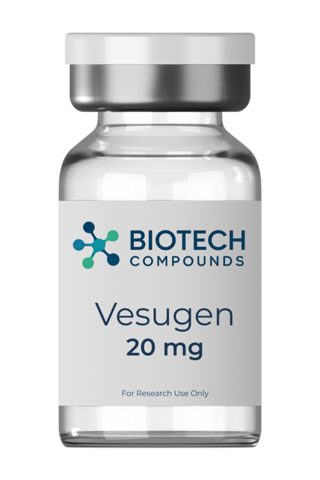
Vesugen

Vesugen is a synthetic tripeptide bioregulator (Lys-Glu-Asp) studied for its role in supporting vascular endothelial function and blood vessel integrity.

Select Size
20mg
SKU: VE20
Batch: 202607-01-VE
$75.99
Ships today if ordered by 4PM EST
Est. Arrival: 09/18/2026
Volume Discounts
Qty: 1 - 4$75.99 each
Qty: 5 - 9$68.39 each(save $7.60)
Qty: 10+$60.79 each(save $15.20)
Quantity:
1
For Research Use Only. This product is intended for laboratory and scientific research purposes only. It is not a drug or dietary supplement and is not for human or veterinary consumption. Not intended to diagnose, treat, cure, or prevent any disease.
99%+ Purity
COA Included
Fast Shipping
USA Based

Product Details

Vesugen is a short-chain peptide bioregulator composed of three amino acids — lysine, glutamic acid, and aspartic acid (Lys-Glu-Asp, abbreviated KED). Belonging to the Khavinson family of short peptide bioregulators, Vesugen is associated with the vascular system and is studied for its proposed influence on endothelial cells that line the blood vessel walls. Investigations have explored its potential to support intercellular communication between endothelial cells (via connexins), promote vascular wall integrity, and modulate gene-regulatory activity associated with cellular health and aging. Its compact size and simple amino acid composition make it a model compound for examining peptide-mediated tissue regulation in vascular biology, cardiovascular research, and related cellular aging pathways.


Disclaimer: This product is intended for laboratory and research use only. It is not for human consumption, ingestion, injection, or any in vivo use in humans or animals. Not for use as a food, drug, cosmetic, or dietary supplement.

Frequently Asked Questions About Vesugen

Answers summarize published research and are provided for laboratory research purposes only.
Vesugen is a synthetic tripeptide bioregulator made of lysine, glutamic acid, and aspartic acid, written Lys-Glu-Asp or KED. It belongs to the Khavinson family of short peptide bioregulators, a group of two to four amino acid peptides each associated with a particular tissue. Vesugen is the member linked to the vascular system. Research studies have examined Vesugen in models of endothelial cell function, blood vessel wall integrity, and cellular aging.
The Khavinson bioregulator hypothesis, explored in published research, proposes that short peptides such as Vesugen pass into the nucleus and interact with DNA to modulate the expression of tissue specific genes. In cell culture studies, researchers have reported that Vesugen influenced the expression of connexins, the proteins that form gap junctions between endothelial cells. Vesugen has been observed in these models to affect markers of endothelial cell proliferation and intercellular communication.
The primary research area for Vesugen is vascular biology, with a focus on the endothelial cells that line blood vessel walls. In cell culture studies, researchers have reported that Vesugen supported the growth and organization of endothelial cell layers. Animal model research has examined Vesugen for its effect on measures of vascular wall integrity. These studies use Vesugen as a compact model compound for peptide mediated regulation of vascular tissue.
A secondary research area for Vesugen is cellular aging. Researchers have studied Vesugen in aging cell cultures and in older animal models to see whether it alters gene expression patterns associated with senescence in vascular tissue. Published research from bioregulator groups has also compared Vesugen with other Khavinson peptides to map which amino acid combinations correspond to which tissues. Limited clinical reports have appeared in the same literature.
Evidence for Vesugen comes mainly from in vitro cell culture work and animal models, much of it published by Russian bioregulator research groups. A smaller number of clinical observations have been reported in that literature. Vesugen is not an approved drug in the United States and has not gone through FDA regulated clinical trials. Biotech Compounds supplies Vesugen as a research grade lyophilized tripeptide for laboratory investigation of these mechanisms.
Vesugen and Epitalon are both Khavinson peptide bioregulators but are associated with different tissues. Vesugen is the tripeptide Lys-Glu-Asp, and research studies have examined it in vascular endothelium models. Epitalon is the tetrapeptide Ala-Glu-Asp-Gly, and researchers have studied it in pineal gland and telomerase related aging models. Both are studied under the same gene regulation hypothesis, so Vesugen and Epitalon are often compared in bioregulator research.
Vesugen and Thymogen are both short Khavinson bioregulators that differ by target tissue. Vesugen is the tripeptide Lys-Glu-Asp studied in vascular and endothelial models. Thymogen is the dipeptide Glu-Trp, and research studies have examined it in immune and thymic models. The two share a glutamic acid residue but are otherwise distinct, and researchers comparing tissue selectivity of short peptides often run Vesugen and Thymogen side by side.
Vesugen is supplied as a lyophilized powder. To reconstitute, Bacteriostatic Water or sterile water is added slowly down the inner wall of the vial so it runs onto the Vesugen powder. The vial is then gently swirled until the solution is clear. Because Vesugen is a small, highly polar tripeptide it dissolves easily in water, but the vial should not be shaken as a matter of good peptide handling practice.
Lyophilized Vesugen should be stored cold, ideally at minus 20 C, in a sealed vial protected from light and moisture. After reconstitution, Vesugen solution should be refrigerated at 2 to 8 C, protected from light, and used within a short period. Repeated freeze thaw cycles should be avoided. Short peptides such as Vesugen are generally more stable in solution than long chain peptides, but cold storage still preserves the quality of the material.
Yes. Vesugen from Biotech Compounds is listed at 99 percent or higher purity and each lot is tested by an independent laboratory. The Certificate of Analysis for Vesugen is available on the product page and reports identity and purity for that batch. Researchers should confirm the lot number on the Vesugen vial matches the posted COA before starting an experiment.
Vesugen has a molecular weight of approximately 390.39 g/mol and the molecular formula C15H26N4O8. It is a tripeptide made of three amino acids: lysine, glutamic acid, and aspartic acid. The combination of one basic residue and two acidic residues gives Vesugen a distinctive charge profile, which the bioregulator research literature points to when discussing its proposed interaction with DNA.
No. Vesugen from Biotech Compounds is sold strictly as a research material for laboratory research by qualified researchers and research organizations. Purchasers must be 21 years of age or older. Vesugen sold here is not a drug or a dietary supplement, has not been approved by the FDA, and is not for human or animal consumption. It is intended only for laboratory investigation.