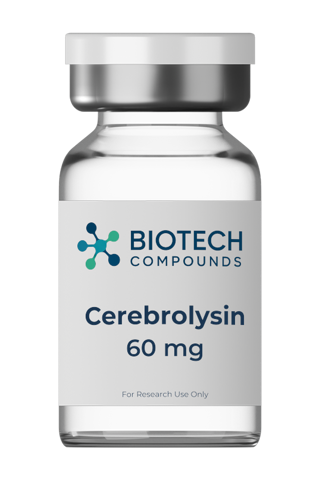
≥ 99% HPLC
Cerebrolysin
Research Compound · Research use only

CerebrolysinCerebrolysin is a standardized peptide preparation derived from porcine brain tissue, consisting of low molecular weight peptides and free amino acids, available for laboratory research.

4.1 on Trustpilot · 46 reviews
This product is not available for purchase right now.
99%+ PurityHPLC · third-party
COA Includedlot 202603-01-CBL
USA BasedMidwest Region
For Research Use Only. This product is intended for laboratory and scientific research purposes only. It is not a drug or dietary supplement and is not for human or veterinary consumption. Not intended to diagnose, treat, cure, or prevent any disease.

Product Details

Cerebrolysin is a standardized preparation from enzymatic processing of purified porcine brain tissue. Approximately 25% low molecular weight peptides (below 10,000 Da) and 75% free amino acids.


Amino acid composition includes: aspartic acid, glutamic acid, serine, histidine, glycine, threonine, alanine, arginine, valine, methionine, tryptophan, isoleucine, phenylalanine, leucine, lysine, and proline. Complex mixture rather than single compound.


Disclaimer: For laboratory and research purposes only. Not for human consumption.

Frequently Asked Questions About Cerebrolysin

Answers summarize published research and are provided for laboratory research purposes only.

Cerebrolysin is a standardized peptide preparation produced by enzymatic processing of purified porcine brain tissue. It is a complex mixture rather than a single molecule, made up of roughly 25 percent low molecular weight peptides below 10,000 Da and 75 percent free amino acids. Biotech Compounds supplies Cerebrolysin as a lyophilized powder for laboratory research into brain derived peptide fractions.
The amino acid composition of Cerebrolysin includes aspartic acid, glutamic acid, serine, histidine, glycine, threonine, alanine, arginine, valine, methionine, tryptophan, isoleucine, phenylalanine, leucine, lysine, and proline. Because Cerebrolysin is a mixture, no single molecular formula applies. Researchers treat the preparation as a defined fraction characterized by its peptide and amino acid profile rather than by one sequence.
Published research describes Cerebrolysin as a mixture of neurotrophic like peptide fragments. In cell culture and animal studies, researchers reported that Cerebrolysin fractions showed activity resembling endogenous neurotrophic factors, including effects on neuronal survival signaling and synaptic markers. Because the preparation contains many peptides, research has not attributed the reported activity of Cerebrolysin to one identified component.
The primary research area for Cerebrolysin is neuroscience. Research studies have examined Cerebrolysin in models of neuronal injury, neurodegeneration, and cognitive function. In animal models, researchers reported changes in neuronal survival, dendritic branching, and markers of neuroplasticity after exposure to Cerebrolysin. These findings describe observations in experimental systems and remain a subject of ongoing investigation.
Yes. Cerebrolysin has a long research history and has been evaluated in clinical trials in several countries, and it is registered as a medicinal product in some markets outside the United States. Cerebrolysin is not approved by the FDA. Published trial results have been mixed, and reviewers have called for larger and better controlled studies. The material sold by Biotech Compounds is for laboratory research only.
Cerebrolysin is a complex mixture of porcine brain derived peptides and free amino acids, while Semax is a single synthetic heptapeptide derived from a fragment of ACTH. Both are studied in neuroscience models. Research on Semax focuses on one defined sequence, whereas Cerebrolysin research examines the combined activity of many low molecular weight peptides. Researchers choose based on whether a defined molecule or a peptide fraction fits the study.
Cerebrolysin is supplied as a lyophilized powder. In the laboratory, it is reconstituted by adding Bacteriostatic Water or sterile water slowly along the inside of the vial and swirling gently until the powder dissolves. The vial should never be shaken. Because Cerebrolysin is a mixture of small peptides and free amino acids, it dissolves readily in aqueous solution.
Lyophilized Cerebrolysin should be stored in a cool, dry, dark place, with refrigeration or freezing preferred for longer storage. After reconstitution, Cerebrolysin should be kept at 2 to 8 C, protected from light, and used within a short window. Repeated freeze thaw cycles should be avoided because they can degrade the peptide fraction.
Cerebrolysin from Biotech Compounds is listed at 99 percent plus purity for the peptide preparation. Each lot is third party tested, and a Certificate of Analysis is available on the Cerebrolysin product page. Because Cerebrolysin is a complex mixture, the COA characterizes the preparation as a whole rather than a single molecular species.
Cerebrolysin does not have a single molecular weight because it is a complex mixture. The peptide fraction of Cerebrolysin consists of low molecular weight peptides below 10,000 Da, and the remainder is free amino acids. No single molecular formula applies. Researchers describe Cerebrolysin by its composition profile rather than by one molecular weight value.
Cerebrolysin is sold strictly as a research material for laboratory research by qualified researchers and research organizations. Purchasers must be 21 or older. Cerebrolysin from Biotech Compounds is not a drug or dietary supplement, and it is not for human or animal consumption. It is intended for in vitro and preclinical investigation only.

Purity, documented